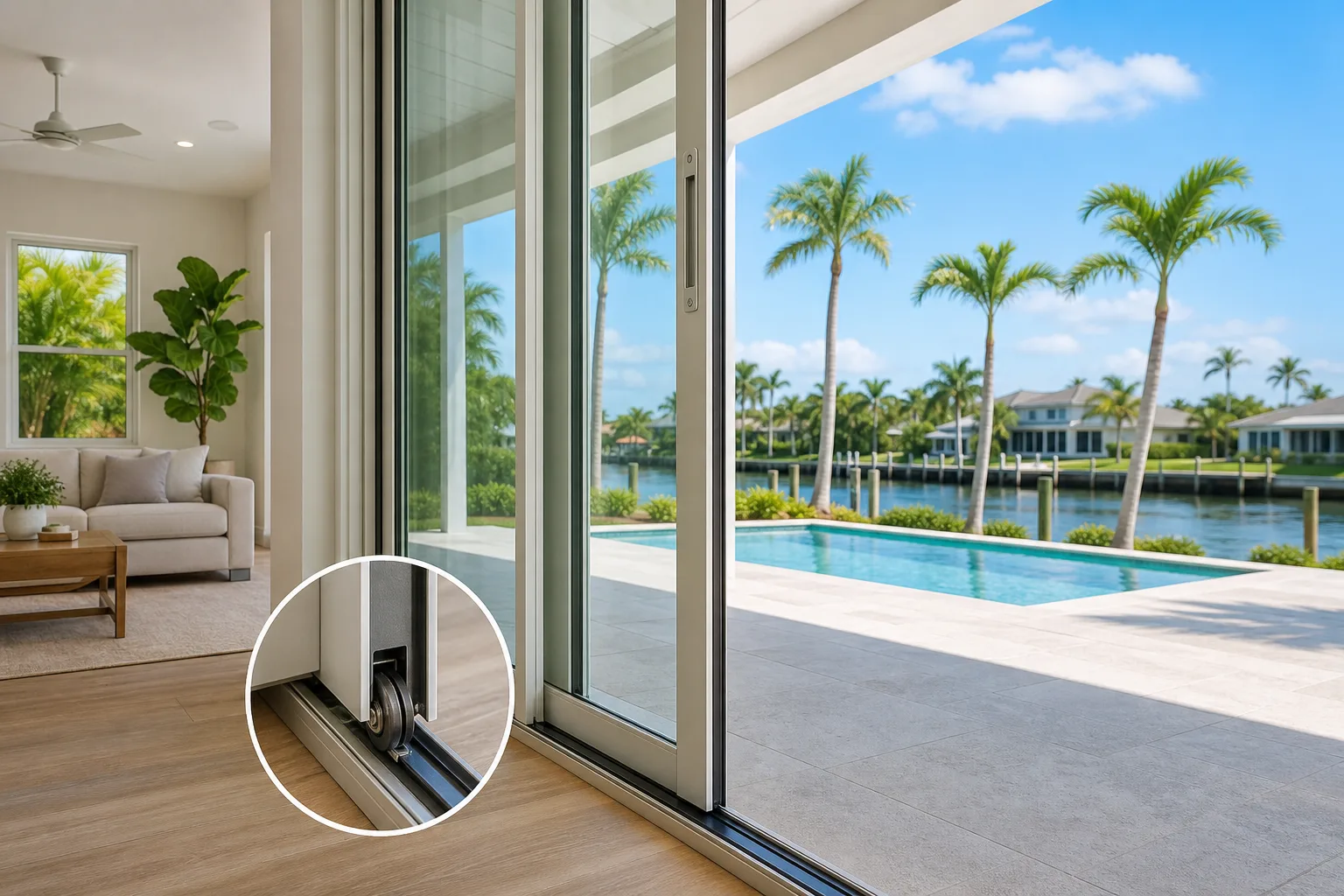
TL;DR: Coastal sliding door tracks collect fine sand, salt residue, insects, and debris faster than inland tracks. A light monthly clean, a deeper seasonal inspection, and careful use of a manufacturer-compatible dry lubricant can help preserve smooth operation and keep weep paths open.
Do not force a dragging panel or add heavy grease to the track. A door that binds, scrapes, drops, leaks, or will not lock may have worn rollers, alignment issues, frame movement, damaged weatherstripping, or drainage problems that cleaning alone will not solve.
What you need
Gather the following before starting:
- Vacuum with a narrow crevice attachment
- Soft nylon brush, old toothbrush, or small detailing brush
- Microfiber cloths or soft rags
- Bucket of clean water
- Mild, non-abrasive soap
- Plastic putty knife or wooden stir stick
- Spray bottle
- Dry PTFE or silicone lubricant only if the door manufacturer permits it
- Flashlight
- Gloves and eye protection
Avoid steel wool, wire brushes, scouring powders, strong solvents, petroleum grease, and pressure-washer spray directed into the threshold. Those products can scratch finished surfaces, attract abrasive grit, interfere with drainage, or affect seals and plastic components.
For a newer impact-rated system, check the owner documentation first. The correct lubricant, adjustment method, roller access, sill design, and drainage layout vary by manufacturer and door series. If documentation is unavailable, a service professional can identify the system before work begins.
1. Start with a coastal maintenance schedule
Near the Atlantic, Intracoastal Waterway, Biscayne Bay, or the Gulf Stream-influenced coastline, airborne salt can settle on exterior door components even when the home is not directly on the beach. Properties in Palm Beach, Broward, Miami-Dade, Martin, and St. Lucie counties also contend with blowing sand, summer rain, landscaping debris, and high humidity.
A practical schedule is based on exposure, not a one-size-fits-all calendar:
- Monthly: Vacuum loose debris from the exposed track and wipe accessible surfaces.
- After major wind, heavy rain, or nearby landscaping work: Remove leaves, mulch, sand, and visible buildup. Check that water has a clear route out of the sill.
- Every three to six months: Perform a deeper cleaning, inspect weatherstripping, and test door travel and locking.
- At least annually: Review roller condition, panel alignment, screen-door condition if applicable, and drainage performance. High-exposure waterfront homes may need this review more often.
The goal is not to make a sliding door completely maintenance-free. The goal is to keep grit out of moving surfaces, prevent blocked drainage, and notice small operating changes before the panel becomes difficult to move.
2. Identify the track, roller path, and drainage areas
Before applying water or lubricant, look closely at the sill. Many sliding doors have more than one channel. One may guide the panel, another may accommodate a screen, and another may serve as part of the sill or water-management design.
Use a flashlight and note:
- Where the operating panel rides
- Whether there is a separate screen track
- Small openings or slots that may be weep holes
- Dirt packed into corners or around track transitions
- Black residue, white salt-like deposits, or corrosion marks
- Loose screws, cracked caps, or displaced weatherstripping
Do not assume every opening should be plugged or sealed. Weep holes and sill channels are often designed to move incidental water to the exterior. Blocking them can contribute to water retention. Likewise, do not poke aggressively into openings with metal tools. A gentle cleaning is appropriate. If a passage appears blocked deep inside the frame, or water remains trapped after cleaning, schedule an evaluation.
This distinction matters especially for large glass openings. If you are considering a new system because of repeated operational or water-management issues, review the available hurricane impact doors options with exact product approvals, engineering, installation conditions, and permit requirements confirmed for the project.
3. Vacuum dry debris before washing anything
Dry removal comes first. Wet sand can turn into an abrasive paste, and pushing it through the track with a rag may worsen the problem.
Open the panel enough to expose as much of the track as possible. Vacuum slowly along each accessible channel, focusing on corners, under the meeting stile area, and where the panel normally stops. Use a soft brush to loosen grit while holding the vacuum nozzle nearby.
For compacted debris, use a plastic putty knife or wood stick gently. Keep the tool flat and avoid digging into painted, anodized, or coated aluminum surfaces. Never pry at the roller track or force a tool beneath the moving panel.
If the door has a screen, clean its separate lower track too. A neglected screen track can shed debris into the primary door track and can be mistaken for a problem with the glass panel.
After vacuuming, slide the door slowly through its full travel. Listen for grinding, clicking, or a spot where resistance changes. Make a note of the location rather than repeatedly forcing the panel over it.
4. Wash salt film and residue with mild soap
Once loose grit is removed, mix mild soap with clean water. Dampen, rather than soak, a microfiber cloth and wipe the exposed sill, track edges, and frame surfaces. Use a soft nylon brush for stubborn residue.
Salt residue can be subtle. It may show up as a dull film, light-colored crusting, or sticky dirt that returns quickly after a dry day. Regular rinsing and wiping can reduce surface buildup, but it cannot reverse established corrosion or repair damaged finishes.
Keep water use controlled. Spray a cloth or brush instead of flooding the threshold. If you use a spray bottle directly on the sill, use a light mist and avoid driving water into joints, interior finishes, or areas where it cannot drain.
Then wipe the track dry as much as practical. Move the panel a few inches at a time to reach newly exposed portions. Do not leave a thick soap film behind, since it can collect dust and sand.
Avoid household products marketed as all-purpose degreasers unless the door manufacturer specifically allows them. Citrus solvents, chlorine-containing cleaners, abrasive cleaners, and certain chemical mixtures can affect finishes, seals, gaskets, and adjacent materials. For corrosion or staining that does not release with mild soap and water, get product-specific guidance rather than escalating to a harsher chemical.
Compare impact-door options for your project. Request a free estimate
5. Clear weep paths gently and test drainage
A sliding door sill is not simply a flat rail. Many systems use channels and weep paths to manage water that reaches the threshold. In South Florida, those routes can clog with pollen, sand, algae-like organic buildup, mulch, insect debris, and old caulk from prior work.
With the track clean, locate visible exterior-facing weep openings. Use the soft brush, vacuum, or a brief low-pressure rinse to remove loose debris. A plastic zip tie may be useful for very shallow obstructions, but stop if you meet resistance. Do not use drill bits, screws, stiff wire, compressed-air blasts, or a pressure washer.
After cleaning, test cautiously with a small amount of clean water in the appropriate sill area. Watch for normal drainage toward the exterior. The exact flow pattern depends on the door design, so the test is observational, not a substitute for a formal water-intrusion assessment.
Stop and seek service if you see water moving indoors, standing in the sill for an extended period, backing up through interior openings, or appearing from an unrelated joint. Repeated water issues can involve installation details, exterior finish interfaces, sill pans, drainage design, wall conditions, or door damage. Those conditions require diagnosis, not more lubricant.
6. Lubricate only the correct moving surfaces
Lubricant is useful only after cleaning. Applying it over salt and sand creates a dirty film that can increase drag.
Some sliding doors use adjustable rollers that carry most of the panel weight. Others have different hardware arrangements. In many systems, a dry PTFE or silicone product is preferred for exposed moving areas because it leaves less residue than oil or grease. But the manufacturer instructions control. Some components should not be lubricated at all, and some rollers are sealed and not serviceable from the track.
If your door documentation permits lubrication:
- Apply a very small amount to the specified track or hardware point.
- Keep lubricant off glass, weatherstripping, lock components, painted surfaces, and drainage openings.
- Move the door slowly several times to distribute the product.
- Wipe away overspray immediately.
Do not coat the whole threshold. Excess lubricant is a grit magnet near the coast. If the door still feels heavy after a proper clean and limited approved lubrication, the likely issue may be roller wear, roller adjustment, a damaged track, or panel alignment.
A door should slide with controlled, even movement. It should not need a shoulder push, a hard pull at the handle, or repeated lifting to clear a rough spot.
7. Inspect weatherstripping, locks, and panel alignment
Track maintenance is an opportunity to check the parts that work with the track. Look along the panel edges and interlock for weatherstripping that is flattened, torn, loose, brittle, or missing. Check for debris caught in the meeting point and inspect the bottom edge of the panel for signs of rubbing.
Operate the door and observe these symptoms:
- The panel scrapes at one end but not the other
- A gap appears unevenly around the panel
- The lock requires lifting, pushing, or pulling the panel to engage
- The panel rocks, rattles, or feels loose in the opening
- The handle is difficult to operate despite a clean track
- The screen door catches or comes off its guide
These signs do not identify one exact cause. They may reflect roller adjustment, worn hardware, settlement, frame distortion, loose fasteners, damage after impact, or installation-related conditions. Avoid turning adjustment screws at random. Incorrect adjustment can make the panel harder to operate, create locking problems, or change how it bears on seals.
For storm-season preparation, make sure sliding doors close and lock normally before a named system is approaching. Last-minute repairs may be limited by weather, supply, access, or permit requirements. A broader opening review may also be appropriate when you are planning windows and doors replacement rather than isolated maintenance.
8. Know when cleaning is no longer the right repair
Routine maintenance can address accumulated debris and light surface buildup. It cannot correct every door issue. Contact a qualified door professional when you notice persistent binding after cleaning, broken rollers, a bent track, recurring drainage problems, visible corrosion affecting operation, cracked glass, loose panels, damaged frame components, or a door that does not close and lock correctly.
For impact-rated sliding glass doors, keep project records if service or replacement is needed. Useful documents include prior invoices, manufacturer labels, product information, permit records where applicable, photos of the condition, and any warranty paperwork. Exact warranty coverage depends on the manufacturer, component, installation date, maintenance terms, transfer provisions, and cause of damage.
Replacement decisions are also project-specific. A new door may involve product selection, Florida Product Approval or Miami-Dade Notice of Acceptance where applicable, engineered conditions, structural opening requirements, permitting, installation details, and finish work. A request for an estimate is the right time to document the opening size, exposure, access, current condition, and the homeowner's goals instead of assuming every slider can be repaired or replaced the same way.
Common mistakes
Using grease or oil on a sandy track. Heavy lubricants can feel helpful briefly, then collect grit and create more drag. Clean first, then use only a manufacturer-approved product in a limited amount.
Treating weep holes as defects. Small openings at the sill may be part of the drainage system. Do not fill them with caulk, foam, tape, or debris. If you are unsure what an opening does, ask before sealing it.
Pressure washing the threshold. High-pressure water can force water and debris where they do not belong. A soft brush, controlled rinse, and cloth are safer starting points.
Forcing a heavy panel. Pulling harder can damage rollers, handles, locks, tracks, or glass-adjacent components. Investigate the cause instead.
Adjusting rollers without identifying the system. Roller screws are not universal, and access points can be confused with other fasteners. Improper adjustment can create uneven gaps and latching trouble.
Ignoring exterior conditions. Mulch piled against a threshold, blocked exterior drainage, damaged sealant interfaces, or landscaping that directs runoff toward the door can contribute to repeated debris and water concerns.
Assuming all coastal corrosion is cosmetic. Early surface staining may be manageable, but pitting, hardware degradation, or corrosion that changes operation deserves professional review.
Bottom line
For South Florida coastal homes, the best sliding-door-track routine is simple and consistent. Remove dry sand first, clean gently with mild soap and water, keep drainage paths clear, and use only approved lubrication sparingly.
When a door remains hard to slide, will not lock, shows recurring water symptoms, or has visible damage, do not treat maintenance as a substitute for diagnosis. Window Guys of Florida can review door conditions and discuss repair or replacement scope. Product approvals, engineering, permits, installation details, insurance requirements, and warranty terms must be confirmed for the exact project.
Compare impact-door options for your project.
Review entry, French, and sliding-door assemblies against the exact opening, approval, design pressure, exposure, glass, hardware, and installation scope.
Frequently asked questions
How often should I clean sliding door tracks near the coast?
A monthly light cleaning is a practical starting point for many coastal South Florida homes. Clean sooner after windy weather, heavy rain, landscaping work, or visible sand buildup, and perform a more detailed inspection every three to six months based on exposure and use.
Can I use WD-40 or grease on my sliding door track?
Do not use oil or grease unless the door manufacturer specifically directs it. These products can collect sand and salt residue. If lubrication is allowed, a limited application of the manufacturer-approved dry PTFE or silicone product is often more suitable for exposed moving areas.
What are the small holes in the bottom of my sliding door frame?
They may be weep holes or part of the sill drainage path. Their purpose and location depend on the door system, but they should generally not be sealed with caulk or foam. Clean visible loose debris gently and seek help if water remains trapped or moves indoors.
Why is my sliding door still hard to open after I clean the track?
The cause may be worn or damaged rollers, a bent track, incorrect alignment, frame movement, damaged weatherstripping, or another hardware issue. Avoid forcing the panel or randomly adjusting screws, particularly on an impact-rated door. A service evaluation can identify the correct repair scope.
Can I pressure wash a sliding glass door threshold?
It is better not to direct pressure-washer spray into a sliding door threshold. High pressure can drive water and debris into joints and drainage areas. Use a vacuum, soft brush, mild soap, controlled water, and microfiber cloths instead.