
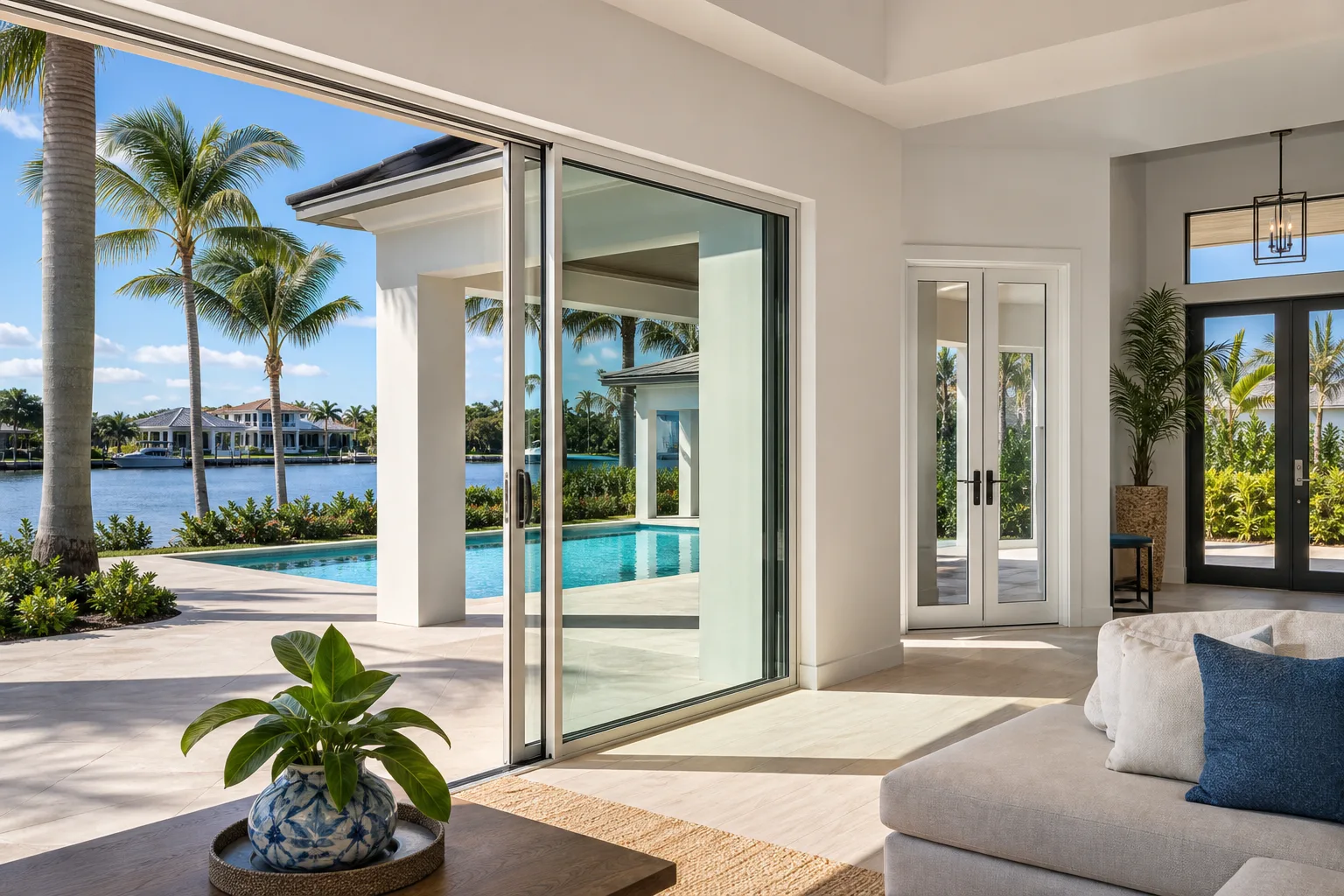
TL;DR: Replace a sliding glass door when it no longer meets your practical storm-protection plan, cannot be operated or secured reliably, has repeat water-management problems, or conflicts with a larger renovation. Age alone is not a decision rule. In South Florida, the exact opening, product approval, glass type, exposure, permit requirements, installation details, and any condominium rules all affect the right scope.
A patio door is a large glazed opening, a daily-use entrance, and potentially part of a home’s hurricane-protection envelope. That combination makes the replacement decision more involved than swapping an interior door. This guide focuses on the conditions that typically justify a closer evaluation in Palm Beach, Broward, Miami-Dade, Martin, and St. Lucie counties.
1. Your current door does not fit your hurricane-protection plan
This is often the clearest reason to consider replacement. A conventional sliding glass door may still function normally in fair weather, yet require separate storm panels or shutters for hurricane conditions. If those coverings are missing, damaged, difficult to deploy, or no longer part of how the household plans to protect the home, the opening deserves attention.
An impact-rated sliding glass door can be one option, but it is not automatically the only option or the right one for every property. A replacement decision should begin with the overall opening protection plan, including nearby windows, shutters, screens, and any existing permits or approvals.
For an impact door project, verify the exact product’s Florida Product Approval or local approval status, applicable design pressures, glazing configuration, installation instructions, and whether the selected system is approved for the specific opening condition. A label saying “impact” is not, by itself, a complete scope of work. The product and installation must match the project.
Homeowners comparing protected openings can review our overview of hurricane impact doors. For a whole-home project, it may also be useful to coordinate the patio opening with hurricane impact windows rather than making decisions one opening at a time.
Changing program details: Hurricane-related code and permitting requirements are enforced locally and can change. Confirm current requirements with the building department having jurisdiction before work begins. Florida’s statewide building standards are published by the Florida Building Commission.
2. The door no longer opens, closes, locks, or latches dependably
A sliding glass door should move in a controlled manner, close fully, and lock as designed without extraordinary force. A door that sticks occasionally may need cleaning, adjustment, rollers, hardware work, or track service. Replacement becomes more reasonable when repair does not restore dependable daily operation, compatible replacement components are unavailable, or several parts have reached the end of useful service together.
Pay attention to practical symptoms:
- The panel must be lifted, shoved, or slammed to move.
- The lock does not engage consistently.
- The meeting rails do not align correctly when closed.
- The panel comes off track or feels unstable in the opening.
- A temporary workaround, such as a stick in the track, has become the regular security plan.
- Repairs recur without producing a durable result.
These conditions do not prove that replacement is necessary. They do justify an on-site assessment. The cause may involve rollers, frame distortion, track wear, sill conditions, settlement, installation details, or a combination of factors. A contractor should distinguish between a repairable operating issue and a door system that no longer supports a sensible repair scope.
3. You are planning a remodel that changes the opening or its use
Door replacement is often most efficient when it is coordinated with related construction. Examples include flooring replacement, kitchen remodeling, patio resurfacing, pool-area changes, stucco work, interior trim replacement, or converting a patio door to a different configuration.
If the opening dimensions, header, side framing, threshold height, drainage plane, or adjacent wall finishes will change, this is no longer a simple door swap. It may require engineering, permitting, structural review, or specific flashing and waterproofing details. The contractor’s written scope should identify what is included and what is excluded, especially where hidden conditions may be discovered after removal.
Accessibility and everyday use can also drive the discussion. A homeowner may want a different panel arrangement, wider clear opening, lower threshold strategy where feasible, or more suitable traffic flow between the home and patio. Those goals need to be balanced against approved product options, water management, structural conditions, and local code requirements.
For coordinated work across multiple openings, see our windows and doors replacement service. Combining scopes can simplify planning, but it does not eliminate the need to document each opening’s product and installation requirements.
4. The glass or frame no longer serves the room well
Replacement can make sense when the existing door creates an ongoing usability problem that a targeted repair cannot address. For example, a homeowner may be planning an updated glazing package, changing the room’s exposure to direct sun after landscape changes, or addressing a door whose framing and panel configuration no longer fit the intended use of the space.
It is important not to assume a particular result from new glass. Energy performance depends on the selected product, glass package, orientation, shading, air leakage, installation, thermostat practices, and how the rest of the home performs. Sound reduction also varies with the assembly, opening size, surrounding construction, gaps, and the type of noise involved.
If energy performance is part of the decision, request the exact product documentation rather than relying on broad claims. The National Fenestration Rating Council explains standardized fenestration ratings, including U-factor and solar heat gain coefficient. Those ratings can help compare products, but they do not predict a specific utility-bill outcome for an individual home.
The same caution applies to insurance. A property may qualify for a carrier-specific premium consideration or wind-mitigation treatment only depending on the carrier and its required inspection and documentation. Do not replace a door based on an assumed premium change. Ask the insurer or agent what documentation is required before committing to a project.
Compare impact-door options for your project. Request a free estimate
5. You are buying, selling, or taking over a property with an unclear door history
A real estate transaction can bring a patio door issue to the surface, particularly when sellers cannot identify the product, protection method, prior permit history, or age of a major door system. The right next step is not necessarily immediate replacement. First, determine what can be documented.
Look for labels on the frame or glass, records of prior work, permit information where available, and evidence of the current storm-protection method. A door can appear new while having an unclear approval or installation history. Conversely, an older door may still be functional and protected by a documented shutter system.
For a replacement proposal, request a written description of the product line, panel configuration, glass, color or finish, hardware, screen arrangement if applicable, permit responsibility, removal and disposal, installation approach, interior and exterior finish work, and warranty terms. Verify warranty coverage for the exact product and scope. Manufacturer warranties and installation warranties are not necessarily the same thing.
Exact licensing, product approvals, engineering needs, permit responsibilities, insurance documentation, installation details, and warranty terms should be confirmed for the written project scope.
6. You have repeated maintenance costs without a lasting solution
Maintenance is normal for a sliding door. Tracks collect debris. Rollers and hardware wear. Screens need attention. Weatherstripping and adjustments may be needed over time. Replacing a door simply because it needs routine service is not always financially sensible.
The calculation changes when the door needs repeated interventions across several components, when parts are no longer available, or when repair costs are approaching a replacement project without addressing the larger concerns. A repair-first evaluation can still be valuable because it clarifies what is actually failing and whether the existing frame and opening conditions remain suitable.
Before deciding, ask for a clear comparison of options:
- What specific repairs are proposed, and what problem should each repair address?
- Which existing components remain in service after repair?
- Are replacement parts original, compatible, or aftermarket?
- What conditions could limit the longevity of the repair?
- If replacement is recommended, what scope does it solve beyond the immediate operating issue?
A useful recommendation explains trade-offs. It does not treat replacement as the answer to every roller, lock, or screen problem.
7. Your current door creates a security concern that repair cannot reasonably resolve
A functioning lock, aligned panels, stable track engagement, and an appropriate protection plan matter for a patio entrance. If the door cannot be secured as intended because of damaged components, frame deterioration, unavailable hardware, or persistent misalignment, it needs prompt professional evaluation.
Some security concerns can be corrected with repairs or hardware service. Others may be tied to the broader condition of the system. Avoid assuming that a new door is automatically more secure in every respect. The result depends on the selected system, glazing, locking components, installation quality, surrounding wall condition, and how the door is used.
For homes with multiple older openings, a phased replacement plan may be more realistic than doing everything at once. Prioritize openings with unreliable operation, missing protection, active deterioration, or the greatest exposure. A site-specific estimate can help establish a documented sequence without promising a particular financing, insurance, or resale outcome. You can request an estimate when you are ready to discuss the condition of a specific opening.
8. You are ready to replace it, but the project timing still needs planning
In South Florida, homeowners often ask whether they should wait until hurricane season ends. There is no universal calendar answer. Lead times, permit review, product availability, weather, household schedules, condominium approvals, and the urgency of the current door’s condition all matter.
For an occupied home, plan for furniture movement near the opening, temporary access limitations, dust and noise, pets, alarm contacts, patio furnishings, screens, and finish touch-up questions. Ask who handles permit submission, inspections, debris removal, and protection of nearby surfaces. If the property is a condominium or townhome, obtain association requirements before ordering products. Associations may control exterior color, frame appearance, glass tint, work hours, elevator use, insurance certificates, and approval procedures.
A thorough scope should also address the threshold and exterior transition. Patio drainage and finished surface elevations can affect the installation approach. Do not assume that an existing patio, paver deck, or interior floor height will work unchanged with every replacement door.
Bottom line
Replace a Florida sliding glass door when its storm-protection role, safe operation, security, repair history, or renovation compatibility no longer supports a practical long-term plan. Do not make the decision solely on age, a broad “impact” claim, an assumed insurance benefit, or a generic price comparison.
The most useful next step is a documented evaluation of the exact opening. Confirm the selected product, approval, engineering if needed, permit path, installation details, insurance requirements, and written warranty coverage before work begins. For a local discussion of a patio-door or whole-opening project in Palm Beach, Broward, Miami-Dade, Martin, or St. Lucie County, contact Window Guys of Florida.
Compare impact-door options for your project.
Review entry, French, and sliding-door assemblies against the exact opening, approval, design pressure, exposure, glass, hardware, and installation scope.
Frequently asked questions
How long do sliding glass doors last in Florida?
There is no fixed replacement age. Service life depends on the product, installation, exposure, maintenance, hardware condition, storm-protection approach, and how heavily the door is used. A door should be evaluated based on its actual operation, condition, and documentation rather than age alone.
Can a sliding glass door be repaired instead of replaced?
Often, yes. Rollers, tracks, locks, screens, weatherstripping, and alignment issues may be repairable. Replacement becomes more reasonable when repairs do not restore reliable operation, parts are unavailable, or the door no longer fits the home’s hurricane-protection or renovation plan.
Do I need a permit to replace a sliding glass door in South Florida?
Permit requirements depend on the local building department, the scope, and the property type. A replacement exterior door commonly involves permitting, but homeowners should verify the current requirement for their exact address and scope with the authority having jurisdiction and the contractor.
Will impact sliding glass doors lower my homeowners insurance premium?
Do not assume a premium reduction. The home may qualify for a carrier-specific premium consideration only after the insurer’s required inspection and documentation. Ask your insurer or agent what documentation is needed before making a purchase decision.
What should be included in a sliding glass door replacement quote?
The written scope should identify the exact product, panel configuration, glass, hardware, permit responsibility, removal, installation details, finish work, and warranty terms. It should also explain exclusions and how hidden conditions, structural changes, or patio and threshold issues would be handled if found.