
TL;DR: Aluminum dominates South Florida impact door installations because it handles high design pressure ratings, coastal humidity, and Florida Product Approval requirements reliably. Vinyl is a reasonable option for lower-traffic openings where thermal performance matters more. Steel is rare in residential work here and carries corrosion concerns that are hard to manage near saltwater.
At a Glance
| Factor | Aluminum | Vinyl | Steel |
|---|---|---|---|
| Coastal corrosion resistance | Good with proper finish | Excellent | Poor without coatings |
| High design pressure ratings | Common | Limited | Possible but rare |
| Florida Product Approvals available | Wide selection | Moderate | Very limited residential |
| Thermal performance | Lower without thermal break | Higher | Variable |
| Maintenance in South Florida | Low to moderate | Low | High |
| Common use case | Residential and commercial entries | Secondary doors, sliders | Specialty commercial |
Why Frame Material Matters More Than It Seems
When homeowners shop for hurricane impact doors, the glass gets most of the attention. The laminated interlayer, the impact rating, the visible thickness. Frame material tends to be treated as a secondary spec.
That is a mistake in South Florida.
A frame carries the structural load when wind pressure pushes against the door panel. It transfers force into the rough opening, the anchor system, and ultimately into the wall. If the frame deflects too much, fails at anchor points, or corrodes through over time, the protection the glass provides becomes irrelevant. Florida Building Code requires that the entire assembly, frame included, carry a valid Florida Product Approval (FPA) for the specific design pressures your project requires. The frame material shapes which approvals are available and what installation details the engineer of record will accept.
South Florida counties also add layers. Miami-Dade County requires its own High-Velocity Hurricane Zone (HVHZ) Notice of Acceptance (NOA) for any opening protection product. Broward, Palm Beach, Martin, and St. Lucie generally follow the Florida Building Code statewide product approval system, though local AHJ interpretations vary. Verify the applicable approval category for your address before selecting a frame system.
Aluminum Frames
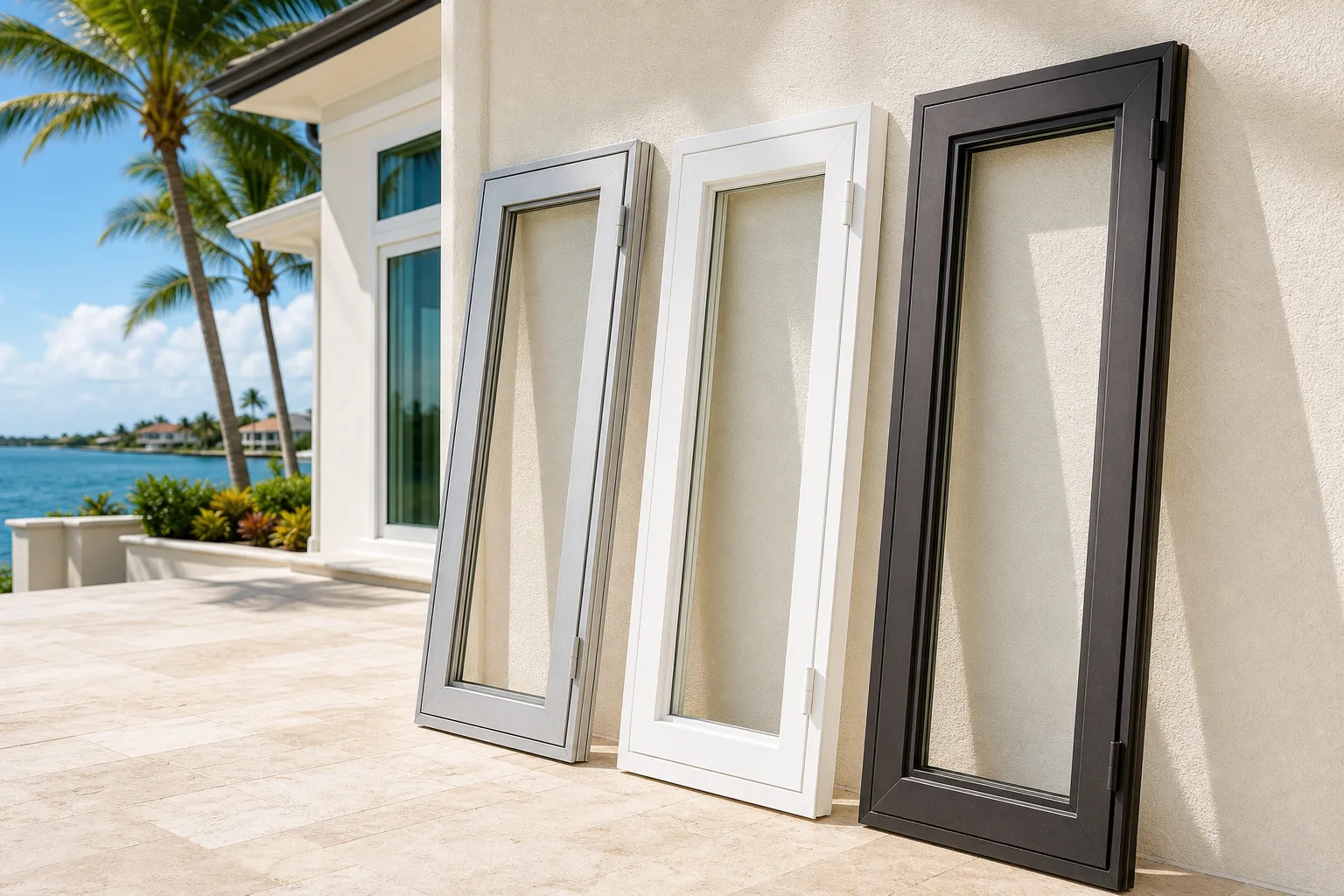
Aluminum is the default frame material for impact doors in South Florida, and that default exists for real reasons.
Structural performance. Aluminum extrusions can be engineered to carry high design pressure (DP) ratings. Entry doors in hurricane-exposed zones often require DP ratings well above what standard residential products meet. Aluminum frames achieve these ratings routinely, and the product approval database reflects a wide range of tested assemblies. When you review what to look for before installing hurricane impact windows, the same structural logic applies directly to doors.
Corrosion behavior. Aluminum does not rust, but it corrodes through oxidation and galvanic reactions. Coastal installations within a few miles of saltwater require marine-grade finishes or anodized coatings. Standard painted aluminum can show surface pitting and coating failure within a few years if the wrong product is specified for a waterfront property. Ask the manufacturer specifically about salt-air ratings and warranty exclusions for coastal exposure.
Thermal performance. Standard aluminum conducts heat readily. In South Florida that means frames can transfer outdoor heat into conditioned space, reducing energy efficiency. Thermally broken aluminum profiles address this by inserting a low-conductivity material between the interior and exterior sections of the extrusion. Thermal break options exist across most major manufacturers, though they typically add cost and may affect which DP ratings are available for a given profile.
Maintenance. Aluminum frames in good condition require periodic cleaning and hardware lubrication. Inspect weatherstripping annually. Salt buildup near the coast should be rinsed off regularly.
Commercial applications. For storefronts, curtain wall, and high-rise entries, aluminum is essentially the only practical choice. See the commercial impact glazing services page for more on those requirements.
Vinyl Frames
Vinyl (PVC) impact door frames have carved out a real but narrower role in South Florida residential work.
Corrosion and moisture resistance. Vinyl does not corrode, rust, or absorb moisture. It handles the combination of humidity, salt air, and driving rain that South Florida delivers better than aluminum on that specific metric. For properties right on the water, a well-specified vinyl frame is not a compromise on corrosion alone.
Thermal performance. Multi-chamber vinyl profiles trap air and reduce heat transfer significantly compared to non-thermally-broken aluminum. For homeowners focused on energy costs alongside hurricane protection, this is a genuine advantage.
Structural limitations. The trade-off is load capacity. Vinyl frames are typically reinforced internally with steel or aluminum inserts to achieve acceptable DP ratings. The compound assembly can complicate long-term maintenance and, in some cases, corrosion of interior reinforcement members is not visible until problems emerge. High DP ratings common on large primary entry doors or doors exposed to unobstructed wind fetch are harder to achieve in vinyl assemblies. The Florida Product Approval database shows a narrower range of tested vinyl door systems compared to aluminum.
Color and aesthetic stability. Vinyl can fade or chalk in intense UV exposure. South Florida sun is not gentle. Specify products with UV-stabilized formulations and check manufacturer documentation on color warranties before committing.
Best use cases. Sliding glass impact doors, secondary exterior doors, and openings in protected locations (screened enclosures, covered lanais) are where vinyl makes the most sense. For a primary front entry door exposed to wind-driven rain and direct sun, aluminum is generally the more defensible specification.
Compare impact-door options for your project. Request a free estimate
Steel Frames
Steel impact door frames come up occasionally in conversations, usually because homeowners associate steel with toughness. In South Florida residential construction, the reality is less straightforward.
Structural capacity. Steel can achieve high structural ratings. In commercial applications, steel hollow metal frames are standard at high-traffic entries, fire-rated assemblies, and security doors. The raw material is strong.
Corrosion in South Florida. Steel corrodes in humid, salt-laden environments unless protected by coatings, galvanizing, or stainless alloys. Standard steel hollow metal frames can begin showing rust at fastener penetrations, welds, and coating damage points within a few years in coastal South Florida conditions. Maintaining those coatings is an ongoing labor cost, and failures inside a wall cavity may not be visible until structural damage is significant.
Product approvals. Florida Product Approval listings for residential steel impact door systems are sparse. HVHZ NOA documentation for steel residential door frames is difficult to locate. This is not a technicality to work around. It is a real constraint. An installation without proper approval documentation will not pass inspection and may affect insurance documentation.
When steel is relevant. Multi-family stairwells, commercial entries, fire-rated assemblies, and security applications where an architect has specified steel and addressed the corrosion protection properly are the appropriate contexts. For a standard single-family home in Wellington, Boca Raton, or Coral Springs, steel impact door frames are not a practical option.
How Florida's Climate Shapes the Decision
South Florida's hurricane season runs June 1 through November 30 per NOAA's National Hurricane Center. That is six months of elevated storm risk, but the climate stress on door frames is a twelve-month reality. Summer humidity regularly exceeds 80 percent. UV index values are among the highest in the continental United States. Salt aerosols travel miles inland from both coasts.
Any frame material specification that does not account for year-round environmental exposure, not just storm events, will underperform over a typical product lifespan. This is one reason the Florida Building Code and HVHZ requirements exist: they encode regional climate reality into minimum performance standards.
For homeowners reviewing whether their current doors are still appropriate, the article on 5 signs it may be time to replace windows in Florida covers several indicators that apply equally to doors.
Documentation and Permitting
Regardless of frame material, a permitted impact door installation in South Florida requires:
- A valid Florida Product Approval or, in Miami-Dade HVHZ, a current NOA for the complete door assembly
- Engineered installation drawings specifying anchor type, spacing, and embedment for the actual wall substrate
- A permit pulled with the local building department
- Inspections at rough and final stages
Frame material affects which FPA numbers apply and which engineer details are available. It also affects the manufacturer's warranty terms, which matter for future insurance documentation. When you request an estimate for a door replacement project, asking for the specific FPA or NOA number for the proposed assembly is a reasonable step before signing a contract.
For context on the full scope of a doors and windows replacement project, the windows and doors replacement services page outlines what the process typically involves.
Verdict
Aluminum is the right starting point for most South Florida impact door projects. The structural performance, breadth of product approvals, and established track record in this climate are difficult to match. Specify a marine-grade or anodized finish for coastal locations and a thermally broken profile if energy performance is a priority.
Vinyl is a legitimate choice for secondary doors, sliding glass doors, and protected locations where thermal performance matters and design pressure requirements are moderate. Confirm the FPA covers your required DP rating before specifying.
Steel is not a practical frame material for standard residential impact door installations in South Florida. Corrosion management, limited product approvals for residential applications, and ongoing maintenance costs work against it in this climate. Reserve steel for the specific commercial and security contexts where it is properly specified and maintained.
Frame material is one variable among several. The glass specification, the anchor system, the installer's experience with the specific product, and the permit documentation all contribute to how well the door performs over time. Getting each piece documented correctly from the start is what makes the difference between a compliant installation and one that creates problems at the next inspection or insurance review.
Compare impact-door options for your project.
Review entry, French, and sliding-door assemblies against the exact opening, approval, design pressure, exposure, glass, hardware, and installation scope.
Frequently asked questions
Why is aluminum the most common impact door frame material in South Florida?
Aluminum achieves high design pressure ratings that match what South Florida wind exposure requires, and it has the widest range of Florida Product Approval listings for impact door assemblies. It handles humidity reasonably well with proper marine-grade or anodized finishes. The combination of structural performance and available approval documentation makes it the default choice for contractors and engineers working in this region.
Can vinyl impact door frames meet Miami-Dade HVHZ requirements?
Some vinyl impact door assemblies do carry Miami-Dade Notices of Acceptance, but the selection is narrower than aluminum. You need to verify that the specific product you are considering has a current NOA covering the design pressure required for your opening. Internal reinforcement in vinyl frames can also affect long-term performance, so review the manufacturer's corrosion and warranty documentation before specifying.
What makes steel impact door frames impractical for coastal South Florida homes?
Steel corrodes aggressively in the humid, salt-laden environment near the Florida coasts unless protected by coatings or stainless alloys that require ongoing maintenance. Florida Product Approval listings for residential steel impact door systems are also very limited, which creates a real permitting obstacle. Standard residential contractors rarely specify steel for single-family impact door installations in South Florida for these reasons.
Does frame material affect my homeowner's insurance documentation?
Frame material itself is not typically a field on a wind mitigation inspection form, but the product approval documentation tied to the frame assembly is relevant. An installation without a valid Florida Product Approval or HVHZ NOA may not support the credits your insurer requires. Always confirm that the complete door assembly, including the frame, carries documentation your contractor can provide to the inspector.
How often should aluminum impact door frames be maintained in a coastal environment?
Rinsing salt buildup from frames with fresh water every few weeks is advisable for properties within a mile or two of the coast. Check weatherstripping and hardware annually and lubricate moving parts according to the manufacturer's schedule. Surface corrosion at fastener points or along frame edges should be addressed promptly before it advances through the finish coating.
Does a thermally broken aluminum frame change the structural rating of an impact door?
Thermal break profiles can affect which design pressure ratings are available for a given frame product because the break interrupts the continuous metal cross-section. Some assemblies maintain their full DP rating with a thermal break; others are tested and approved at lower ratings. Confirm the FPA or NOA for the specific thermally broken assembly you are considering covers the DP your project requires before finalizing the specification.