
TL;DR: Hurricane windows in Wellington must meet Palm Beach County's building code and carry a valid Florida Product Approval (NOA). The frame material, glass package, and installation method matter as much as the brand. Get all three right and you have protection, energy savings, and a smoother insurance conversation.
I've been installing hurricane impact windows in South Florida for over two decades. Wellington comes up a lot lately because the village has grown fast and a big chunk of the housing stock, especially in communities like Versailles, Olympia, and Paddock Park, was built with standard aluminum single-pane windows that were never designed for a serious storm. Homeowners there are replacing them now, and they're asking the right questions. This guide is my honest attempt to answer them.
1. Understand What "Hurricane Window" Actually Means in Wellington, FL
The phrase "hurricane windows" gets used loosely. What you actually need in Wellington are impact-rated windows with a valid Florida Product Approval, sometimes called an NOA (Notice of Acceptance). That approval number tells you the window was tested to withstand large-missile impact and cyclic pressure loads per the Florida Building Code.
Wellington is in Palm Beach County but it is not in the High-Velocity Hurricane Zone (HVHZ). That's a distinction that matters. HVHZ covers Miami-Dade and Broward and requires stricter Miami-Dade product approvals. In Wellington you need a Florida Product Approval, not necessarily a Miami-Dade NOA, though windows carrying the Miami-Dade approval are also valid here and are generally a higher standard.
Here's what I actually see on real homes: a homeowner shows me a quote from a budget outfit and the window listed has a Florida Product Approval but it's a bare-minimum approval for the 110 mph design pressure zone. Wellington's wind speed maps put most of the village at 140 mph or higher for newer construction. Make sure the DP rating on the window matches what your permit requires. Your county building department or your installer can pull that from the approved construction documents.
2. Frame Material: Aluminum vs. Vinyl in the Wellington Climate
This is where a lot of Wellington homeowners get tripped up by national big-box advertising. Vinyl frames are fine in northern climates. In South Florida the heat, UV exposure, and humidity are a different story.
Aluminum frames expand and contract more predictably in high heat and hold their shape over decades. Properly installed with thermal break technology, aluminum also performs well on energy efficiency. Most of the high-performance brands we install, including PGT, CGI, and WinDoor, build their South Florida lines around aluminum for exactly this reason.
Vinyl is not automatically bad. Some vinyl windows carry valid Florida Product Approvals and are installed here. But the DP ratings tend to be lower, and I've seen vinyl frames warp at corner welds after several Florida summers, especially on west-facing exposures where afternoon sun is intense. If someone is quoting you a vinyl impact window at a price that seems too good, ask to see the DP rating and the install location relative to your exposure.
For Wellington specifically, the western communities near the Acreage have longer lot depths and taller tree canopy that reduces direct exposure somewhat. Homes in Versailles or Olympia with unobstructed lake-facing western elevations deserve more attention to frame quality and glass solar performance.
3. Glass Package: What the Numbers Mean for Your Home
Impact glass is laminated, meaning two panes of glass bonded with an interlayer that holds together on impact instead of shattering. That's the baseline. Beyond that, the glass package determines heat gain, UV blocking, and noise reduction.
The key number is SHGC, Solar Heat Gain Coefficient. Lower is better for South Florida. A window with an SHGC of 0.23 blocks significantly more solar heat than one at 0.35. In Wellington, where afternoon sun on west and south elevations is intense, a low-SHGC glass package reduces your AC load noticeably. This is one of the real ways energy efficient windows pay back over time, not a marketing line.
Low-E coatings are standard on most quality impact windows now. There are different grades. Some have a single low-E coating. Others have dual or triple silver coatings that push SHGC lower while keeping visible light transmission reasonable. Ask your installer to show you the NFRC label data for the specific unit being quoted, not the line-level spec sheet.
For UV blocking, look for windows that block 99 percent or more of UV. This matters for flooring, furniture, and artwork in Wellington homes that get significant southern or western sun exposure.
Get storm-ready before the next season. Request a free estimate
4. The Installation Is Where Budget Quotes Fall Apart
I want to be direct about this because it's the most important point in this whole guide. The window itself is only half the system. The other half is how it's attached to your wall.
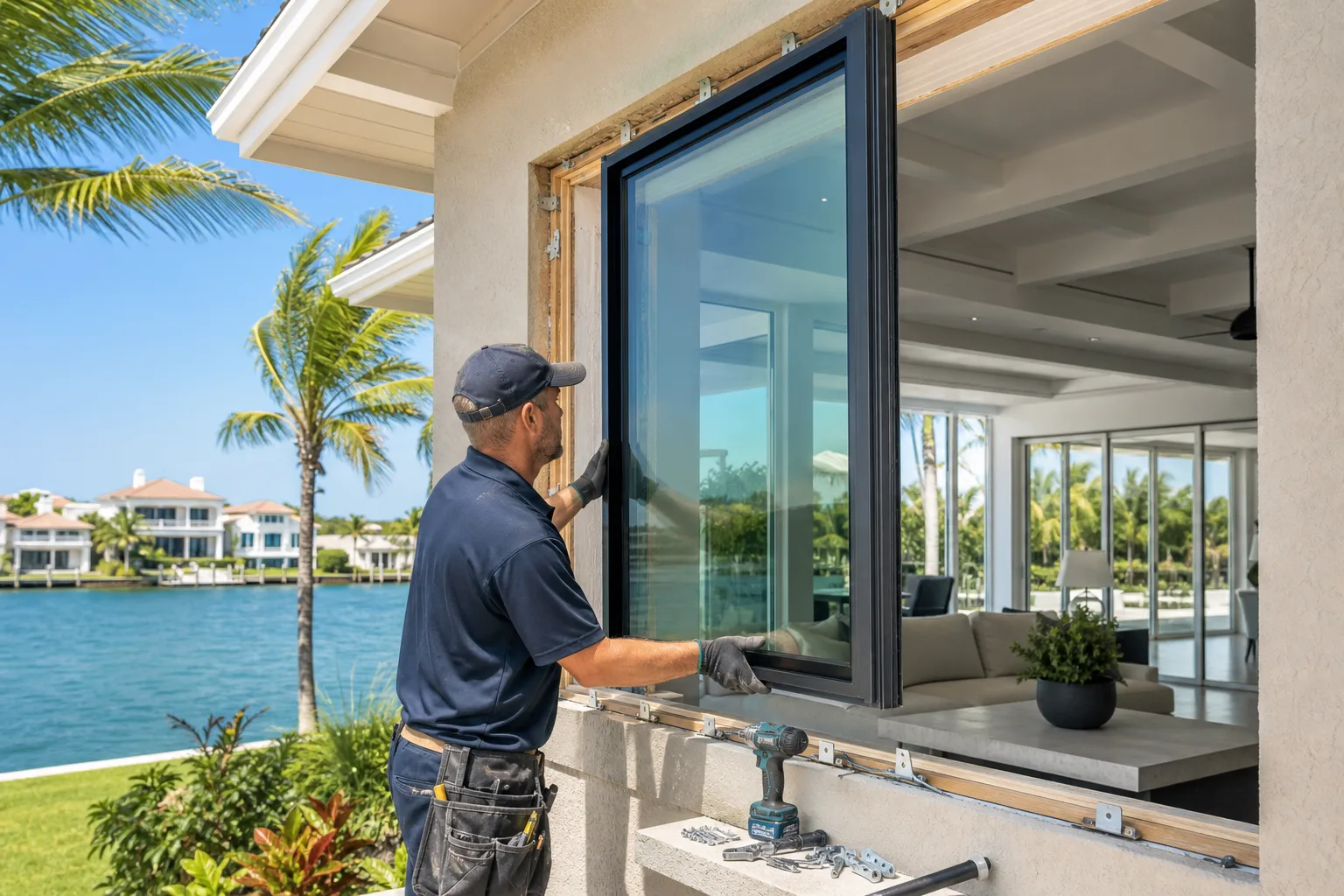
Florida Building Code requires impact windows to be installed with anchors at specific spacing intervals into the rough opening. The anchor type, embedment depth, and spacing are all specified in the product's installation instructions, which are reviewed as part of the Florida Product Approval process. If those specs aren't followed, the window approval is void and the window can fail under storm pressure even if it's a top-tier product.
Here's what shortcuts cheaper outfits actually take. They reduce anchor count to save time. They use undersized fasteners. They skip the perimeter sealant or use a non-compliant sealant. They pull a permit but don't schedule the rough-in inspection properly, hoping the inspector misses it.
After installation, your project should have a closed permit with inspection records you can access through the Palm Beach County Building Division. If a contractor tells you permits aren't necessary for a window replacement, walk away. Unpermitted impact windows create problems when you sell the home and can void your insurance coverage.
If you want to see what a proper installation involves, our window replacement service page walks through the process.
5. HOA Requirements in Wellington Communities
Wellington has some of the most active HOAs in Palm Beach County. If you're in Versailles, Olympia, Isles at Wellington, or any of the master-planned communities, your HOA likely has an architectural review process for exterior changes.
Most Wellington HOAs approve impact windows without much friction because they are a visible upgrade. But they often specify frame color and whether bronze or white is permitted on the exterior. Some specify grid patterns to match the existing community aesthetic.
Get HOA approval in writing before you sign a contract with your installer. HOA approval and county building permit approval are separate processes. Both are required. Your contractor should not be starting work on either until both are in hand.
For homes in Wellington that also involve door replacements, especially entry doors or sliding glass doors, HOA review is even more common. We see a lot of combined windows and doors replacement projects in Wellington where the HOA review covers both at once, which is more efficient.
6. Insurance Credits and What to Expect in Wellington
Replacing standard windows with compliant hurricane impact windows in Wellington can qualify you for an opening protection credit on your homeowner's insurance. The credit amount depends on your insurer, your policy, and whether all openings, including doors and garage, are protected.
To get the full opening protection credit, every glazed opening in the home typically needs to meet the impact standard. That means you can't do just the front elevation and leave the rear with standard glass. Partial protection may get you a partial credit or none at all, depending on how your insurer calculates it.
After your project closes permit, ask your installer for a copy of the permit card, inspection results, and the product approval numbers for each window installed. Submit those to your insurance agent. Some insurers also require a Wind Mitigation Inspection, which is a separate inspection done by a certified inspector who documents the opening protection to the insurer. That report is what drives your actual premium adjustment.
For a broader look at impact window benefits beyond storms, the 10 reasons to install impact windows page covers the insurance, energy, and security side together.
Bottom Line
If you're shopping hurricane windows in Wellington, the four things that actually determine whether you get what you paid for are: a valid Florida Product Approval with a DP rating matched to your permit requirements, the right frame and glass package for your home's exposure, a licensed installer who pulls the permit and schedules inspections correctly, and HOA approval before work starts.
Budget quotes that skip any of those four aren't actually cheaper. They're deferred problems.
We've done hundreds of projects in Wellington and the surrounding communities. If you want a straight conversation about what your home needs and what it will cost, request an estimate and we'll come out and take a look.
Get storm-ready before the next season.
Impact glass protects your home 24/7 with no panels to put up. Window Guys of Florida handles permits, code, and install end to end.
Frequently asked questions
Do hurricane windows in Wellington require a building permit?
Yes, every impact window replacement in Wellington requires a Palm Beach County building permit. The permit triggers a required inspection that confirms the windows were installed to the product approval specifications. Any contractor telling you permits aren't needed is either cutting corners or unfamiliar with local code, and either situation puts your home and your insurance coverage at risk.
Are Miami-Dade approved windows required in Wellington, FL?
Wellington is not in the High-Velocity Hurricane Zone, so Miami-Dade product approval is not strictly required. A Florida Product Approval is sufficient, provided the window's DP rating meets the design pressure requirements for your specific permit. That said, windows carrying Miami-Dade approval are also valid in Wellington and are generally built to a higher tested standard.
How do I get an insurance discount for hurricane windows in Wellington?
After your project closes permit, collect the permit card, inspection records, and product approval numbers for all installed windows. Submit these to your insurance agent and ask whether a Wind Mitigation Inspection is required. Most insurers use that certified inspection report to calculate your opening protection credit, and you typically need all glazed openings in the home protected to qualify for the full discount.
Do I need HOA approval before replacing windows in a Wellington community?
Most Wellington HOAs require architectural review for exterior changes, including window replacements. HOA approval is separate from your county building permit and both are required before work begins. HOAs in communities like Versailles and Olympia commonly specify exterior frame color, so confirm those requirements before you finalize your window selection with your installer.
What is a DP rating and why does it matter for Wellington homes?
DP stands for Design Pressure and measures how much wind load and pressure difference a window is tested to withstand. Wellington's wind speed maps require most homes to meet a 140 mph or higher design wind speed, which translates to a specific minimum DP rating on your permit. An impact window with a Florida Product Approval but a DP rating lower than what your permit requires is non-compliant, even if it passed impact testing.
How long does a hurricane window installation take in Wellington?
For a typical single-family home in Wellington, the physical installation usually takes one to three days depending on the number of openings and the complexity of the existing rough openings. Permit processing time through Palm Beach County adds a few weeks before work can begin. Factoring in HOA review, budgeting six to ten weeks from signed contract to closed permit is realistic for most Wellington projects.