TL;DR: When you search "hurricane windows near me," the results are a mix of licensed contractors, subcontracted crews, and lead-generation sites. Verify the license, confirm the product has a valid Florida product approval for your wind zone, and get the scope in writing before you sign anything.
What You Need Before You Start Calling Anyone
Before you even type "hurricane windows near me" into a search bar, gather a few basics. It will save you time and help you spot vague or evasive answers during your first call.
- Your county and whether your property falls in the High Velocity Hurricane Zone (Miami-Dade and Broward have stricter product approval requirements than Palm Beach, Martin, or St. Lucie).
- A rough count of openings you want addressed (windows, sliding doors, entry doors). A typical single-family home in South Florida has anywhere from 12 to 25 openings depending on the floor plan, so even a rough number helps a contractor give you a meaningful estimate over the phone.
- Any HOA or condo association rules on window appearance, color, or approved vendors. Some associations require a specific frame color or prohibit certain glass tints visible from the exterior. Finding this out before you get quotes prevents you from falling in love with a product your board won't approve.
- Whether you're doing a full window replacement or a mixed project with impact doors as well. Combining both under one permit and one contractor is almost always more cost-effective than splitting the work.
- A copy of your homeowner's insurance policy declarations page, since some carriers ask for specific documentation after impact window installation. Some insurers may require a completed opening protection form or a copy of the permit and inspection sign-off before they'll apply a wind mitigation discount to your premium, though requirements vary by carrier and policy.
Having this ready lets you ask sharper questions and compare apples to apples across bids. A contractor who struggles to answer basic questions about wind zones or product approvals when you're clearly prepared is showing you something important about how they operate.
Step 1: Confirm the Contractor's License Is Real and Active
Florida requires contractors doing this work to hold an active license, typically a General Contractor (CGC) or Certified/Registered Specialty Contractor license covering glass and glazing. Anyone can put a license number on a website. Verify it yourself through the Florida Department of Business and Professional Regulation's license search tool. Type in the license number and confirm the name matches the business, the license is active, and there's no disciplinary history.
Don't stop at a screenshot the company sends you. Look it up independently. Pay attention to the license expiration date and the qualifier name, the qualifier is the licensed individual whose credentials the company operates under. If the qualifier recently changed or the license is in a renewal grace period, ask follow-up questions. If a company won't give you a license number when asked directly, that's a reason to move on, not a detail to overlook.
Also check whether the contractor carries general liability insurance and workers' compensation. Ask for a certificate of insurance naming you as an additional insured for the duration of the project. If a worker is injured on your property and the contractor doesn't carry proper workers' comp, you can be held liable. This is not a formality, it's a meaningful financial protection.
Step 2: Check That the Product Has a Valid Florida Approval for Your Zone
This is where a lot of homeowners get tripped up. Not every impact window sold in Florida is approved for every part of Florida. Products need a Florida Product Approval or Miami-Dade Notice of Acceptance (NOA), and the specific approval has to match the design pressures and wind zone for your address, not just a general statewide listing.
Here's how the distinction matters in practice: a window carrying a standard Florida Product Approval number might be rated for design pressures common in Orlando or Tampa but fall short of the higher pressure requirements in Miami-Dade or Broward's HVHZ. If a contractor installs that product in the HVHZ, it won't pass inspection, and you could be required to remove and replace the windows at your own expense, even if you already paid the contractor in full.
To verify a product, ask the contractor for the Florida Product Approval number (found on the Florida Building Commission's product approval site) or the Miami-Dade NOA number. Look up the approval yourself and confirm it's current, not expired, and that the specific window series and size being quoted matches what's listed in the approval documentation. Approvals are specific to product series, frame material, glazing type, and sometimes even the installation method, pocket installation versus full-frame replacement can have different approved design pressure ratings for the same window unit.
A knowledgeable contractor should be able to hand you the product approval number without hesitation and explain exactly how it applies to your home's calculated design pressures.
Review opening-protection options before storm season. Request a free estimate
Step 3: Understand Who Is Actually Doing the Work
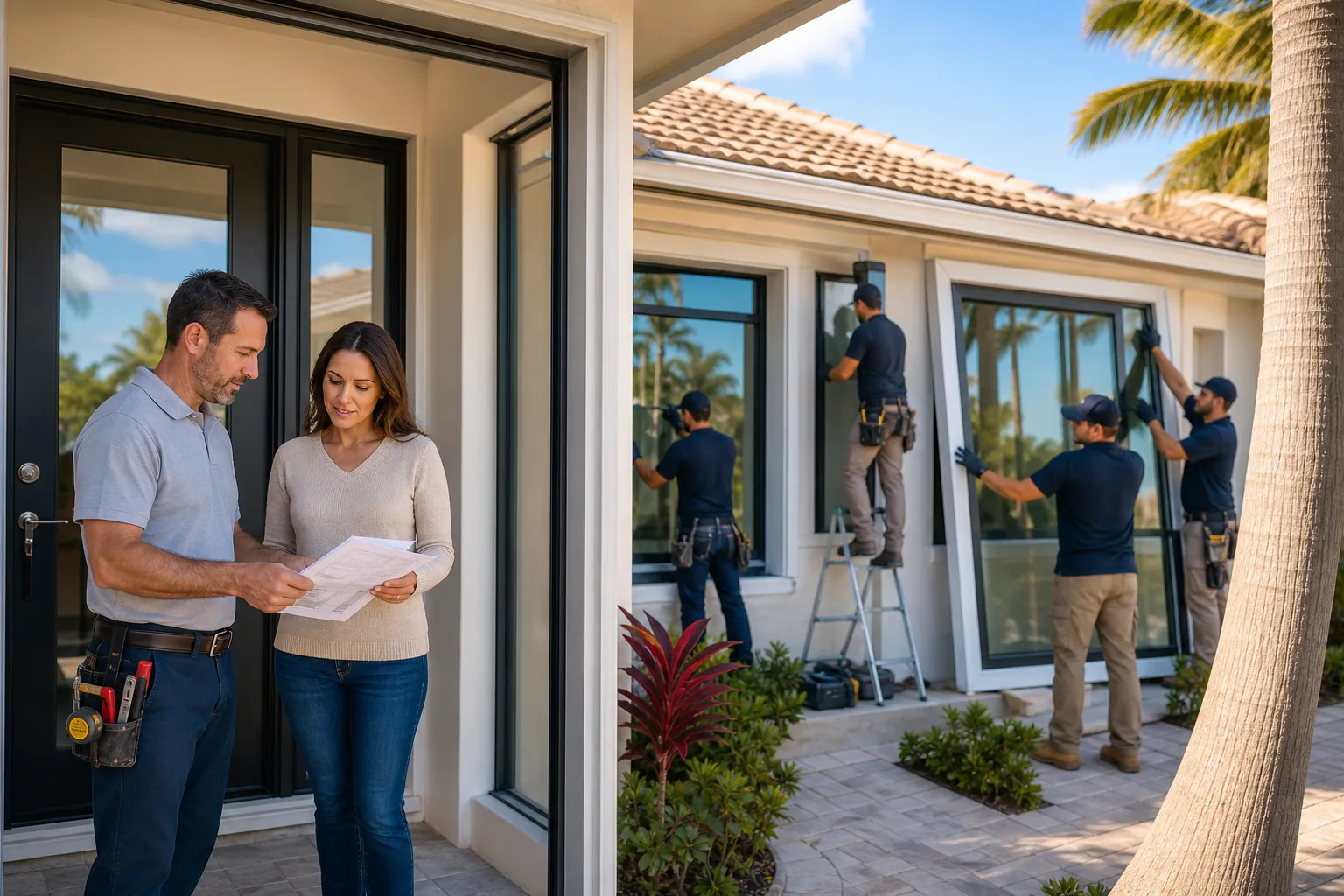
When you search "hurricane windows near me," a significant portion of the results are lead-generation websites, manufacturer dealer programs, or large companies that win the sale and then subcontract the installation to crews they don't directly employ. None of that is automatically disqualifying, but you need to know the structure so you can hold the right party accountable if something goes wrong.
Ask directly: "Will your company's own employees be installing my windows, or will you subcontract the installation?" If they use subcontractors, ask whether those subcontractors are licensed and insured independently, and whether the primary contractor's license covers the work or whether the subcontractor will be pulling their own permit. The entity that pulls the permit is the entity responsible for the work passing inspection, so this question has real legal and practical weight.
Also ask who will be your point of contact from contract signing through the final inspection. Large companies sometimes have a strong sales process and a weaker project management process. If the salesperson who knew your project inside and out disappears after you sign, and the installation crew shows up without a clear scope sheet, problems follow. Get the name of the project manager or field supervisor before you commit.
Step 4: Get the Full Scope in Writing Before You Sign
A written contract for hurricane window installation should include more than a price and a product name. At minimum, it should specify:
- The exact product being installed, including the manufacturer name, product series, and Florida Product Approval or NOA number.
- The number and dimensions of openings being addressed, listed individually if possible.
- The installation method (pocket replacement or full-frame removal and replacement) and what happens to the existing window frame and interior trim.
- Who is responsible for pulling the permit and scheduling inspections.
- The payment schedule, including what percentage is due at signing, what's due at delivery of materials, and what's due at completion after final inspection sign-off.
- A completion timeline with a start date and a projected finish date.
- How change orders will be handled if unexpected conditions arise (rotted framing behind an old window is common in coastal homes and can add cost).
As a consumer-protection best practice, industry guidance generally recommends paying no more than 10 to 30 percent upfront. A demand for 50 percent or more before any work starts is a warning sign worth taking seriously. Final payment should be tied to the permit closing, not just to the crew finishing and leaving your driveway.
Step 5: Use Local Reviews the Right Way
Google reviews, Houzz, and Nextdoor recommendations all have value, but read them critically. Look for reviews that mention the permit process, inspection results, and how the company handled problems, not just reviews that say "the windows look great." A review that says "the inspector passed everything on the first visit and the crew patched my interior trim cleanly" tells you more than a five-star review with no specifics.
Also search the contractor's name alongside the county building department's permit search if one is available online. Many South Florida county portals let you search open and closed permits by contractor. A contractor with dozens of closed permits and clean inspection histories in your county is demonstrably more reliable than one with no local permit history regardless of how polished their website is.
Asking neighbors who have recently completed impact window projects is still one of the most reliable methods. If three houses on your street used the same company and all three permits closed without issues, that's meaningful real-world evidence that no amount of advertising can replicate.
What a Trustworthy Answer to "Hurricane Windows Near Me" Actually Looks Like
The right local contractor will give you a license number immediately when asked, hand you a product approval number that you can verify before signing, pull the permit themselves, schedule and pass inspections without requiring you to chase them down, and tie your final payment to permit closure rather than to their crew's departure. They'll also be able to explain clearly why the product they're recommending is appropriate for your specific wind zone and design pressure requirements, not just tell you it's "impact rated" and move on.
That combination of transparency, documentation, and accountability is what separates a trusted local installer from the noise that fills most search result pages. It takes an extra hour of verification on the front end and saves you from the much larger headaches of failed inspections, insurance disputes, and workmanship claims on the back end.
Review opening-protection options before storm season.
The performance and responsibilities for permits, engineering, documentation, installation, and inspections depend on the exact assembly and written project scope.
Frequently asked questions
How do I verify a hurricane window contractor's license in Florida?
Use the Florida Department of Business and Professional Regulation's license search tool at myfloridalicense.com to look up the license number yourself. Confirm the name matches the business, the license is active, and there is no disciplinary history. Do not rely on a screenshot the company sends you, always verify independently.
What is a Florida Product Approval and why does it matter for my home?
A Florida Product Approval certifies that a window product meets specific design pressure and wind zone requirements for a given area of Florida. Not every impact window approved for one region is approved for another, products installed in Miami-Dade or Broward's High Velocity Hurricane Zone must meet stricter standards. Installing an unapproved product can result in a failed inspection and require removal and replacement at your own expense.
Should I be concerned if a contractor subcontracts the installation work?
Subcontracting is not automatically disqualifying, but you need to understand the arrangement clearly. Ask whether the subcontractors are independently licensed and insured, and confirm who will be pulling the permit, since the permit-holding entity is legally responsible for the work passing inspection. Also establish who your ongoing point of contact will be from signing through final inspection.
How much should I pay upfront for a hurricane window installation?
As a consumer-protection best practice, industry guidance generally recommends a deposit of around 10 to 30 percent of the total project cost. A demand for 50 percent or more before any work begins is a warning sign. Final payment should be tied to permit closure and a passed inspection, not simply to the crew finishing and leaving your property.
What should a hurricane window installation contract include?
The contract should specify the exact product with its Florida Product Approval or NOA number, the number and dimensions of all openings, the installation method, who is responsible for pulling the permit and scheduling inspections, a detailed payment schedule, a project timeline, and how unexpected conditions like rotted framing will be handled. Vague contracts without these specifics leave you with little recourse if problems arise.
How can I use local reviews effectively when searching for hurricane window installers?
Look for reviews that mention specific details like permit outcomes, inspection results, and how the company resolved problems, not just general praise about appearance. Searching the contractor's name in your county building department's permit portal can reveal their actual inspection history in your area. Recommendations from neighbors who have recently completed similar projects and had permits close successfully are among the most reliable signals of contractor quality.