
TL;DR: Laminated glass holds together after impact because a polymer interlayer bonds the panes. Tempered glass shatters into small pieces and cannot maintain a weather barrier after a strike. Florida building codes require laminated or laminated-hybrid assemblies for openings classified as impact-rated. Tempered-only glass does not qualify.
At a Glance
| Feature | Laminated Glass | Tempered Glass |
|---|---|---|
| How it breaks | Cracks but stays bonded to interlayer | Shatters into granular pieces |
| Post-impact barrier | Maintains weather seal | Opening is immediately exposed |
| Florida large-missile standard (ASTM E1886/E1996) | Can pass with correct assembly | Cannot pass alone |
| Common use in windows | Impact window glazing | Shower doors, sliding glass panels, interior lites |
| Noise reduction | Moderate to good (interlayer dampens sound) | Minimal dampening |
| Cost relative to each other | Higher | Lower |
How Each Glass Type Is Made
Tempered glass is produced by heating a standard glass lite to around 620°C and then rapidly cooling it. That thermal process puts the surface in compression, which makes the pane roughly four times stronger than annealed (untreated) glass under normal loads. When it does break, it fractures into small, relatively blunt cubes rather than long shards. That fragment pattern is why tempered glass is used in car side windows, shower enclosures, and glass table tops.
Laminated glass starts with two or more glass lites bonded by a polymer interlayer, most often polyvinyl butyral (PVB) or a similar resin. Heat and pressure fuse the layers in an autoclave. The interlayer is the critical element: when the glass fractures, the broken pieces adhere to the interlayer instead of scattering. The opening stays covered.
Many impact-rated window units combine both processes. The outer lite is often tempered for added surface strength; the inner lite or interlayer provides the retention layer. The specific combination varies by product and must be documented in the product's Notice of Acceptance (NOA). Verify the exact construction for any unit you are considering.
Why Tempered Glass Alone Fails Storm Requirements
Florida's building code, which references ASTM E1886 (test method) and ASTM E1996 (performance specification), requires that glazing in wind-borne debris regions withstand a large-missile impact without creating an opening. The standard large-missile test fires a 9-lb 2x4 at the glazing at speeds defined by design wind speed.
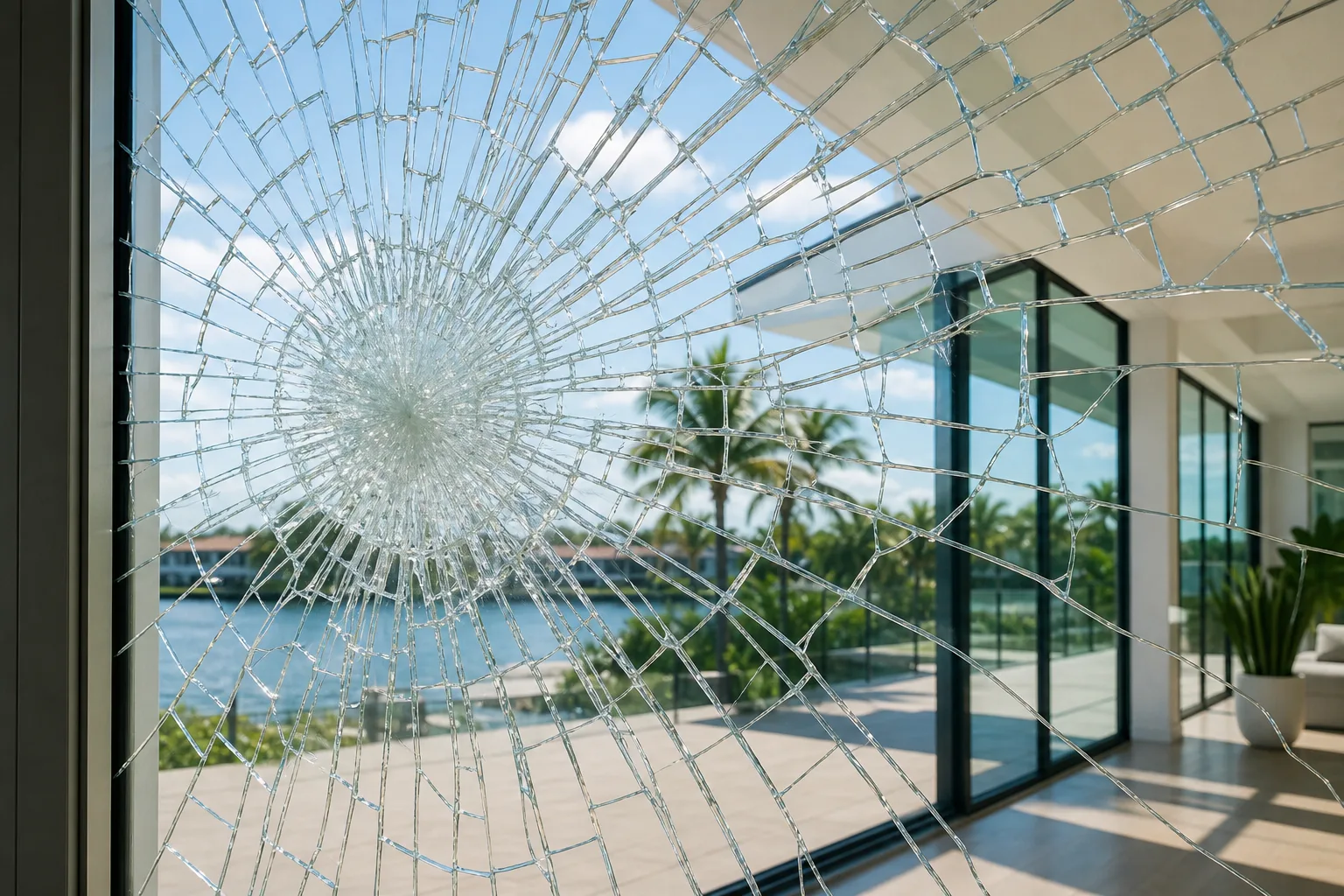
When a tempered lite is struck by a large projectile, it typically shatters completely on impact. The granular pieces fall out or are blown inward. That failure mode creates exactly what the code is designed to prevent: a breached opening that allows wind-driven rain, pressure differentials, and additional debris into the structure.
The interlayer in laminated glass changes the failure mode. The pane may crack extensively, but the polymer holds the fragment matrix together. The opening remains covered. That post-impact continuity is what allows the assembly to pass the ASTM E1996 large-missile protocol and receive an approval that Florida inspectors will accept.
For more background on how impact products are evaluated, see 6 things you need to know before you install hurricane impact windows.
Review opening-protection options before storm season. Request a free estimate
Where Tempered Glass Is Still Used in Florida Homes
Tempered glass is not the wrong product; it is the wrong product for a hurricane-rated opening. It remains the correct choice for:
- Shower enclosures and frameless glass doors (safety glazing requirement under FBC)
- Interior partition glass and sidelites not exposed to the building envelope
- Some non-impact sliding glass panels in communities with approved shutter systems covering the entire opening
- Skylights in certain configurations (verify with the product's approval)
If your home relies on a shutter system to protect a tempered sliding glass door, the shutter itself must carry the impact and pressure approval. The glass behind it is not the protection layer. That arrangement is a different strategy from impact glazing and has its own documentation requirements.
The Interlayer Makes the Difference
Not all laminated glass performs identically. Interlayer thickness, resin type, and the number of glass plies affect both impact resistance and the unit's pressure rating. A standard laminated lite used in architectural applications may pass some tests but not the missile levels required in South Florida's high-velocity hurricane zone (HVHZ), which covers Miami-Dade and Broward counties , verify exact boundaries with your local authority having jurisdiction (AHJ), as the precise HVHZ boundary is defined in FBC Section 202 and applicable maps.
Products sold for HVHZ installation carry Miami-Dade NOAs, which set a higher bar than the standard Florida product approval. If your project is in Palm Beach, Martin, or St. Lucie County, the required approval level may differ depending on your specific location and design wind speed within those counties. Your contractor should identify the correct approval category for your project address before specifying a product.
Products from manufacturers such as PGT, CGI, SIW, and others are available in the Florida market, each with their own glazing configurations and approvals. The right unit depends on your opening size, design wind speed, and county requirements, not a single glass type label.
Sound Reduction as a Side Benefit
The PVB interlayer in laminated glass also attenuates sound by interrupting the vibration path through the assembly. This is a genuine secondary benefit for homes near airports or busy roads, though the degree of noise reduction depends on the full assembly: glass thickness, interlayer type, frame seals, and installation quality. Do not select a glass type for noise reduction without reviewing the unit's STC rating. See are impact windows soundproof for more on what the numbers mean.
Verdict
Laminated glass belongs in a hurricane window. Tempered glass does not provide post-impact continuity and cannot satisfy Florida's large-missile impact standard on its own. Many impact units use a tempered outer lite combined with a laminated inner lite or a laminated-tempered hybrid, but the laminated interlayer is always the element that makes the assembly code-compliant.
If you are replacing windows in South Florida and need to confirm which glazing configuration is appropriate for your county and wind zone, the hurricane impact windows page covers product options. For a project-specific review, request an estimate and ask your contractor to show you the NOA for any product under consideration before signing a contract.
Self-help is appropriate for understanding glass types and reading product specifications. Identifying the correct approval for your address, opening size, and design wind speed requires a licensed contractor reviewing the actual project conditions.
Review opening-protection options before storm season.
The performance and responsibilities for permits, engineering, documentation, installation, and inspections depend on the exact assembly and written project scope.
Frequently asked questions
Can I use tempered glass with hurricane shutters instead of impact windows?
Yes, that is a recognized strategy in Florida. The shutter carries the impact and pressure approval; the glass behind it is not the protection layer. Both the shutter and its attachment must have the appropriate product approval for your county and wind zone. Confirm the documentation with your contractor before relying on that system.
What is the PVB interlayer and can it fail over time?
Polyvinyl butyral (PVB) is the most common interlayer resin used in laminated glass. It can delaminate at the edges over time if the unit seal fails and moisture intrudes, which typically shows as a yellowish or cloudy border. A failed unit should be replaced; the interlayer's adhesion cannot be restored in the field. Inspect your units periodically for edge discoloration or bubbling.
Does laminated glass qualify for Florida insurance discounts?
Insurance credits in Florida are generally tied to wind mitigation inspection results, which document opening protection type and rated design pressure, not glass type alone. A qualifying impact-rated assembly with a valid NOA installed under permit can contribute to a favorable wind mit report, but the insurer and inspector determine the credit. See your wind mitigation inspector's findings for the specific line items that affect your premium.
How do I find out which glazing approval applies to my address?
Your county's design wind speed and whether you are in the High Velocity Hurricane Zone (HVHZ) determine the minimum approval level. Miami-Dade and Broward are HVHZ; counties such as Palm Beach, Martin, and St. Lucie generally follow the standard Florida product approval track, but requirements can vary by specific location within those counties , portions of some counties may have elevated wind speed requirements. A licensed contractor can identify your design wind speed from the current Florida Building Code tables and match it to the correct NOA for the product being specified.