
TL;DR: Tempered glass is a safety glass that breaks into small, less-harmful pieces. Impact-rated (hurricane) glass is a laminated assembly that resists penetration, holds the opening, and meets Florida Building Code wind and debris requirements. They are not interchangeable, and tempered glass alone does not satisfy hurricane protection code in most South Florida applications.
At a glance
| Feature | Tempered Glass | Impact (Laminated) Glass |
|---|---|---|
| Construction | Single heat-treated pane | Two glass lites bonded with PVB or SGP interlayer |
| On hard impact | Shatters into small cubes | May crack but stays bonded to interlayer |
| Opening protection after strike | None, opening becomes exposed | Yes, the laminate holds the barrier |
| Florida Building Code hurricane compliance | No (alone) | Yes, when NOA-approved and properly installed |
| Common uses | Shower doors, interior doors, some commercial glazing | Exterior windows and doors in hurricane zones |
| Noise reduction | Minimal | Moderate improvement over single-pane |
What tempered glass actually is
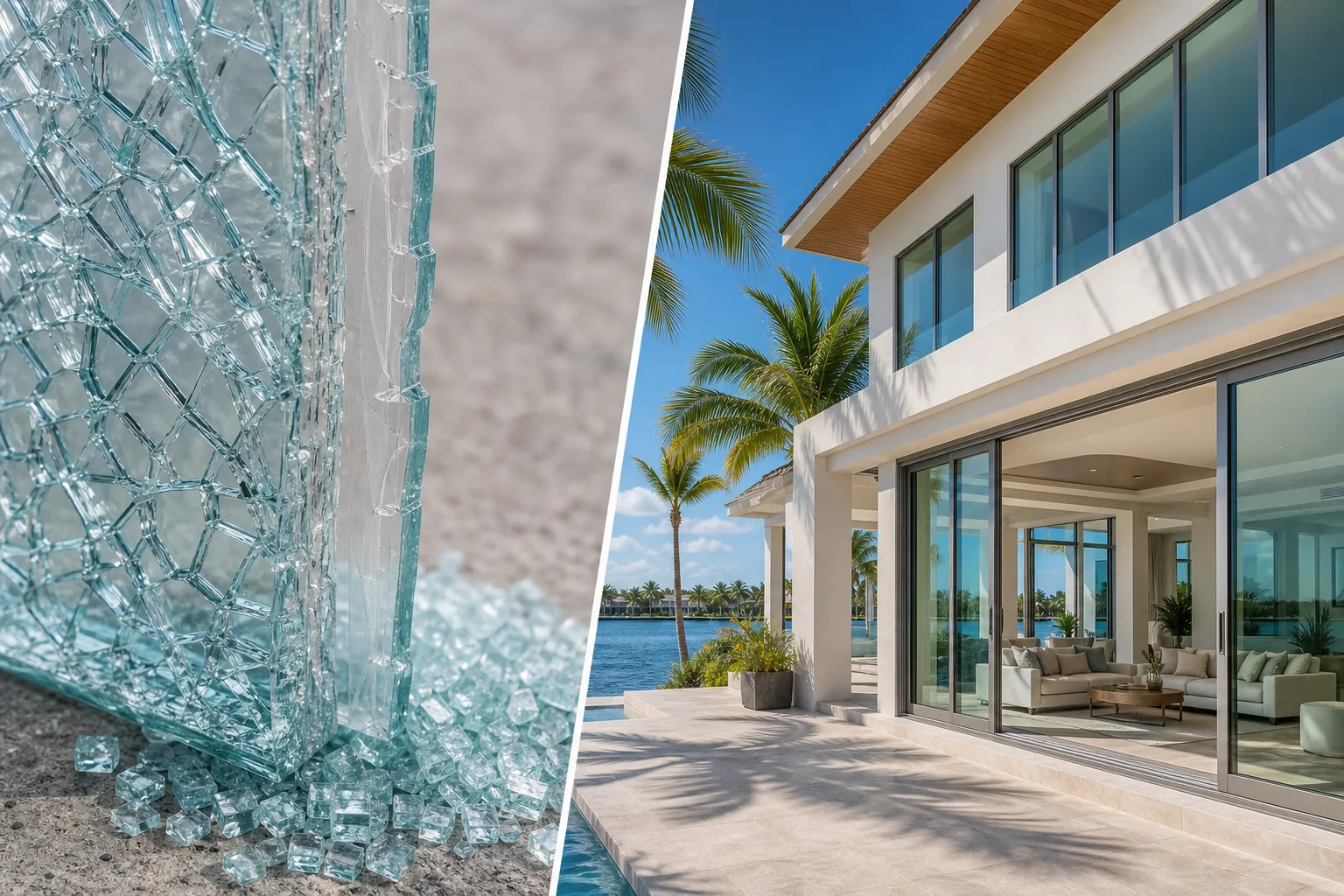
Tempered glass is a single pane that has been rapidly heated and cooled to create surface compression. That process makes it roughly four times stronger than annealed (ordinary) glass under slow or uniform pressure, and it fractures into small, rounded cubes rather than long, sharp shards.
That fracture behavior is why you see tempered glass in shower enclosures, interior partitions, sliding glass patio doors (non-impact rated), and some storefronts. The safety profile on breakage is the point, not wind or debris resistance.
When tempered glass breaks from a sharp point-impact, such as windborne debris, it does exactly what it is designed to do: it shatters completely. That leaves your opening fully exposed to wind-driven rain and continued debris during a storm.
What impact-rated glass actually is
Impact glass is a laminated assembly. Two glass lites are permanently bonded to an inner plastic interlayer, most commonly polyvinyl butyral (PVB) or the stiffer sentry glass plus (SGP). The glass plies can crack under a severe impact, but the interlayer holds the broken pieces in place.
That retained structure is what matters for hurricane performance. The opening stays covered, interior pressure does not spike, and the home envelope stays intact. Florida Building Code and Miami-Dade County HVHZ protocols (TAS 201) test this with a large missile impact (a 9-pound 2x4 fired at 50 feet per second, per the applicable edition of TAS 201 in effect at time of approval) followed by cycling pressure loads. Note that this specific test parameter applies to the HVHZ (Miami-Dade and Broward counties); non-HVHZ regions of Florida rely on ASTM E1996, which specifies different test parameters. Tempered glass alone does not pass either test sequence.
Impact windows and doors sold in South Florida carry a Notice of Acceptance (NOA) or Florida Product Approval that documents exactly which conditions and installation requirements the assembly is rated for. Installers and building departments verify this before a permit is approved.
Why the construction method is the core difference
The performance gap comes from structure, not glass hardness.
- Tempered glass: One layer. When the surface compression fails at a point of impact, the entire pane releases its stress energy and disintegrates.
- Impact laminated glass: Two layers plus an interlayer. The interlayer absorbs and distributes energy. Even after the glass cracks, the assembly behaves more like a membrane than a rigid pane.
Some impact units use tempered glass as one of the two lites in the laminated assembly, combined with a heat-strengthened lite and the interlayer. In that configuration the tempered ply is a component of an impact-rated system, not a standalone solution. The system as a whole earns the rating, not the individual glass type.
Review opening-protection options before storm season. Request a free estimate
Florida Building Code requirements and where each glass fits
Florida Building Code wind-resistance and opening-protection requirements , including the High-Velocity Hurricane Zone (HVHZ) provisions that govern Miami-Dade and Broward counties , require that glazing in the building envelope withstand design wind loads and large-missile debris impact. Palm Beach, Martin, and St. Lucie counties follow similar wind-borne debris region rules depending on location and wind speed zone.
Tempered glass in a non-laminated assembly does not meet those requirements for exterior openings in wind-borne debris regions. Acceptable options under the code generally include:
- Approved impact-laminated glazing
- Non-impact glazing combined with an approved storm shutter or panel system
Installing tempered-only glass in an exterior window or door and calling it hurricane protection does not satisfy the code and will not pass inspection. It also will not satisfy a wind mitigation inspector or most insurance underwriters looking for opening protection credits.
For more on what the approval documentation looks like, see our article on what a Notice of Acceptance (NOA) means and why your installer needs one.
Common points of confusion
Sliding glass doors: Many older sliding patio doors use tempered glass because the code required tempered for safety in egress openings. That does not make them hurricane-rated. If the frame and glazing assembly does not carry an impact product approval, the door is not impact protection.
Double-pane insulating units: An insulating glass unit (IGU) can be made with tempered lites, laminated lites, or a combination. The insulating spacer and dual-pane construction improve thermal performance but have no bearing on whether the unit is impact-rated. Impact rating depends on the laminated assembly and the approval test, not on how many air spaces the unit has.
Thickness: Thicker glass is not the same as laminated glass. A thick tempered pane still shatters completely on point impact.
Tradeoffs worth knowing before you decide
Impact glass costs more than tempered glass for the same opening size. The interlayer, laminating process, and required framing systems add cost. That cost comes with specific returns: no supplemental shutters to store or deploy, continuous protection, and potential eligibility for Florida wind mitigation credits subject to insurer determination and a qualifying wind mitigation inspection.
Tempered glass in a non-impact application may be appropriate for interior uses, shower enclosures, and some commercial glazing applications where hurricane compliance is not the goal. It is not an economical shortcut for exterior openings in South Florida.
If you are comparing window options for a replacement project, see 5 things to look for in new impact windows for a broader evaluation framework.
Verdict
Tempered glass and impact glass solve different problems. Tempered glass manages human safety on breakage. Impact laminated glass manages storm protection by keeping the opening intact after a strike. In South Florida's wind-borne debris regions, exterior glazing that needs to comply with Florida Building Code must meet the impact and pressure-cycle test standard, which tempered glass alone cannot pass.
If you are replacing exterior windows or doors and are unsure whether existing glass is impact-rated, that determination requires looking up the product approval or NOA on file with the building department, not inspecting the glass visually.
Window Guys of Florida installs impact-rated products in Palm Beach, Broward, Miami-Dade, Martin, and St. Lucie counties. If you want to understand which product fits your project, request an estimate or review our hurricane impact window options.
Review opening-protection options before storm season.
The performance and responsibilities for permits, engineering, documentation, installation, and inspections depend on the exact assembly and written project scope.
Frequently asked questions
Can I tell by looking at a window whether it is impact-rated or just tempered?
Not reliably. Both types can look similar from inside a home. Impact-rated windows typically have a permanent etching or label on the glass listing the product approval number, but the only definitive check is looking up the product's NOA or Florida Product Approval on file with the building department for that address.
Does impact glass break at all, or is it unbreakable?
Impact glass can and does crack under a sufficient strike. The difference is that the interlayer holds the broken pieces in place, so the opening stays covered. It is not unbreakable glass; it is glass designed to retain its barrier function after breakage.
Will my insurance company treat tempered glass the same as impact glass for discounts or credits?
Generally, no. Florida wind mitigation inspectors classify openings based on whether they meet the impact-rated opening protection standard, and tempered glass without an approved impact assembly typically does not qualify for opening protection credits under the wind mitigation uniform mitigation verification inspection form issued by the Florida Office of Insurance Regulation (form number and version subject to current OIR requirements). Consult your insurer and a licensed wind mitigation inspector to confirm how your specific openings would be classified under the form in effect at the time of your inspection.
Is impact glass in a door the same product as impact glass in a window?
The laminated glass technology is similar, but impact doors and impact windows are separate product categories with their own product approvals, frame systems, and installation requirements. An approval for a window product does not transfer to a door product, even if the glass type is identical.