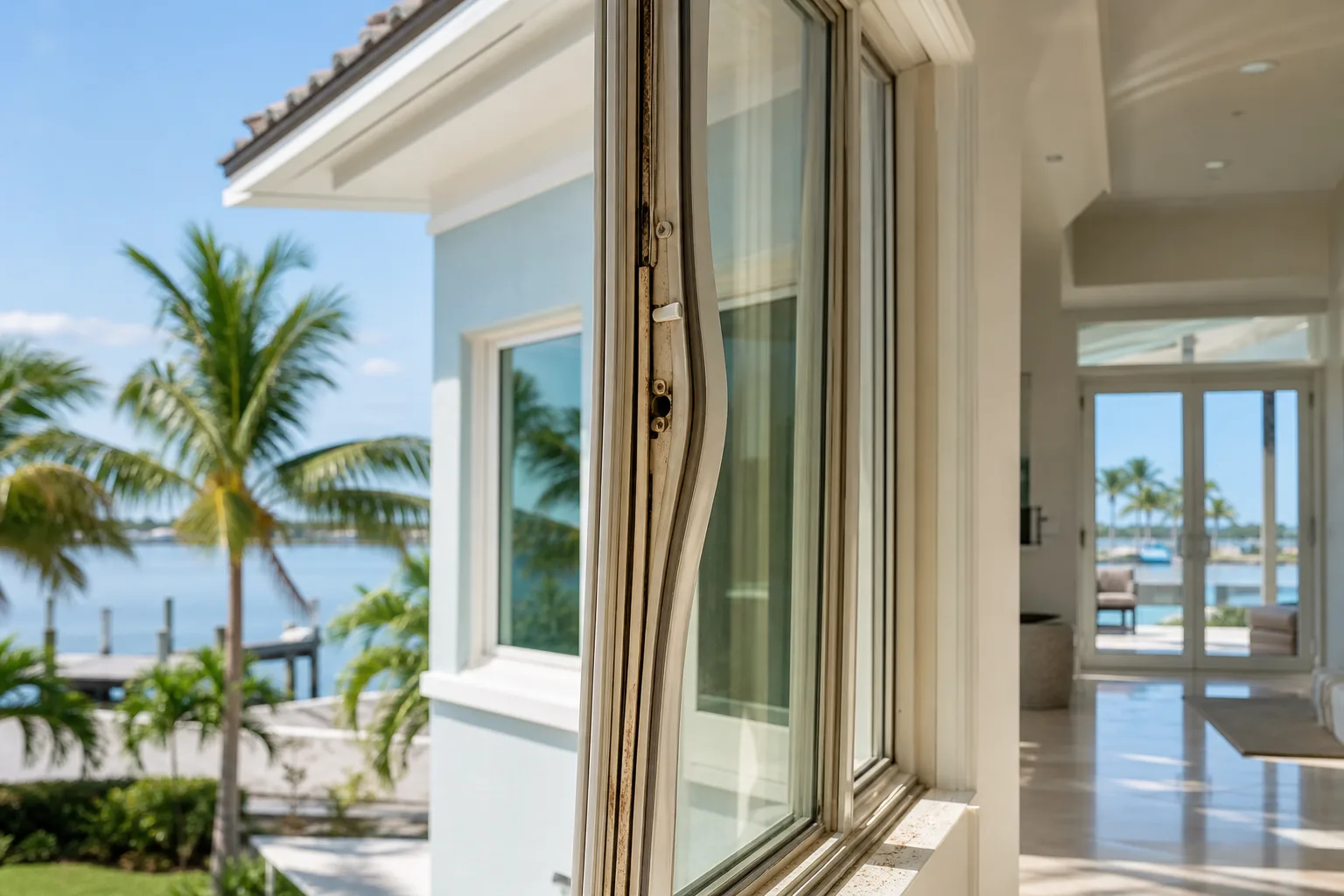
TL;DR
South Florida windows go through constant expansion and contraction from heat, sun, and humidity, and over years that cycling can warp frames, loosen seals, and crack caulking. Older or lower-grade windows are most at risk. Regular inspection and, eventually, replacement with properly rated hurricane impact windows is the practical long-term fix.
Anyone who has lived in Palm Beach, Broward, Miami-Dade, Martin, or St. Lucie County long enough has noticed it: a window that used to close smoothly now sticks in July, or a sliding track that worked fine last year suddenly binds. This isn't random. It's the slow, cumulative effect of heat cycling and humidity on window materials, and it's one of the most overlooked reasons windows fail before homeowners expect them to.
This guide explains what's physically happening inside your window frames, how to check for early warping, and what your realistic options are once damage sets in.
What you need
Before inspecting your own windows, gather a few basic things:
- A flashlight for checking corners and tracks in shaded light
- A basic level or straightedge to check for frame bowing
- A notepad or phone camera to document dates and locations of problems
- Patience to check windows at two different times of day (morning and mid-afternoon), since some warping is temperature-dependent and only visible when the frame is hot
If you rent or if the home is under a homeowners association agreement, also pull any existing permit records or past window installation paperwork. Knowing the age and type of your current windows tells you a lot about how much heat cycling they've already absorbed.
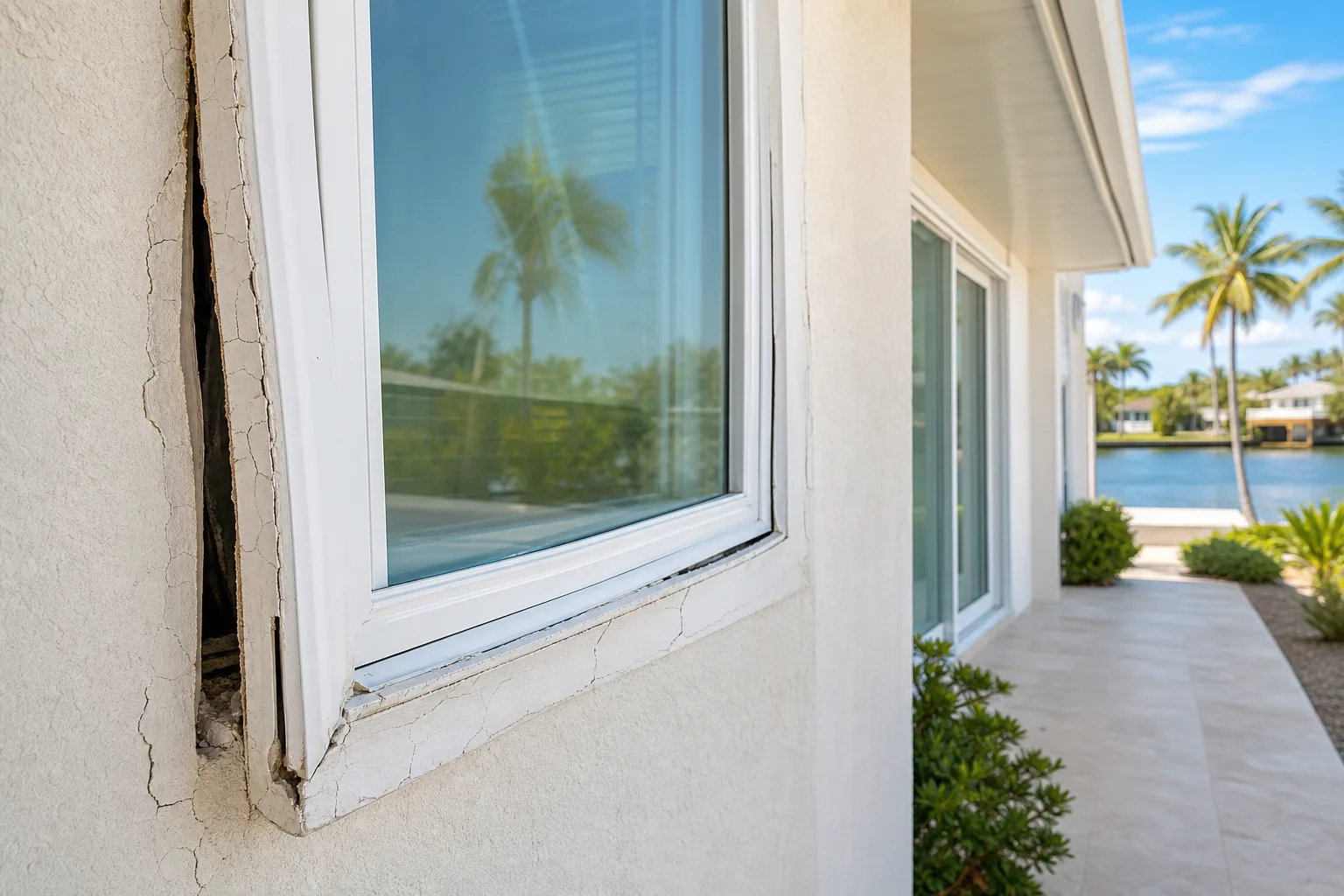
Step 1: Understand why heat cycling happens here
South Florida's climate is unusual in that it combines intense direct sun, high ambient humidity, and daily temperature swings between a cool, damp morning and a hot, dry afternoon surface temperature on window-facing walls. A west-facing or south-facing window frame can go from ambient air temperature in the morning to well above 120 degrees Fahrenheit on the frame surface by mid-afternoon, especially on darker-colored vinyl or aluminum frames.
Materials expand when heated and contract when cooled. Vinyl and aluminum expand and contract at different rates than glass and different rates than the wood or masonry structure around them. Over thousands of cycles across many years, this repeated movement stresses the corner welds, screw points, and sealant joints in a window frame. It's the same physical principle that causes expansion joints in bridges and sidewalks, just happening at a smaller scale in your walls.
Humidity compounds the problem. Florida's air holds a lot of moisture, and that moisture gets absorbed into wood components, gets trapped in aluminum frame cavities, or condenses inside double-pane glass units when seals begin to fail. Wood-composite and some older wood-frame windows are especially vulnerable because they can absorb moisture, swell, then dry and shrink, repeating that cycle with the seasons.aluminum windows generally resist moisture absorption better but conduct heat quickly, meaning they experience more dramatic day to night temperature swings than vinyl or wood.
Step 2: Know which window types and locations are most at risk
Not every window on your house ages the same way. A few patterns are consistent across most homes in this region:
- West and south-facing windows take the most direct afternoon sun and see the widest daily temperature swings, so they tend to show warping and seal failure first.
- Older aluminum-frame windows, especially those installed before Florida's post-Hurricane Andrew building code updates, often lack the thermal breaks and reinforced corners found in modern impact-rated products, making them more prone to visible warping over the decades.
- Wood and wood-composite frames in humid, less-ventilated rooms (bathrooms, laundry areas, garage-adjacent walls) are more susceptible to swelling and rot at the sill.
- Windows near irrigation sprinklers or downspouts experience repeated wetting in addition to heat cycling, which accelerates both corrosion in metal components and rot in wood ones.
If you're unsure how your existing windows compare to current standards, a 5 signs it's time to replace your windows style self-check combined with a professional look can clarify whether you're dealing with cosmetic wear or a structural problem.
Step 3: Inspect your frames for early warping signs
Walk your home's exterior and interior window by window. Look and feel for these specific indicators:
- Uneven gaps. Hold a flashlight along the frame edge where it meets the wall or the sash. Gaps that are wider at the top than the bottom (or vice versa) suggest the frame has begun to bow.
- Sticking or binding sashes. A window that opens fine in the morning but sticks by afternoon is showing you thermal expansion in real time. This is a strong early sign of warping stress, even before it's visually obvious.
- Cracked or pulled-away caulk and sealant. Repeated movement breaks the bond between caulk and frame faster than simple aging does. Look for hairline gaps where caulk has separated from either the frame or the wall surface.
- Condensation between glass panes. In insulated glass units, warped or stressed frames can compromise the edge seal, letting moisture into the airspace. Fogging that doesn't clear is a sign the seal has failed, not just a cleaning issue.
- Visible bowing under a straightedge. Place a level or straightedge against a long section of frame. Any noticeable curve, especially on a frame that used to be flat, indicates the material has permanently deformed rather than just expanded and contracted elastically.
Document what you find with photos and dates. This record is useful both for tracking whether a problem is worsening and for any future insurance or contractor conversations.
Compare impact-window options for your project. Request a free estimate
Step 4: Address early problems before they become structural
If you catch warping early, some issues are manageable without full replacement:
- Re-caulking and re-sealing gaps can buy time on frames that are otherwise structurally sound.
- Adjusting or replacing worn weatherstripping can restore some function to sticking sashes.
- Trimming vegetation and redirecting sprinklers away from window walls reduces added moisture exposure.
- Adding or improving attic and wall ventilation can reduce the extreme surface temperatures that drive the worst of the cycling on west and south walls.
These are maintenance-level fixes. They don't reverse warping that has already occurred in the frame material itself, but they can slow further degradation and address the leaks or drafts that warped frames tend to create.
Step 5: Know when replacement is the realistic answer
Once a frame has visibly bowed, the corner joints have separated, or you're seeing recurring leaks despite re-sealing, you're generally past the point where maintenance alone solves the problem. Warped frames don't self-correct, and continuing to patch them usually means recurring costs without addressing the underlying issue.
This is also the point where many South Florida homeowners choose to move to impact-rated replacement products rather than replacing like-for-like. Modern hurricane impact windows are engineered and tested to Florida Building Code requirements for wind-borne debris regions, and manufacturers generally build them with reinforced frame construction intended to handle the thermal and structural stresses common in this climate. That said, product performance, exact frame material, and warranty terms vary by manufacturer and by the specific line installed, so it's worth reviewing the documentation for any product you're considering rather than assuming all impact windows perform identically over time.
If you're weighing whether to replace individual problem windows or take on a full-home project, the window replacement and windows and doors replacement service pages outline what a typical project scope covers. For homes where both aging windows and doors are showing wear, bundling the work is often more efficient than replacing components separately over several years, though the right approach depends on your home's condition and budget.
Commercial property owners face similar heat cycling issues, often across many more window units. If you manage a commercial building, the commercial page covers considerations specific to larger-scale projects.
Step 6: Get a professional assessment before deciding
Because warping severity varies so much by orientation, age, and material, a visual self-check only gets you so far. A licensed contractor can check corner weld integrity, test for air infiltration, and evaluate whether a frame's structural performance has degraded even if it still looks acceptable from a few feet away.
If you're seeing any of the warning signs above, or simply want a baseline assessment before problems worsen, you can request an estimate or contact us to schedule a walkthrough. An in-person look at your specific windows, their orientation, and their age is the only reliable way to know whether you're looking at a maintenance issue or a replacement decision.
Common mistakes
Assuming all warping is cosmetic. A slightly bowed frame can still be sealing adequately today, but it's a sign of ongoing stress that typically worsens, not a one-time cosmetic flaw.
Re-caulking repeatedly without addressing the cause. If a frame keeps cracking caulk in the same spot every year, the underlying movement hasn't been addressed. Repeated caulking is a temporary patch, not a fix.
Ignoring west and south-facing windows because the rest of the house looks fine. Sun exposure varies dramatically by orientation. A home can have decades-old, perfectly functional north-facing windows while the west-facing ones are already failing.
Assuming humidity only matters indoors. Exterior humidity and moisture exposure, from rain, sprinklers, and coastal air, contribute just as much to frame stress as indoor conditions, particularly for wood and wood-composite units.
Waiting for a visible leak before acting. By the time water is actively coming through, the seal or frame damage has usually been developing for a while. Earlier signs like sticking sashes or uneven gaps are worth acting on sooner.
Comparing all impact windows as interchangeable. Frame material, reinforcement, and warranty coverage differ by manufacturer and product line. What performs well for one home's exposure and orientation may not be the ideal choice for another.
Bottom line
Heat cycling and humidity are constant, low-grade stresses on every window in South Florida, and over years they add up to real structural wear, not just cosmetic aging. Catching early signs, sticking sashes, uneven gaps, failed caulk, condensation between panes, gives you the chance to extend a window's usable life with maintenance. Once a frame has visibly warped or bowed, replacement with a properly rated, well-installed product is generally the more reliable long-term path. Because exact performance depends on the specific product, installation quality, and your home's sun exposure, a professional assessment is the most reliable way to know where your windows currently stand.
Compare impact-window options for your project.
Request a written estimate that identifies the quoted assembly, opening, design pressure, product approval, exposure, installation scope, and applicable project requirements.
Frequently asked questions
How long does it take for heat cycling to warp a window frame in Florida?
It varies widely by material, orientation, and window quality, but visible warping in vulnerable frames, especially older aluminum or wood-composite units on west or south-facing walls, can develop over roughly 10 to 20 years of daily sun and heat exposure. Higher-quality, properly installed windows generally hold up longer, though exact timelines depend on the specific product and site conditions.
Can a warped window frame be repaired instead of replaced?
Minor issues like cracked caulk or worn weatherstripping can often be repaired, which may extend the window's usable life. Once the frame itself has visibly bowed or corner joints have separated, repair typically only addresses symptoms temporarily, and replacement is generally the more reliable long-term solution.
Does humidity alone cause window frames to warp, or does it need heat too?
Both usually contribute together. Humidity causes materials, especially wood and wood-composite, to absorb and release moisture, while heat cycling causes expansion and contraction. The combination of repeated moisture swings and daily temperature extremes is what accelerates warping in Florida's climate compared to drier, more temperature-stable regions.
Are impact windows less likely to warp from heat and humidity than standard windows?
Impact-rated windows built to current Florida Building Code standards are generally engineered with more robust frame construction, but exact performance depends on the specific manufacturer, materials, and installation quality. No window product is entirely immune to long-term thermal and moisture stress, so warranty terms and product documentation are worth reviewing carefully.
How can I tell if my window's fogging is from heat cycling damage or just needs cleaning?
If cleaning the interior and exterior glass surfaces doesn't clear the haze, and the fogging appears between the panes of an insulated glass unit, that typically indicates a failed seal rather than dirt. Seal failure is often related to accumulated frame stress from heat cycling and is not something cleaning can fix.
Should I replace all my windows at once if only a few show warping?
That depends on the age and condition of your other windows, your budget, and how much sun exposure each side of your home gets. Many homeowners in South Florida choose to replace windows in phases starting with the most sun-exposed or visibly damaged units, though a full-home assessment can clarify whether phased or full replacement makes more sense for your situation.