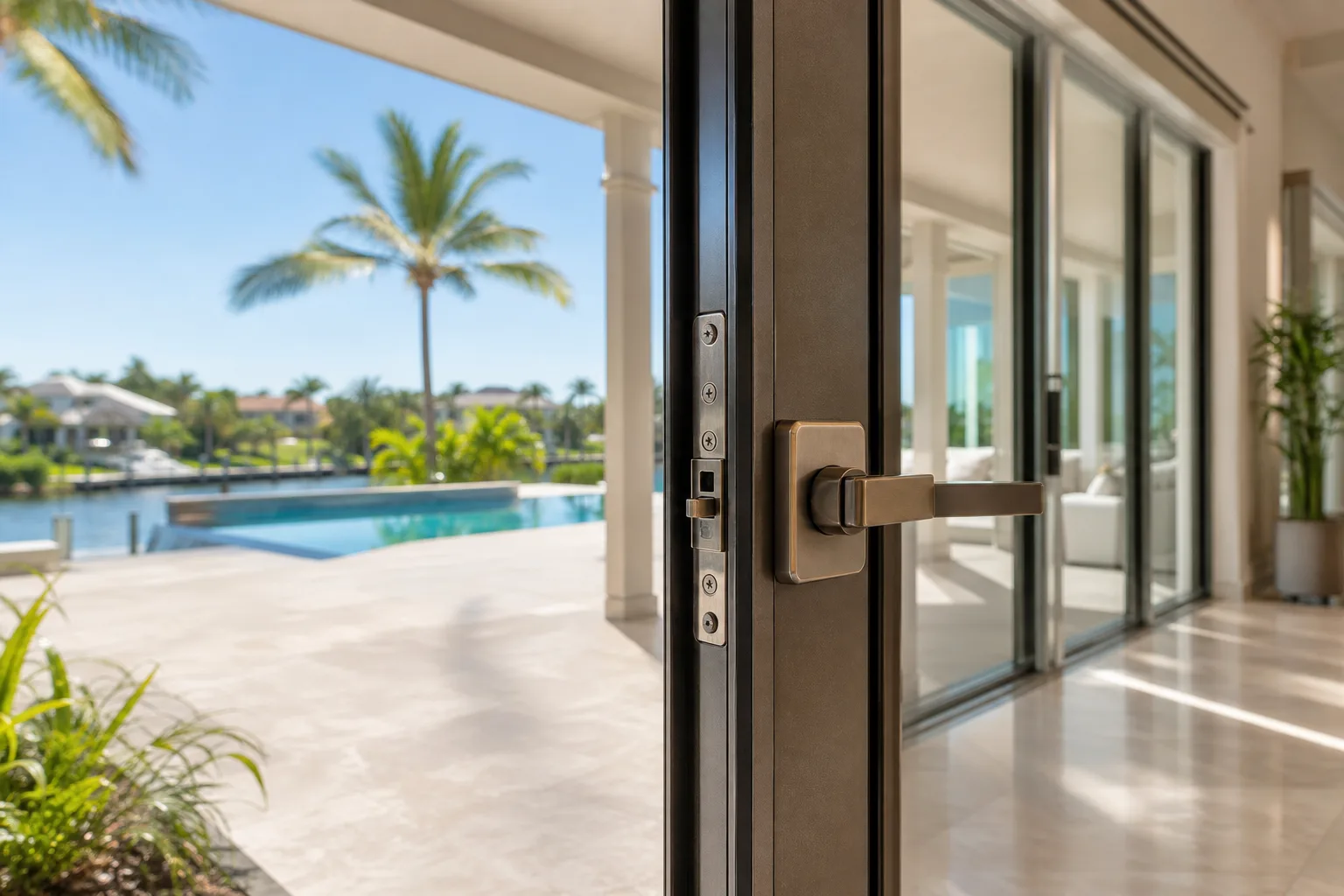
TL;DR: Do not force an impact door lock if the latch will not engage. Start by checking for an obstruction, testing the door position, and looking for visible strike-plate misalignment. If the latch only works when you lift, push, or pull the door, schedule a project-specific inspection because the door, frame, hinges, threshold, hardware, or building opening may need adjustment.
An impact-rated door is a system, not just a slab with stronger glass. Its panel, frame, hardware, anchorage, weatherseals, threshold, and approved installation details must work together. A latch problem can be minor, but repeated forcing or improvised modifications can damage hardware and may affect the door's intended operation.
What you need
For basic, non-invasive troubleshooting, gather:
- A flashlight
- A clean microfiber cloth
- A vacuum with a narrow attachment or a soft brush
- Mild soap and water for surface cleaning
- Painter's tape or a pencil for marking where the latch meets the strike
- A screwdriver only if the hardware manufacturer's instructions permit a simple strike-plate screw check
- The door's manufacturer information, installation paperwork, and any written warranty documents if available
Avoid grinders, drills, chisels, shims, lubricants not approved by the hardware maker, and force. Do not enlarge a strike opening, move a lock body, alter hinges, or modify the frame based on a general online tutorial. Impact door products are tested and approved as specific assemblies. Whether an adjustment or repair is appropriate depends on the exact door, lockset, frame, approval, engineering, condition, and written project scope.
If your door is difficult to secure before a storm, use another safe means of access and contact a qualified service provider promptly. A door that cannot reliably latch should not be treated as storm-ready simply because it contains impact glass.
1. Confirm the exact problem before adjusting anything
First, determine whether the issue is the latch, the deadbolt, or the door's overall alignment.
Close the door gently with the handle in its normal position. Does the spring latch enter the strike but fail to hold? Does it hit the strike plate? Does the latch work only if you push the panel toward the frame, pull it toward you, lift the handle side, or lift the door by the handle? Does the deadbolt also miss its opening?
These observations matter. A spring latch that does not reach the strike may point to panel-to-frame alignment or a loose hinge. A latch that reaches the strike but does not stay caught may involve the strike opening, latch adjustment, debris, or worn hardware. If both latch and deadbolt are off in the same direction, the panel or frame position may have changed relative to the lock jamb.
Test the hardware with the door open. Operate the handle several times and watch the latch extend and retract. It should move freely and return consistently. If it binds even with the door open, do not assume the door alignment is the only issue. The lockset itself may require manufacturer-directed service or replacement.
For multipoint locking doors, follow the manufacturer's operating sequence. Some systems require lifting the handle before turning a key or thumbturn. Do not force the key, handle, or locking points when the panel is not fully seated against the seals.
2. Remove simple obstructions from the latch and threshold area
South Florida doors collect windblown sand, landscaping debris, pet hair, salt residue near the coast, and ordinary household dirt. Even a small obstruction can interfere with a latch or prevent the panel from closing fully against the frame.
Open the door and inspect the latch edge, strike plate, lock jamb, threshold, sill track, and weatherstripping. Use a flashlight to look inside the strike opening. Vacuum or brush away loose debris. Wipe accessible surfaces with a damp cloth and mild soap solution, then dry them.
Do not pack grease into the latch or strike. Lubricants can attract dirt, affect finishes, and may not be compatible with a particular lock mechanism. If the lock manufacturer specifies a product and application method, follow that documentation. When documentation is unavailable, a hardware technician or the original installer can help identify the correct maintenance approach.
Check weatherstripping without pulling it loose. A seal that has slipped, torn, curled, or become displaced can stop the panel from reaching its intended closed position. Seals should not be cut or removed to make a door latch. The proper correction depends on the door system and replacement part.
3. Check whether the latch lines up with the strike plate
With the door open, place a small piece of painter's tape over the strike opening, or lightly mark the latch face with a pencil. Close the door gently until the latch touches the tape or strike area. Open the door and examine the contact point.
A mark above, below, or beside the strike opening indicates a misalignment. For example, a latch contacting the lower edge of the strike may mean the door panel is sitting slightly low. A mark that is too far toward the exterior or interior can indicate that the panel is not closing to the correct depth. This is a diagnostic observation, not a reason to enlarge the opening.
Also inspect the strike plate screws. If a screw is visibly backed out, it can interfere with the latch. Tightening an obviously loose accessible screw may be reasonable if it is a like-for-like fastener in the existing hardware and the manufacturer's instructions allow it. Stop if the screw spins, the plate moves, the fastener is corroded, or the hardware appears damaged.
Do not substitute longer screws, relocate the strike plate, file its opening, or drill new holes without project-specific guidance. The lock jamb and frame construction may contain reinforcement, hardware components, or manufacturer-specific details that should not be altered casually.
4. Test the door position without using force
A useful test is to close the door while applying very light, temporary pressure in different directions. Try gently lifting the handle side of the panel. Then try a light push toward the jamb, followed by a light pull toward the interior. Do not lean your body weight into the door or use tools as leverage.
If the latch works only when you lift the panel, hinges, rollers, pivots, frame alignment, or panel sag may be involved. If it works only when you push firmly toward the jamb, the panel may not be seating properly against the weatherseals or lock jamb. If the latch works only when you pull the panel inward, the condition could be related to closing depth, strike position, hardware adjustment, or the relationship between the panel and frame.
Write down what changes the result. This gives a service technician a more useful starting point than simply reporting that the door will not lock. Include whether the issue affects the latch, deadbolt, multipoint locks, or all of them.
Avoid using the handle as a lifting point. Handles and locksets are not designed to support a door panel's weight, and repeated lifting can worsen hardware damage.
Compare impact-door options for your project. Request a free estimate
5. Inspect hinges, pivots, rollers, and visible fasteners
The components to inspect depend on the door type. A hinged entry door has hinges or pivots. A sliding glass door uses rollers, a track, and an interlock arrangement. French doors and other paired systems may have active and inactive panels, astragals, flush bolts, and multipoint hardware.
For a hinged impact door, look for loose, missing, corroded, or visibly damaged hinge screws. Check whether the gaps around the panel appear noticeably uneven. An uneven top gap, rubbing near the threshold, or a panel that visibly drops when opened can support the need for professional adjustment.
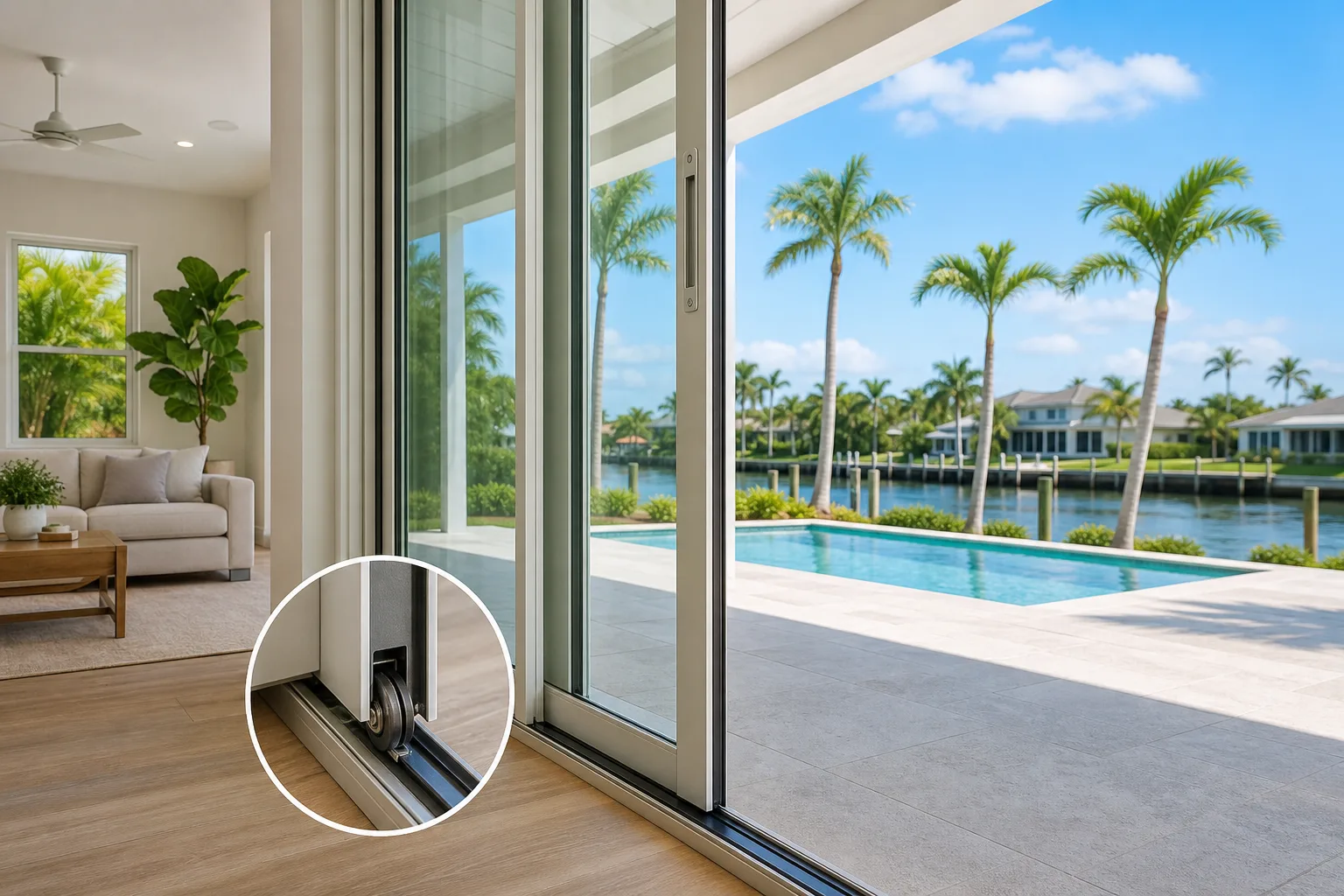
For a sliding impact door, clean only the accessible track surfaces and look for debris that prevents the panel from reaching the closed position. Do not raise or lower roller adjustment screws unless you have the product-specific instructions and understand the door's adjustment procedure. Improper roller adjustment can create poor sealing, difficult operation, panel drag, or inadequate interlock engagement.
For paired doors, verify that the inactive panel is fully secured in its intended position before testing the active panel's latch. If an astragal, flush bolt, or multipoint mechanism is not set correctly, the active panel may not have a stable strike point. Do not force a multipoint mechanism that feels jammed.
If corrosion is present, particularly in coastal areas, document it with photos before attempting repairs. Corrosion can affect fasteners, hinges, hardware finishes, and internal mechanisms. The correct remedy may range from hardware service to replacement parts, depending on the documented condition and product availability.
6. Consider conditions that can change door operation
A latch issue that appears only at certain times can still require attention. Note whether the problem began after a severe storm, pressure washing, construction nearby, a change in flooring, a lock replacement, or repeated exposure to wind-driven rain.
Temperature, direct sun, moisture, building movement, and normal wear can influence how a door operates. However, those possibilities should not be used to guess at a repair. A Florida-licensed contractor or qualified door technician needs to inspect the actual system before identifying a cause, especially if the issue is persistent or affects a door in a high-exposure location.
For doors installed in condominiums, townhomes, or commercial buildings, coordinate with the property manager or association before any work that could affect common elements, exterior finishes, approved products, or permit responsibilities. Larger or shared-building openings can have additional project requirements. Our commercial door and window services page explains the types of projects that often need closer coordination.
7. Know when to stop troubleshooting and request service
Stop homeowner troubleshooting and arrange a professional evaluation if any of the following apply:
- The door will not latch without lifting, pushing, or pulling it.
- The deadbolt or multipoint locking system also fails to engage.
- You see a cracked frame, loose hinges, damaged lock hardware, broken glass, visible corrosion, or displaced weatherstripping.
- The door rubs hard on the threshold, frame, or adjacent panel.
- The latch and strike are significantly misaligned.
- The problem began after a storm, impact, break-in attempt, water intrusion, or construction activity.
- The door is part of a recently installed system and may be within a documented service or warranty process.
- You are preparing for a storm and cannot secure the opening reliably.
For a service request, provide photos of the latch edge, strike plate, hinges or rollers, threshold, and full door opening. Include the brand and model if known, the approximate installation date, whether the problem affects the latch or deadbolt, and the results of the light-pressure test described above.
Window Guys of Florida can review replacement and installation needs for eligible scopes in Palm Beach, Broward, Miami-Dade, Martin, and St. Lucie counties. Use our contact page or request an estimate form to describe the door and the issue. Product approval, engineering, permitting, repair eligibility, insurance, warranty coverage, and installation details must be verified for the exact written project scope.
If the door is beyond practical repair, a replacement should be selected as a complete approved system, not only by appearance. Review hurricane impact doors to understand the broader considerations for impact-rated door assemblies. If multiple openings have operating or aging concerns, windows and doors replacement may provide useful planning context.
Common mistakes
Forcing the handle, key, or deadbolt
Forcing hardware can strip internal components, bend a latch, damage a key, or conceal the original alignment problem. If the mechanism resists, stop and identify whether the panel is fully seated and whether the latch is actually aligned with the strike.
Filing the strike plate or drilling new holes
This may appear to create a quick fix, but it can reduce the latch's engagement or move hardware outside its intended position. It can also complicate later service. A strike modification should be considered only after product-specific inspection.
Using the door handle to lift a sagging panel
A handle is for operating the lockset, not supporting the panel. Repeated lifting can damage the hardware while leaving the underlying hinge, roller, pivot, or frame concern unresolved.
Treating a closing problem as only a lock problem
A lock that misses its strike can be a symptom of door alignment, threshold contact, displaced seals, hinge wear, roller adjustment, or movement in the surrounding opening. The full system should be assessed when basic cleaning does not solve the issue.
Removing weatherstripping to make the door close
Weatherseals contribute to the door's intended water and air management. Removing or trimming them without manufacturer guidance can create new problems and does not address why the door stopped closing correctly.
Assuming every impact door uses the same adjustment method
Door systems vary widely by manufacturer, configuration, material, hardware, and approval. A technique appropriate for one hinged door or slider may be wrong for another. Use the exact product documentation and obtain project-specific service when needed.
Bottom line
When an impact door lock will not latch, begin with safe checks for debris, visible damage, and latch-to-strike alignment. A latch that works only when the door is lifted or pushed is not a condition to ignore, because it can indicate a broader adjustment or hardware issue.
Do not force the door or modify its frame, strike, hinges, rollers, or locks based on a generic fix. Document the symptoms, preserve the product information, and have the specific door system evaluated. A properly operating impact door should close, latch, and lock as intended without excessive pressure or improvised workarounds.
Compare impact-door options for your project.
Review entry, French, and sliding-door assemblies against the exact opening, approval, design pressure, exposure, glass, hardware, and installation scope.
Frequently asked questions
Why does my impact door latch only when I lift it?
If a latch catches only when the panel is lifted, the panel may not be aligned with the strike at its normal resting position. Hinges, pivots, rollers, threshold contact, or frame and panel alignment can contribute. Avoid using the handle to lift the door repeatedly and arrange an inspection for the specific system.
Can I move an impact door strike plate myself?
Do not relocate, enlarge, file, or drill around an impact door strike plate as a general DIY repair. The hardware and frame details vary by manufacturer and door configuration, and an improvised adjustment can reduce latch engagement or create another problem. A qualified technician should determine why the latch and strike are out of alignment.
What should I clean when an impact door will not latch?
Clean loose debris from the latch edge, strike opening, threshold, sill or track, and accessible weatherstripping using a soft brush, vacuum, and mild soap and water. Do not use abrasive tools or unapproved lubricants. If cleaning does not restore normal operation, the door may need an alignment or hardware evaluation.
Is an impact door safe for a storm if the lock does not latch?
A door that cannot reliably latch and lock should not be assumed ready for storm conditions. The condition may affect how the panel seats in the frame and how its hardware operates. Contact a qualified service provider promptly and use another safe access plan until the issue is assessed.
Does a deadbolt problem mean the impact door needs replacement?
Not necessarily. A deadbolt can miss its opening because of alignment, hardware wear, debris, or adjustment needs, but the cause must be inspected on the actual door. Replacement may be considered if components are damaged, unavailable, or the existing system cannot be restored appropriately for the written project scope.