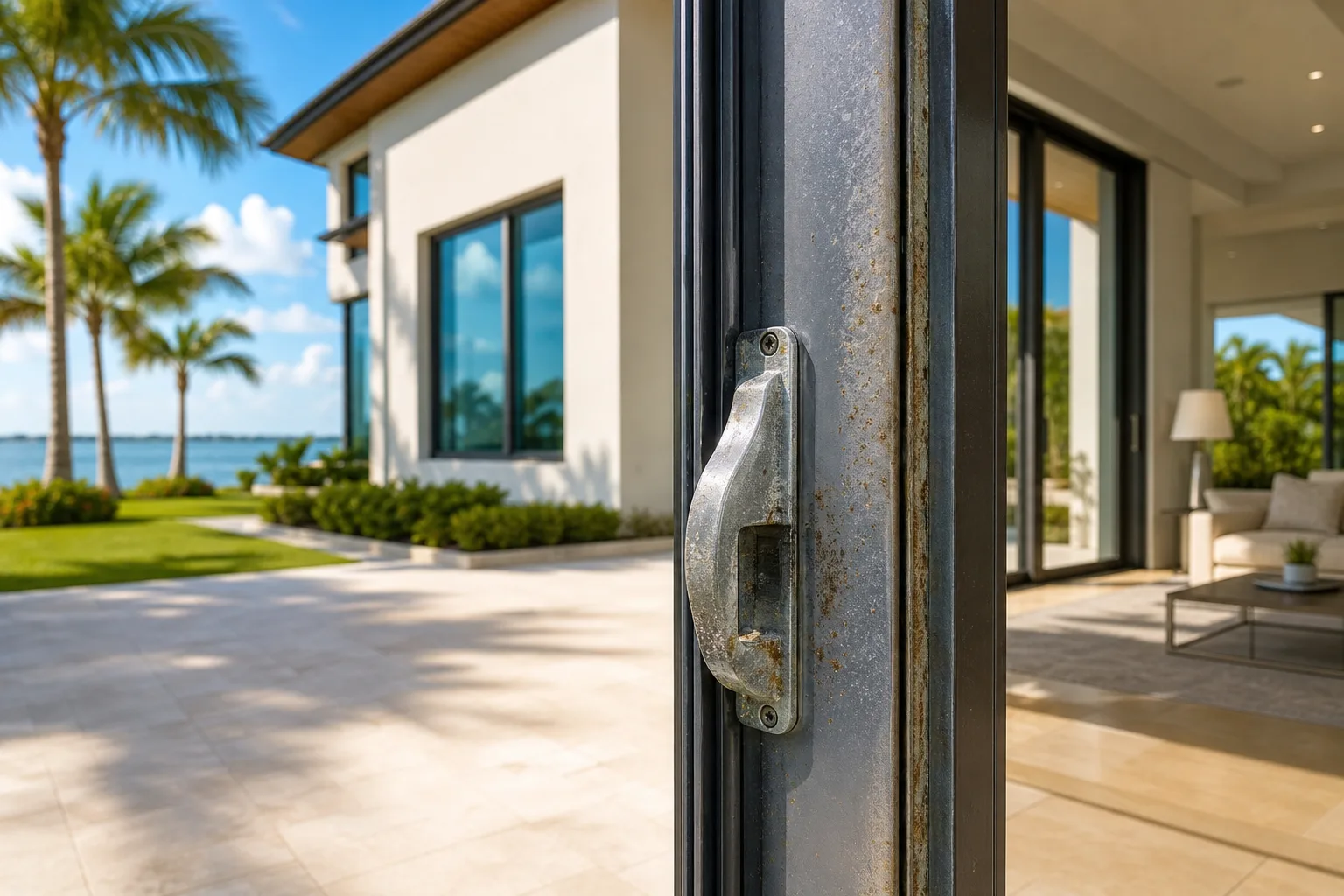
TL;DR: When two dissimilar metals touch in a moist or salty environment, one metal corrodes faster than it would alone. South Florida's humidity and coastal air speed this up significantly. Catching the warning signs early, and specifying compatible metals from the start, is far less costly than replacing corroded hardware or frames mid-project.
What you need
- Access to all operable window and door hardware: hinges, locks, fasteners, and sill anchors
- A flashlight and a non-metallic probe or wooden skewer for poking soft or pitted areas
- A camera or phone to document what you find
- The original window specs or shop drawings, if available, to identify listed metals
- A contractor or glazier familiar with Florida coastal exposure conditions
Step 1: Understand what galvanic corrosion actually is
Galvanic corrosion is an electrochemical reaction. It requires three things at the same time: two metals with different electrode potentials, a physical or electrical connection between them, and an electrolyte, meaning a liquid that can carry ions. In South Florida, that electrolyte is usually condensation, rainwater, or salt-laden humidity.
When these three conditions exist, the metal that is more electrically active (called the anode) gives up electrons to the less active metal (the cathode). The anode corrodes. The cathode is protected, at least temporarily.
The further apart two metals sit on the galvanic series, the more aggressive the reaction. Aluminum and steel are a common pairing in window systems, and they sit far enough apart that aluminum will corrode noticeably when paired with carbon steel fasteners in a wet environment.
Step 2: Know which metal pairings appear in window and door assemblies
Window and door assemblies in Florida homes typically involve several metal types in close contact:
- Aluminum frames are the most common extrusion material in impact window systems.
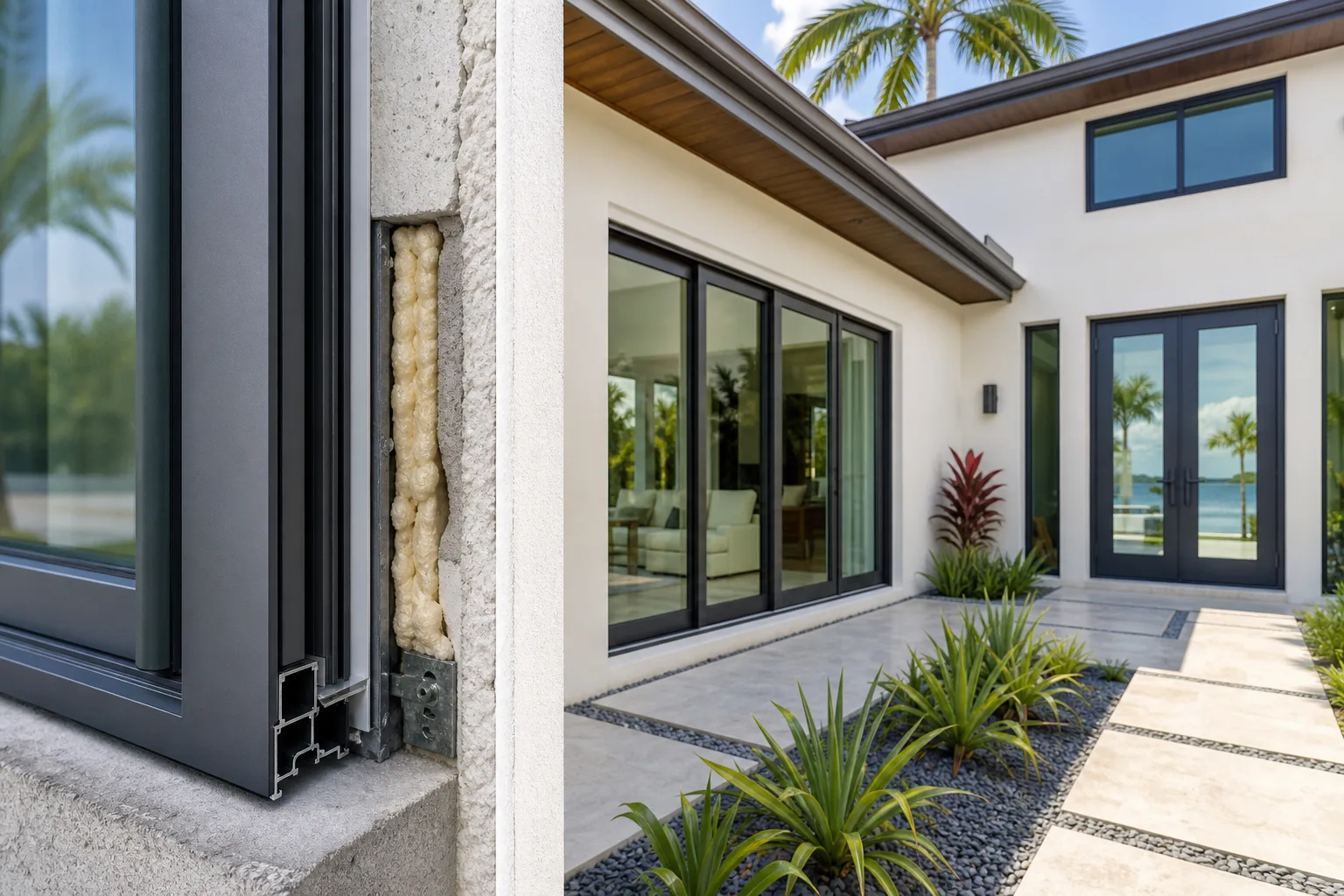
- Steel or zinc-plated fasteners are often used to anchor frames to concrete block or wood bucks.
- Stainless steel hardware appears in hinges, locks, and multi-point locking mechanisms.
- Galvanized steel may be used in anchor clips or subsill components.
- Brass or bronze appears in some lock cylinders and older sliding door hardware.
The risk is highest where aluminum contacts carbon steel or zinc-coated steel without an isolating barrier. Stainless steel and aluminum are closer together on the galvanic series, so their pairing is less aggressive, though not zero risk in direct salt exposure.
If you are reviewing shop drawings before an installation, the 9 details to review before approving window shop drawings post covers the documentation points where material specifications should appear.
Step 3: Inspect the highest-risk locations on your existing windows
Galvanic damage does not always announce itself. Work through these locations in order:
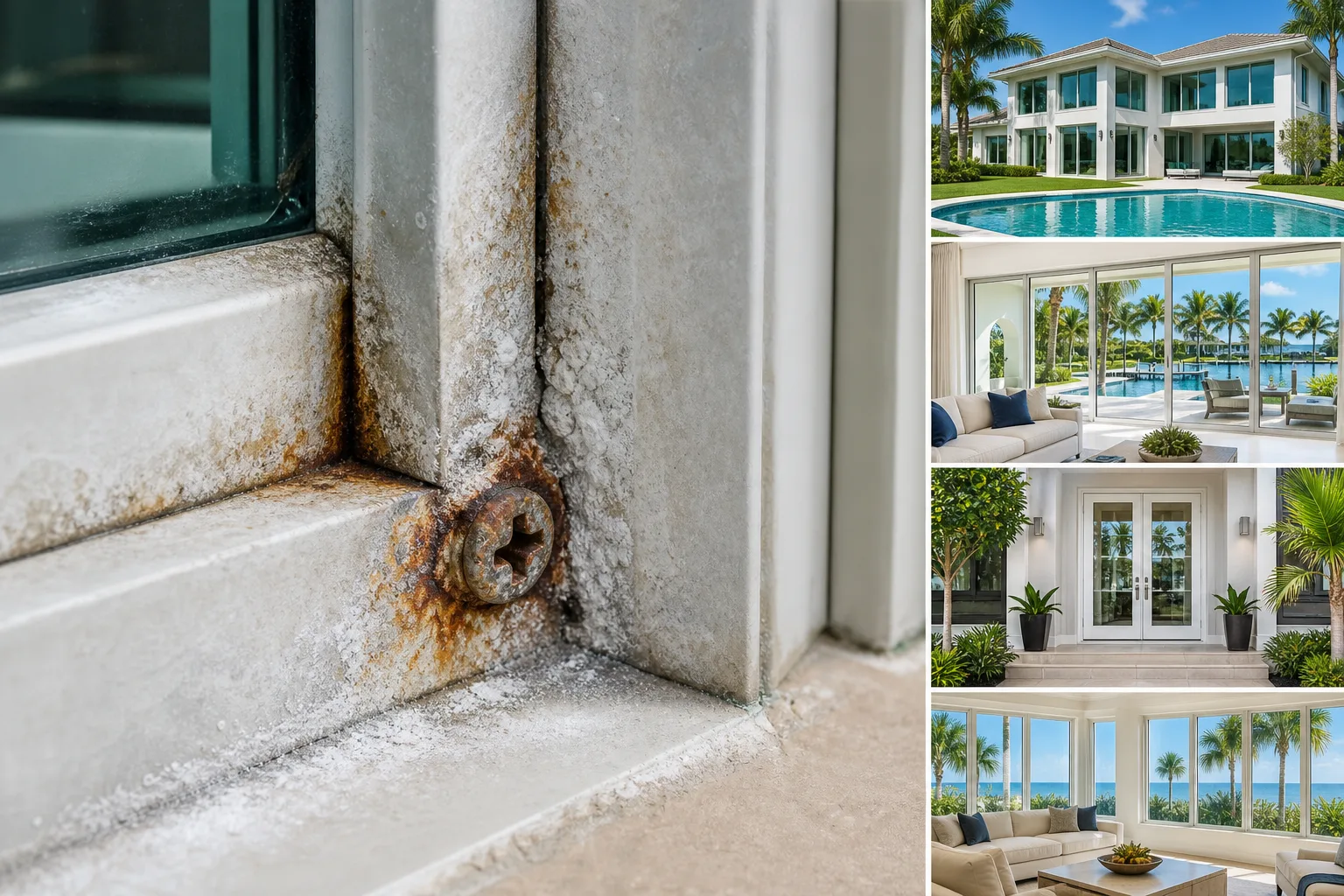
- Anchor fasteners at the frame perimeter. Lift any interior trim or backer rod and look for white or rust-colored staining on the aluminum near the screw heads. White powder on aluminum near a steel fastener is aluminum oxide and is a direct sign of active galvanic loss.
- Hinge pockets and pivot points. Hinges are under mechanical load, which keeps the contact area tight and moist. Look for pitting in the aluminum recess where hinge pins or plates sit.
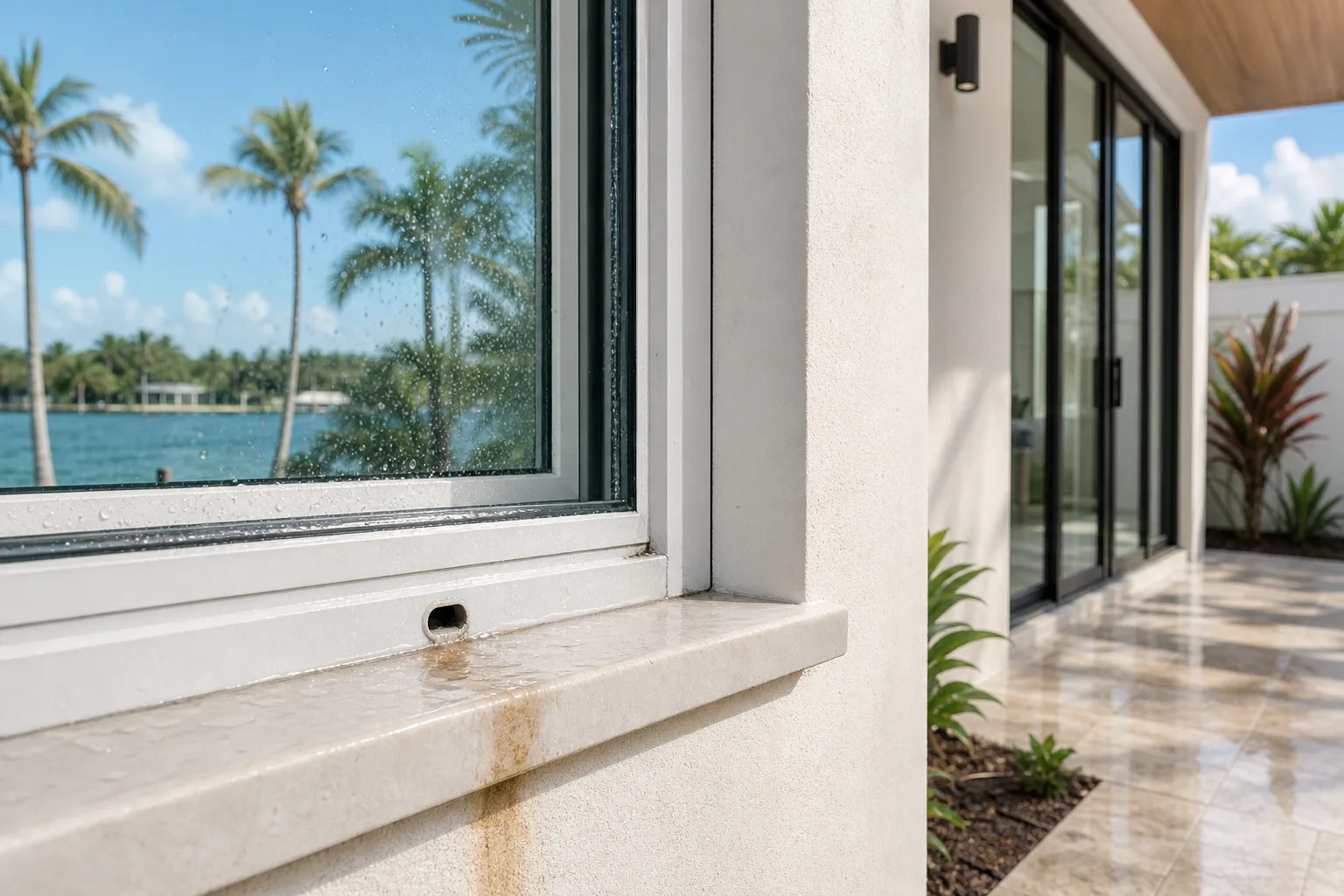
- Sill corners and weep areas. Water pools here before it exits. Any standing moisture at a dissimilar metal joint accelerates the reaction.
- Lock strike plates and keeper hardware. On casement and awning windows, the lock hardware is often a different alloy than the frame. Examine the frame surface directly under steel strike plates.
- Subsill-to-frame contact. On concrete block homes, a galvanized or steel subsill can sit directly against an aluminum frame. This joint, if not isolated with a thermal or non-conductive barrier, is a common initiation point.
If you press a wooden skewer into a corroded area and it sinks, the metal has pitted through. That is structural loss, not just surface oxidation.
Compare impact-window options for your project. Request a free estimate
Step 4: Distinguish surface oxidation from active galvanic loss
Not all white residue on aluminum is galvanic. Aluminum oxidizes on its own in coastal air, forming a thin protective layer. That is normal and self-limiting.
Galvanic corrosion is different:
- It is localized at or near the contact point with another metal.
- It produces a heavier, flakier, often chalky deposit.
- The underlying aluminum may be pitted or etched rather than smooth under the oxide.
- It tends to progress over time rather than stabilize.
Rust staining migrating from a steel fastener onto adjacent aluminum is one of the clearest visual indicators. The aluminum is sacrificing itself to protect the steel.
Step 5: Evaluate whether the damage is cosmetic, functional, or structural
Use this decision table to categorize what you find:
| What you observe | Category | Likely next action |
|---|---|---|
| Light surface chalking on aluminum, no pitting | Cosmetic | Clean, re-inspect annually |
| Moderate pitting near one fastener, hardware still functions | Functional concern | Document, monitor, plan hardware replacement |
| Fastener head corroded and spinning, frame pitted at anchor point | Structural concern | Consult a licensed contractor |
| Frame wall thickness visibly reduced at anchor zone | Structural concern | Do not defer. Frame may not meet wind load path requirements. |
For impact windows, a compromised anchor point is not just a hardware issue. Florida's wind load requirements depend on the full fastener schedule holding. A corroded anchor that has lost section may not transfer load the way the product's Notice of Acceptance requires.
See 5 signs it's time to replace your windows in Florida for other threshold indicators that tip a repair decision toward replacement.
Step 6: Understand what proper installation practice reduces galvanic risk
Metal selection and isolation are addressed at the design and specification stage, not after installation. Practices that reduce galvanic risk include:
- Specifying stainless steel fasteners (typically 304 or 316 grade) rather than zinc-plated carbon steel when anchoring aluminum frames, particularly within a few miles of salt water.
- Installing a non-conductive isolating tape or sealant between dissimilar metal contact surfaces.
- Avoiding direct contact between galvanized steel components and bare aluminum in the sill or subsill assembly.
- Applying a compatible sealant at all fastener penetrations to limit moisture intrusion at the joint.
316-grade stainless is more corrosion-resistant than 304 in direct salt exposure, though it costs more. The tradeoff is relevant for projects close to the Intracoastal or directly on the Atlantic coast in Palm Beach, Broward, or Miami-Dade counties.
If you are evaluating a new installation, the 8 tips to ensure a flawless impact window installation article covers installation quality checkpoints more broadly.
Common mistakes
Assuming anodized aluminum is fully protected. Anodizing increases aluminum's natural oxide layer and improves corrosion resistance, but it does not eliminate galvanic risk at metal-to-metal contact points where the coating is interrupted by a fastener or cut edge.
Using whatever fastener is on the truck. Zinc-plated screws are cheaper and widely available. In a dry interior climate they are adequate for many applications. In South Florida's coastal zones, substituting them for stainless at anchor points is a decision that shows up in corrosion patterns years later.
Sealing over visible corrosion without removing it. Caulking over an actively corroding joint traps moisture and may accelerate rather than slow the reaction. Corroded material should be cleaned or removed before resealing.
Skipping hardware inspection during routine maintenance. Galvanic loss is slow enough that it rarely triggers an obvious event. Homeowners often discover it only when a lock fails or a hinge binds. Annual inspections of operable hardware, especially after hurricane season, catch problems at the functional-concern stage rather than the structural stage.
Assuming all impact window hardware is marine grade. Impact-rated does not mean corrosion-resistant in every component. The laminated glass and frame profile may carry a Miami-Dade or Florida product approval, but the fastener specification and hardware grade used on a specific installation should be confirmed in writing.
Bottom line
Galvanic corrosion between dissimilar metals in window assemblies is a slow, predictable process that South Florida's salt air and humidity push faster than it would progress in a drier climate. The risk is highest at fastener-to-frame interfaces, hinges, and any point where aluminum contacts carbon or galvanized steel without an isolating barrier.
Inspect those locations annually, document what you find, and treat pitting at anchor zones as a structural concern rather than a cosmetic one. The right time to address metal compatibility is at specification and installation. For existing windows showing active galvanic loss at load-bearing anchor points, a licensed contractor can assess whether spot repair is viable or whether the frame section needs replacement.
If you are planning new windows or doors and want to discuss material specifications for your location in South Florida, request an estimate or contact Window Guys of Florida to review the project scope.
Compare impact-window options for your project.
Request a written estimate that identifies the quoted assembly, opening, design pressure, product approval, exposure, installation scope, and applicable project requirements.
Frequently asked questions
Does a Florida product approval address galvanic corrosion in impact windows?
A Florida product approval or Miami-Dade Notice of Acceptance covers the structural performance of the window system under wind and impact loads. It does not certify long-term corrosion resistance of every hardware component or fastener. Metal specifications for the installation itself should be confirmed separately with the installing contractor.
How close to the ocean does a property need to be before galvanic corrosion becomes a serious concern?
There is no single distance threshold, but properties within roughly a mile of salt water, including the Intracoastal Waterway, typically experience accelerated corrosion. Factors like prevailing wind direction, shade, and how often frames are rinsed also affect the rate. A conservative approach uses 316 stainless fasteners and isolating barriers on any coastal South Florida project.
Can galvanic corrosion void a window manufacturer's warranty?
Warranty terms vary by manufacturer, and most exclude damage attributed to improper installation or use of non-specified hardware. If a corrosion failure traces back to incorrect fasteners that were not part of the listed installation method, the manufacturer may decline a warranty claim. Always confirm the fastener specification matches what the product documentation requires.
Is bronze hardware a safer choice than steel for aluminum window frames in coastal areas?
Bronze and aluminum sit closer together on the galvanic series than carbon steel and aluminum, which reduces but does not eliminate galvanic risk. Bronze is a reasonable choice for exposed hardware like locks and handles in coastal conditions. However, the full assembly, including anchors and any subsill components, still needs to be reviewed for metal compatibility.