TL;DR: A single-window replacement can make sense for damage, a failed seal, or a tight budget. A full-house replacement is often more efficient for permitting, insurance premium eligibility, and contractor mobilization. Neither is automatically the better choice. The right answer depends on your specific home, goals, and timeline.
At a Glance
| Factor | Single Window | Whole House |
|---|---|---|
| Upfront cost | Lower | Higher |
| Cost per window | Often higher per unit | Usually lower per unit |
| Permit complexity | One opening, one inspection | One permit covers all openings |
| Insurance premium impact | Varies by carrier and policy | More likely to qualify for opening-protection credits |
| Mobilization cost | Paid once for one window | Spread across all windows |
| Project disruption | Minimal | Significant but concentrated |
| HOA approval | Required per project | One approval covers all |
| Mixing old and new product | Yes, unless planned | No |
When Replacing One Window Is the Right Call
A single replacement makes sense when the reason is isolated: a broken seal, storm damage to one opening, or a failed frame that is letting water in. In those cases, waiting or doing more work than necessary adds cost without benefit.
It also makes sense when budget is a genuine constraint. A staged replacement plan, where you replace windows in sections over time, is a real option. The trade-off is that you pay mobilization and permit costs more than once, and you may carry a mix of old and new products for years.
If you are replacing one window because of damage, verify whether your homeowner's insurance covers the opening. Replacement of a single damaged window may be a covered claim depending on your policy and the cause of loss. That is a separate conversation from energy or hurricane-protection upgrades.
Learn what signs indicate it is time to replace windows before deciding whether one opening or several are actually overdue.
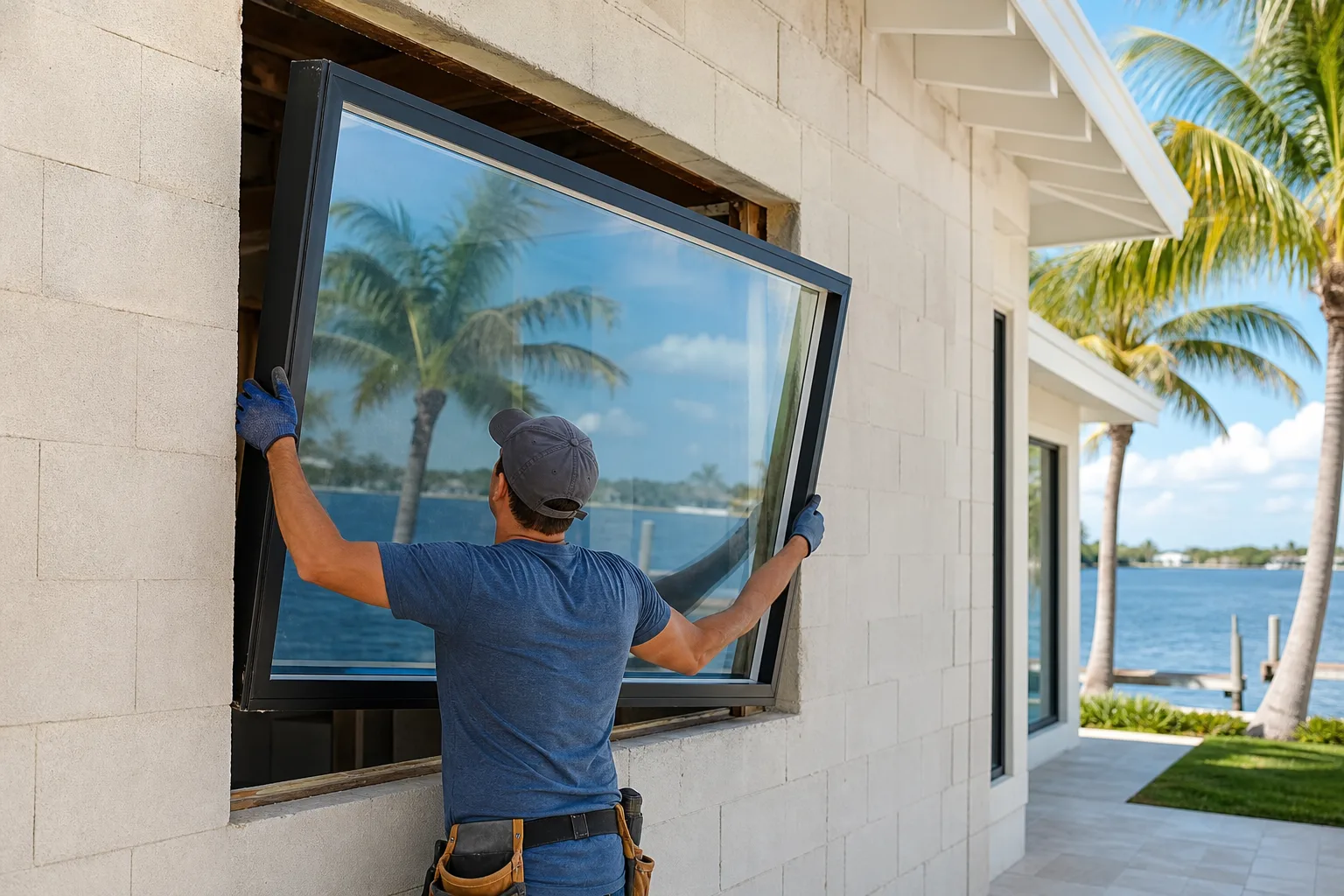
When Whole-House Replacement Makes More Sense
A full replacement in one project typically lowers the cost per window because you are paying for one mobilization, one permit pull, one inspection cycle, and one set of shop drawings. Contractors and product manufacturers can also order all units together, which simplifies logistics.
For insurance purposes, many Florida carriers apply an opening-protection credit when all exterior openings meet a qualifying wind-resistance standard. Replacing only some windows may leave your home ineligible for that credit even if the replaced windows are high-performing. Check your specific policy and ask your insurer what threshold triggers any available credit before making assumptions. Credits are not guaranteed and vary by carrier, policy type, and county.
If your HOA requires design approval for window replacement, doing the whole house at once means one submission, one approval process, and one set of correspondence rather than repeating it each time you replace a section.
A whole-house project also eliminates the visual and functional mismatch that comes from mixing older single-pane or standard-glass windows with newer impact units. Product lines, frame colors, and hardware styles may not match across brands or even across production years within the same brand.
See why South Florida homeowners often choose to replace windows and doors together when addressing the whole building envelope at once.
Compare impact-window options for your project. Request a free estimate
The Permit and Inspection Variable
In Florida, replacing a window, even one, typically requires a permit in most jurisdictions. The permit requires product approvals (Miami-Dade NOA or Florida Product Approval), engineered drawings for the opening, and a final inspection. That process has a base cost and timeline whether you are replacing one window or twenty.
When you replace multiple windows under one permit, those fixed costs are distributed. When you replace windows in stages over several years, you repeat those fixed costs each time. That is not a reason to do everything at once if budget does not allow it, but it is a cost that staged plans should account for.
Review the details worth checking before approving shop drawings so you understand what the permitting process involves regardless of project size.
Financing and Budget Considerations
Some homeowners stage replacements because they are using cash and prefer to avoid financing. Others use a financing option to do the full project at once and avoid repeat permitting and mobilization costs. Neither approach is universally better.
If you are considering financing, approval, terms, and eligibility depend on the lender and your financial profile. No contractor can guarantee financing approval. The question worth asking is whether the long-run cost of staged replacement (repeat permits, higher per-unit cost, mobilization fees) exceeds the financing cost of doing it all at once. That math depends on your specific situation.
The Disruption Trade-Off
A single-window replacement causes minimal disruption. Crew is in and out quickly, one room is affected, and cleanup is contained.
A whole-house replacement is more disruptive but concentrates that disruption into one window. Furniture moves once, dust management happens once, inspectors visit once. Homeowners who have done staged projects often report that repeated small disruptions over years feel more burdensome than one planned project.
That is not a universal rule. If you are in the home with young children, elderly family members, or pets, a room-by-room or section-by-section approach may be more manageable even if it costs more overall.
Verdict
Replace one window when the reason is specific to that opening: damage, failure, or a strict budget that makes staged replacement the only realistic path. Account for the fact that you will pay permit and mobilization costs again on the next stage.
Replace the whole house when you are trying to qualify for insurance credits, eliminate product mismatches, minimize total permit costs, or simply get the project done. The higher upfront cost usually reflects genuine project efficiency rather than upselling.
If you are unsure which approach fits your home, a written estimate that prices both scenarios gives you real numbers to compare rather than general guidance.
Request an estimate for your project to see how the numbers compare for your specific home and goals. If you want to understand the full scope before committing, our window replacement service page outlines what the process involves.
Compare impact-window options for your project.
Request a written estimate that identifies the quoted assembly, opening, design pressure, product approval, exposure, installation scope, and applicable project requirements.
Frequently asked questions
Can I replace just one window with impact glass and leave the others as standard glass?
Yes, there is no rule requiring all windows to be replaced at once. However, your home will have mixed protection levels, and your insurer may not apply an opening-protection credit if all exterior openings do not meet the qualifying standard. Confirm your policy terms with your carrier before assuming partial replacement changes your premium.
Do I need a separate permit for each window I replace in stages?
In most Florida jurisdictions, each replacement project requires its own permit, even if you are replacing a single window. That means repeat permit fees, product approval submissions, and inspections each time you stage a project. The total fixed cost of several small permits often exceeds what you would pay for one permit covering all openings.
Will my HOA require separate approval for each phase if I stage the replacement?
That depends on your HOA's governing documents and how they define a project. Some HOAs treat each permit pull as a separate approval request. Confirming this with your association before committing to a staged plan avoids surprises and delays.
Is it harder to match a new window to an existing frame or product line years later?
It can be. Frame colors, profile dimensions, and hardware styles change across production years, and a product line available today may be discontinued or updated by the time you replace additional windows. This is one reason some homeowners prefer to complete the full project at once rather than risk visible mismatches.