TL;DR: A Miami-Dade NOA is not a brand badge. It is a product-specific test record showing that a particular window or door assembly survived defined impact, pressure, and water tests at an accredited laboratory. The NOA number ties the tested configuration to the approved installation method, so any deviation, such as a different frame depth or anchor spacing, may void the approval.
What Happened
Miami-Dade County developed its product approval system after Hurricane Andrew in 1992 exposed widespread failures in building envelope products. The county created a testing and approval protocol that is widely regarded as one of the most demanding in the United States. A product earns a Notice of Acceptance (NOA) only after passing a defined battery of tests on the exact assembly submitted, including frame, glazing, hardware, and fastener schedule.
The Florida Building Code now incorporates Miami-Dade approval as one accepted path to compliance statewide, which means a valid NOA is relevant well beyond the county line, including Palm Beach, Broward, Martin, and St. Lucie counties.
Why It Matters
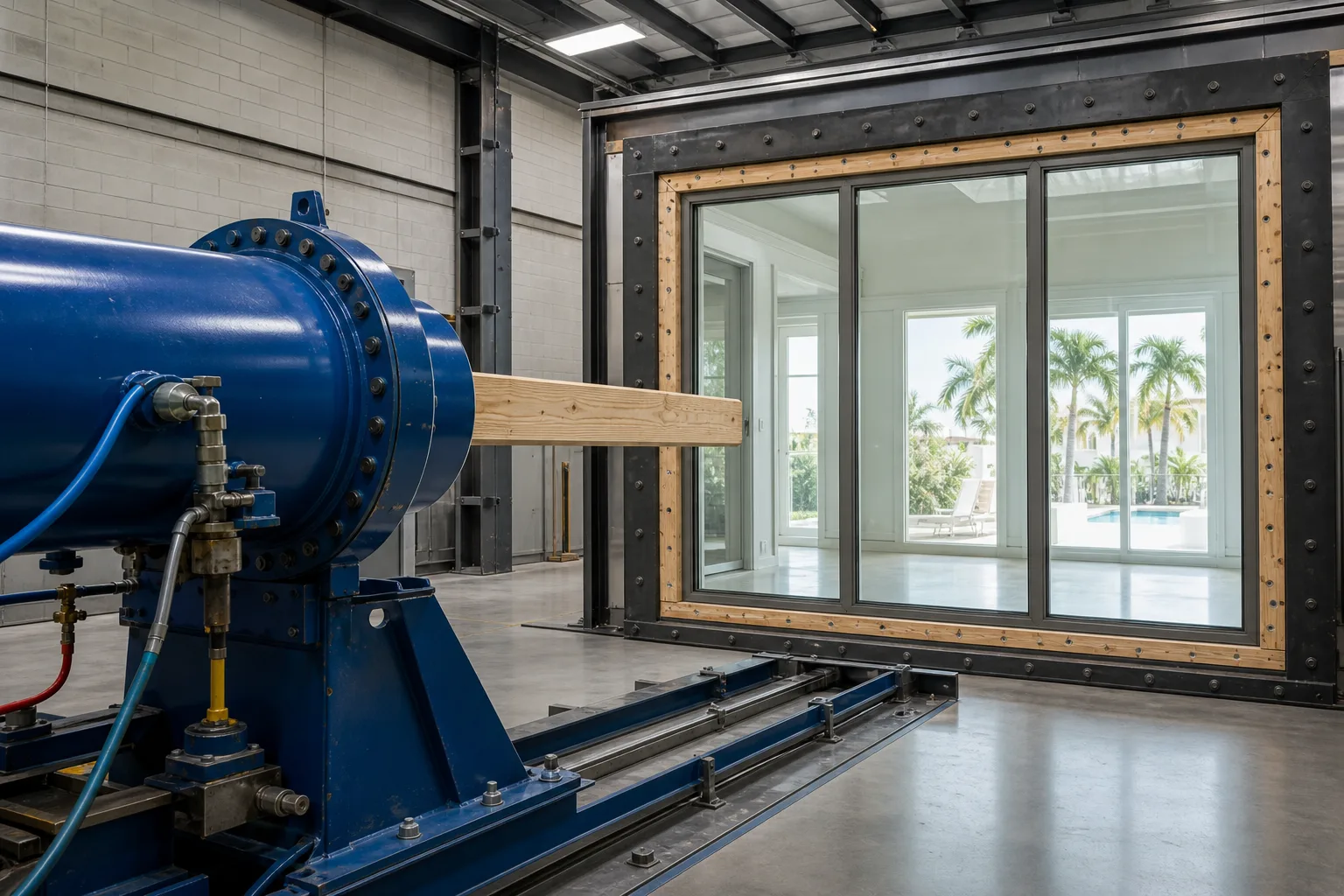
The Large-Missile Impact Test
The most recognized part of NOA testing is the large-missile impact protocol. A 9-pound 2x4 lumber piece is fired at the specimen at a minimum speed of 50 feet per second, targeting corner and field locations. The glass must not allow penetration that would expose building occupants.
This test is what separates impact-rated products from standard laminated or tempered glass. The laminated interlayer holds glass fragments in place after impact, but the frame and anchorage must also absorb the load without the assembly pulling away from the test buck.
Cyclic Wind Pressure Loading
After surviving impact, the same assembly is subjected to positive and negative pressure cycles that simulate the fluctuating loads a window experiences as wind gusts pass. The test applies hundreds of pressure cycles at increasing magnitudes.
This step matters because real hurricane wind is not a steady push. It fluctuates rapidly, fatiguing seals, hardware, and frame corners in ways a single static pressure test would not reveal. A product that passes only static pressure testing may perform differently under cyclic loading.
Uniform Static Air Pressure
Following the cyclic sequence, the assembly is tested at a uniform static design pressure in both positive and negative directions. The design pressure rating stamped on the NOA, expressed in pounds per square foot (psf), comes from this test.
Higher design pressure ratings allow the product to be used in taller buildings or more exposed locations. For a residential project in South Florida, the required design pressure depends on the building height, exposure category, and opening location, all of which are determined during the permit engineering review, not by the homeowner.
Water Infiltration
A water spray test is applied simultaneously with air pressure to verify that the window system does not allow water penetration under conditions simulating wind-driven rain. Failure here means water enters the wall assembly, leading to mold and structural damage over time.
What the NOA Document Actually Contains
An NOA is a public document. Miami-Dade publishes approved NOAs at their product control search portal. Each NOA includes:
- The approved product description, including frame material, glass makeup, and hardware
- The tested configuration dimensions and limits
- The design pressure ratings
- The installation detail drawings showing anchor type, spacing, and edge distances
- The expiration date and any conditions or limitations
If a contractor proposes a product, you can look up the NOA number and verify that the configuration they plan to install matches what was actually tested.
Review opening-protection options before storm season. Request a free estimate
What We Don't Know Yet
The NOA tells you the product passed in a laboratory under controlled conditions. Several project-specific variables are outside its scope:
- Whether the rough opening in your specific wall construction will achieve the anchor pullout values assumed in the installation detail
- Whether the product's tested size range covers your actual opening dimensions
- Whether the design pressure required by your local permit jurisdiction matches or falls within the NOA rating
- Whether any product modifications requested during fabrication, such as divided lites or custom hardware, were included in the tested configuration
These questions require project-specific engineering and permit review. A valid NOA on a product data sheet is a starting point, not a final answer for your installation.
It is also worth noting that NOA ratings are tied to the complete assembly. Substituting a different sealant, anchor, or installation method, even one that seems equivalent, may technically place the installation outside the approved configuration. Review the shop drawings carefully before approval.
What to Do About It
If you are evaluating hurricane impact windows or impact doors for a South Florida home, a few practical steps apply:
- Ask for the NOA number before signing. Any legitimate product proposal should include the NOA number for the specific product and configuration proposed.
- Look it up. Search Miami-Dade's product control database using that number and confirm the product description matches what is being quoted.
- Check the design pressure against your permit requirements. Your contractor or the permitting engineer can tell you the required design pressure for each opening. The product NOA rating must meet or exceed that value.
- Confirm the tested size range covers your openings. NOAs list maximum and sometimes minimum tested dimensions. An opening larger than the tested range may require a separate engineering evaluation or a different product.
- Verify the installation detail will be followed. The anchor schedule, substrate type, and sealant in the NOA drawing should match what your contractor plans to install.
For a licensed contractor review of product approvals and permit documentation in Palm Beach, Broward, Miami-Dade, Martin, or St. Lucie counties, you can request an estimate or contact us directly to discuss your project scope. Product, approval, engineering, and permit details must be verified for the exact written scope of each project.
Review opening-protection options before storm season.
The performance and responsibilities for permits, engineering, documentation, installation, and inspections depend on the exact assembly and written project scope.
Frequently asked questions
Does a Miami-Dade NOA automatically satisfy the Florida Building Code statewide?
A valid Miami-Dade NOA is one accepted path to Florida Building Code compliance and is generally recognized across the state. However, local jurisdictions may have additional requirements, and the product must still meet the specific design pressure and installation conditions required by the permit for your project.
Can the same NOA cover different sizes of the same window model?
NOAs typically list a tested size or a range of sizes for which the approval applies. If your opening dimensions fall outside the tested range, the product may need a separate engineering evaluation or a different product may be required. Always confirm your actual opening dimensions against the NOA size limits before finalizing a product selection.
How do I find a product's NOA number if a contractor hasn't provided it?
Miami-Dade County maintains a public product control search portal where you can search by manufacturer name or product type. A licensed contractor should be able to supply the NOA number for any product they propose, and you can cross-reference it in that database independently.
Does an NOA expire, and what happens if a product's NOA lapses during my project?
NOAs carry expiration dates, and products must be re-evaluated to maintain approval. If an NOA lapses before your permit is closed, it can create compliance questions during inspection. Confirm the NOA expiration date when reviewing product documentation, and flag any potential timing issues with your contractor during the permitting phase.