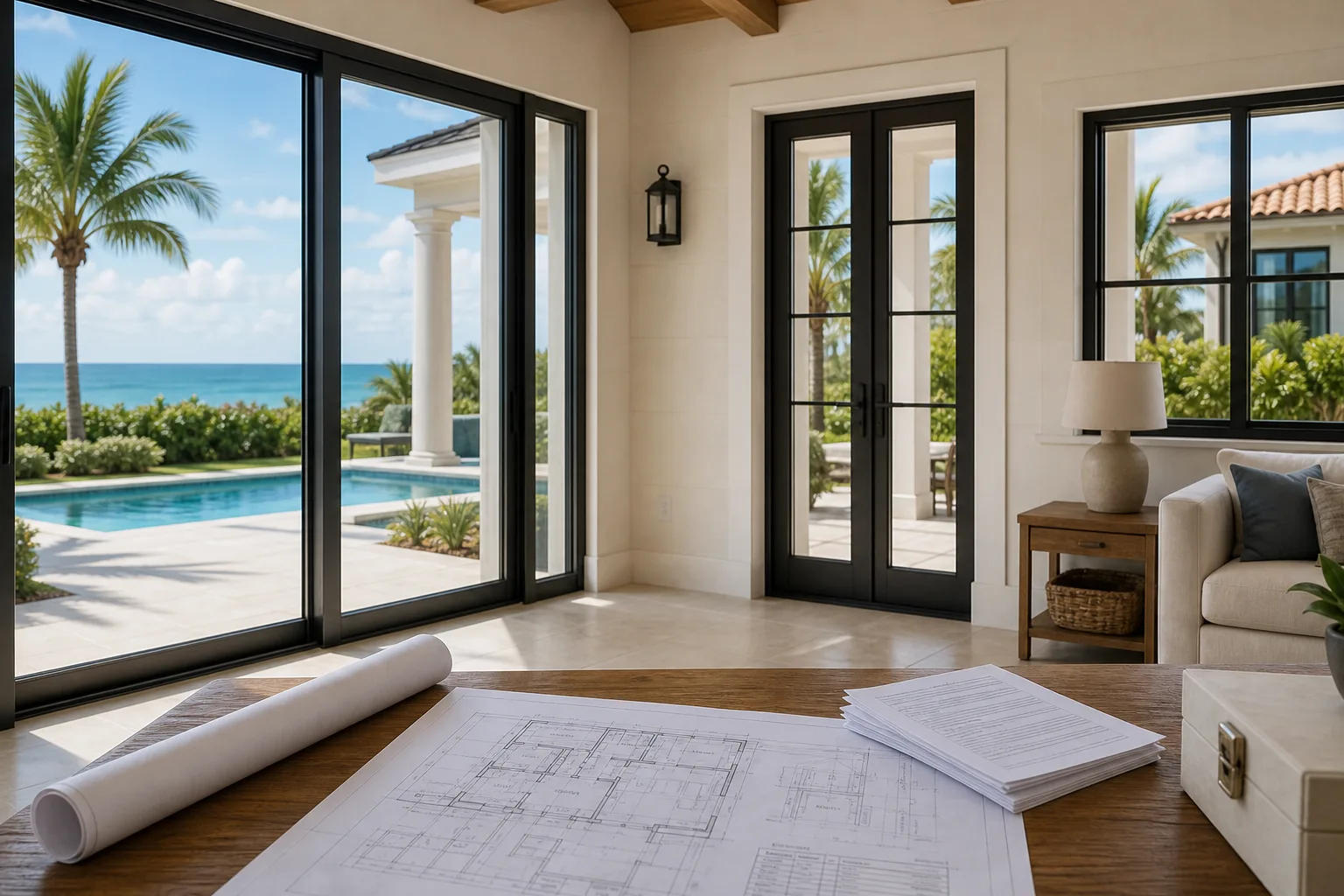
Homeowners in South Florida often assume an impact window permit is just paperwork. In reality, your permit plan set is the roadmap that connects what you bought (the product approval) to what your home actually needs (site-specific pressures) and what the inspector will verify (installation and documentation).
If you are in West Palm Beach, Boca Raton, Delray Beach, Boynton Beach, Jupiter, Wellington, Lake Worth Beach, Palm Beach Gardens, Fort Lauderdale, Hollywood, Pembroke Pines, Miramar, Davie, Plantation, Coral Springs, or Pompano Beach, this guide will help you read permit plan sheets with confidence and avoid the most common plan review comments and inspection failures.
Window Guys of Florida is licensed and insured, with 25+ years of experience, and we install code-compliant impact windows and doors across Palm Beach County and Broward County using top brands like PGT, CGI, ES Windows, and Andersen. If you want help interpreting your plans or preparing a clean permit submittal, schedule a free consultation here: Contact/Free Quote.
Why permit plans matter in Palm Beach and Broward
Impact windows are regulated by the Florida Building Code (FBC). Both Palm Beach County and Broward County require documentation that answers three core questions:
- Is the product legally approved for use in Florida? (Florida Product Approval or Miami-Dade NOA)
- Does the specific configuration meet your home’s site-specific design pressures? (positive and negative pressures for each opening)
- Will it be installed exactly as the approval requires? (fasteners, embedment, anchors, bucking, shims, sealants, and perimeter conditions)
Plans that fail to tie these together can trigger plan review rejections, change orders, delays with HOAs or condo boards, and inspection failures.
For a broader view of what inspectors commonly fail, see: Permit-to-Pass Checklist for Impact Window Inspections.
Quick glossary: the documents you will see in a permit set
FBC Product Approval (Florida Product Approval)
Florida’s statewide approval system for building products, managed through the Florida Building Commission. A compliant impact window or door will have a Florida Product Approval number and supporting evaluation reports.
Miami-Dade NOA (Notice of Acceptance)
A county-based approval issued by Miami-Dade. Many impact products sold in Palm Beach and Broward carry both a Miami-Dade NOA and Florida Product Approval.
Site-specific design pressures
Calculated wind pressures that apply to your building at your address, factoring in wind speed, exposure, height, zone, opening size, and geometry. This is where many permit packages fall apart.
If you want a deeper primer on DP and what it actually means for homes and condos, read: DP Ratings Explained for Impact Windows in South FL.
Window schedule (impact window schedule)
A table that lists every opening and its required performance, typically including:
- Mark or ID (W1, W2, D1, etc.)
- Location (room, elevation, or grid)
- Rough opening (RO) size
- Product type (single hung, horizontal roller, casement, fixed, SGD)
- Glass type and thickness
- Required pressures (+/-)
- Mullions or combination units
- Reference to product approval and the specific tested configuration
This is often the most important page for plan review.
Palm Beach County impact window permit plans: what is typically required
Palm Beach County submittals vary by municipality (for example, West Palm Beach vs Palm Beach Gardens vs Boca Raton). Still, most plan review packages include:
- Permit application and contractor license/insurance
- Scope of work and elevation references
- Window and door schedule showing each opening and pressures
- Engineer letter or signed/sealed calculations when needed (especially for condos, high-rises, or unusual openings)
- Product approvals (Florida Product Approval and/or Miami-Dade NOA)
- Installation details matching the approvals (fastener type, spacing, embedment)
In coastal zones and higher exposure areas near the Intracoastal, the pressure requirements and water intrusion expectations can increase. Water management is not just a comfort issue in South Florida, it is an inspection and liability issue. Related reading: Stop Rain Bomb Leaks Around Impact Windows in FL.
Broward County impact window permit requirements: what changes
Broward County and Broward cities (Fort Lauderdale, Hollywood, Pembroke Pines, Miramar, Davie, Plantation, Sunrise, Coral Springs, Pompano Beach) tend to be very detail-driven during plan review.
What often gets extra scrutiny in Broward:
- Clear identification of design pressures per opening
- Confirming that the selected product approval options match the project (masonry vs wood frame, buck type, fasteners)
- Mullions and combinations, including engineered mullions
- For condos: board requirements, uniform appearance, and glazing specs
If you are navigating approvals in a condo or HOA setting, these are useful:
- HOA and Condo Board Approval for Impact Windows
- HOA and Condo Approval Checklist for Impact Windows
- HOA Approval for Impact Windows: PBC vs Broward
Florida product approval vs Miami-Dade NOA: how to compare them on plans
What inspectors and plan reviewers want to see
In both counties, the reviewer is not impressed by a 200-page NOA packet dropped into the permit upload without context. They want:
- The approval number(s)
- The exact product series and model referenced on your schedule
- The exact configuration selected (size limits, glass, interlayer, frame options)
- The exact installation method selected (substrate, fasteners, spacing, embedment)
Common misunderstandings
Misunderstanding 1: “If it has a Miami-Dade NOA it automatically passes everywhere.”
Not necessarily. A Miami-Dade NOA is a strong indicator of testing and acceptance, but your permit still needs to show the product is installed per the approval and meets your site pressures.
Misunderstanding 2: “Florida Product Approval is optional if you have an NOA.”
In many cases, the product has both. Some jurisdictions prefer seeing the Florida Product Approval because it aligns directly with the statewide system. The safest approach is to include both when available, then clearly mark the chosen options.
Misunderstanding 3: “DP on a brochure equals code compliance.”
Marketing DP claims are not a permit document. Plans must reference the approved, tested configuration and match it to the calculated design pressures.
For how impact testing ties into approvals, see: Impact Windows vs Debris: Large-Missile Test Explained.
Site-specific design pressures for windows: how to read them and where they come from
Your plans may list pressures as something like:
- +55 / -65 psf
- +60 / -75 psf
Positive vs negative pressure in plain English
- Positive pressure pushes inward on the window.
- Negative pressure pulls outward, often controlling in corners and upper areas.
Negative pressures are frequently higher in magnitude (more demanding). This is one reason corner openings, second-story openings, and wide units often trigger upgrades.
Related concept: interior pressure changes. If you want to understand why intact glazing matters beyond “not breaking,” read: Do Impact Windows Reduce Hurricane Interior Pressure?.
The inputs behind engineered pressures in PBC and Broward
An engineer or code-based software calculation typically considers:
- Ultimate wind speed per FBC wind maps
- Exposure category (B, C, or D)
- Mean roof height, building height, and roof type
- Internal pressure condition (enclosed vs partially enclosed)
- Opening size and tributary area
- Zone effects (corners vs edges vs field)
Wind-Borne Debris (WBD) zones and why they change the conversation
If your property is in a Wind-Borne Debris region, impact protection is required for glazing and certain doors. In Palm Beach and Broward, WBD mapping can differ by location, distance to coastline, and local interpretation.
For a focused guide, see: Palm Beach vs Broward WBD Zones: Impact Window Guide.
How to read an impact window schedule (and catch issues before plan review does)
A strong window schedule acts like a crosswalk between the engineer’s pressures and the manufacturer’s approval.
What “good” looks like
A complete schedule typically includes:
- Opening ID (W1, W2, etc.)
- Floor and elevation (North, South, etc.)
- RO width and height (or unit size)
- Type (SH, XO, OX, casement, fixed, SGD)
- Required design pressure (+/-)
- Selected product line (for example, PGT, CGI, ES, Andersen impact-rated series)
- Reference approval numbers
- Notes for mullions, transoms, and combinations
Red flags that cause rejections or change orders
Red flag 1: One pressure listed for the whole house
Corners and upper floors often require higher negative pressures. If every opening is listed as the same +/- value, reviewers may request clarification.
Red flag 2: Pressures listed, but no link to an approved configuration
Plans must show that the specific window type and size meets or exceeds the required pressures in the approved tables.
Red flag 3: Missing mullion engineering
If two windows are mulled together, you need to prove the mullion meets pressure and is approved as installed.
Red flag 4: No installation method selected in the approval packet
Approvals often include multiple anchor options. Plans should clearly identify which option is used.
For guidance on choosing replacement method that affects anchoring and inspection, see:
- Retrofit vs Full-Frame Impact Windows in PBC & Broward
- Retrofit vs Full Frame Impact Windows in South Florida
NOA and Product Approval packets: the “highlighting” step that makes or breaks a permit
Plan reviewers commonly require the contractor or applicant to:
- Circle or highlight the exact model
- Mark the glass option
- Mark the installation detail (substrate and fasteners)
- Mark the maximum approved size and DP for that configuration
If you submit the entire packet without identifying the chosen option, the reviewer may respond with a comment such as: “Provide selected option from product approval and installation method.”
What inspectors actually look for: an impact window inspection checklist Florida homeowners can understand
Inspection expectations can vary by municipality and inspector, but these are consistent themes across Palm Beach County and Broward County.
Documentation on site
Inspectors often ask for:
- Permit card and approved plans
- Product approval/NOA documents (or confirmation they match approved plans)
- Job address matching labels or paperwork
Opening prep and measurement checks
They may verify:
- Correct opening matches schedule location and type
- Proper rough opening prep for chosen install method
- No unapproved field modifications
Fasteners and anchorage
This is where most technical failures occur. Inspectors commonly check:
- Fastener type (Tapcons, screws, anchors) matches approval
- Correct diameter and length
- Spacing pattern (edge distance and on-center spacing)
- Embedment depth into the substrate
- Substrate condition (sound concrete block, solid framing)
Bucks, fins, and attachment conditions
If your approval calls for a specific buck material and thickness, inspectors may verify it. Condo retrofits and older homes in Lake Worth Beach, Lantana, Deerfield Beach, and older Fort Lauderdale neighborhoods often have conditions that require careful detailing.
Sealants, flashing, and water management
In South Florida, wind-driven rain is real, especially during fast-moving squalls and outer bands.
Inspectors may look for:
- Proper perimeter sealant application
- Compatibility with substrate and window materials
- Any required flashing or waterproofing steps per approval or best practice
Related reading: Stop Rain Bomb Leaks Around Impact Windows in FL.
Labels and glazing verification
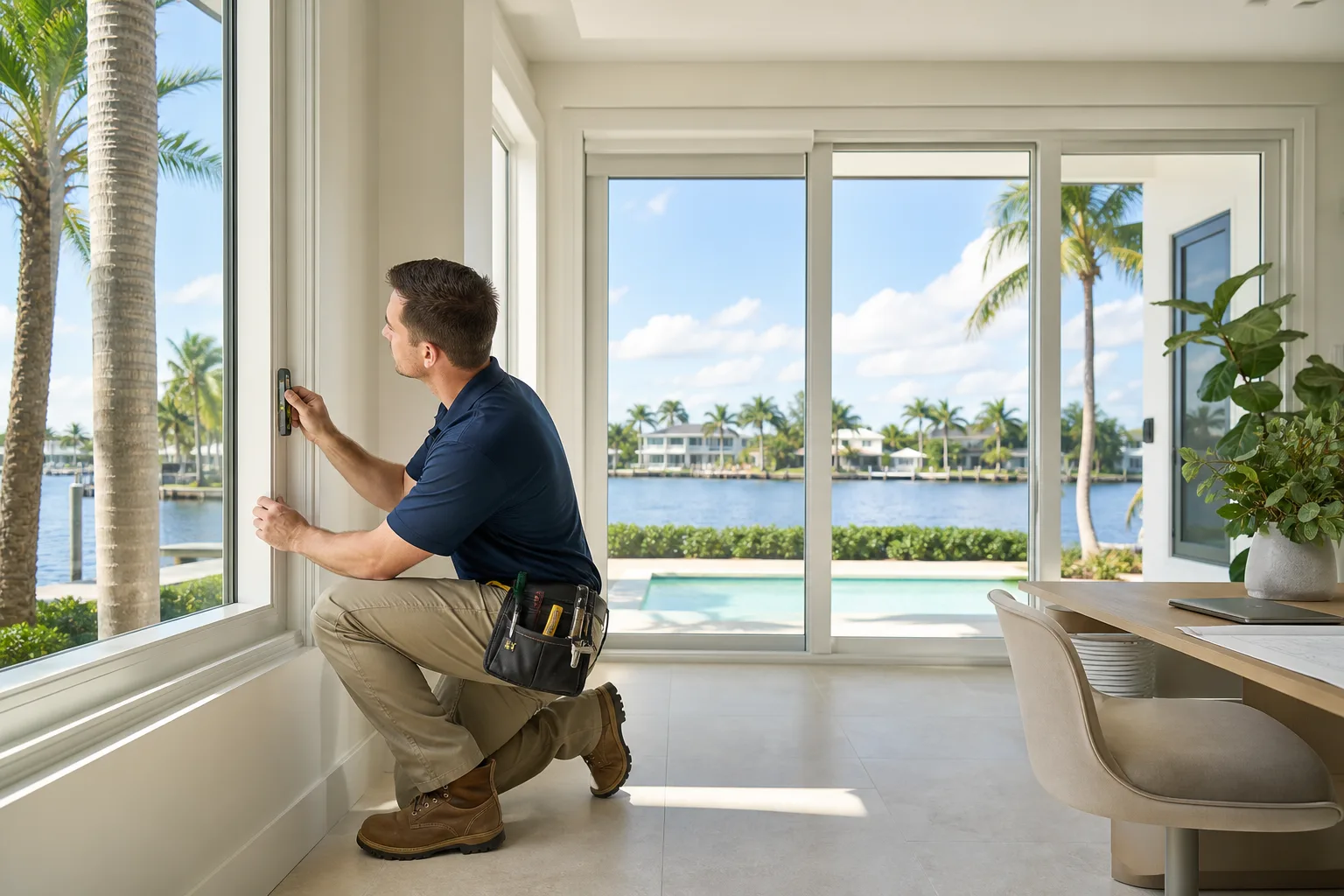
Some products have labels, etch marks, or paperwork that ties the installed unit to the approved system. Inspectors may confirm the units installed are the units permitted.
For a detailed rundown of common inspection failure points and how to avoid them, see: Permit-to-Pass Checklist for Impact Window Inspections.
Practical workflow: how we recommend homeowners review their permit plan set
Use this order and you will catch most problems early.
Step 1: Find the window schedule and count openings
- Does the schedule list every window and door being replaced?
- Are sliding glass doors and garage side doors included if part of scope?
If you are also planning doors, start here: Impact Doors.
Step 2: Confirm pressures are site-specific
- Do pressures vary by elevation, floor, or zone where expected?
- Does the plan reference an engineer or calculation method?
Step 3: Match each opening to a tested configuration
For each line item:
- Window type matches approval tables
- Size is within max limits
- Required DP is met or exceeded for both + and -
Step 4: Verify installation detail matches your wall type
Block homes in Boca Raton or Delray Beach, CBS condos in Fort Lauderdale, and wood-frame sections in older neighborhoods can require different anchoring methods.
If you are unsure whether you are doing retrofit or full-frame and how that affects compliance, see: Hurricane Window Installation Guide for Florida Homes.
Step 5: Make sure the permit set includes what the inspector needs
If it is not in the approved plan set, it can become an inspection issue later.
Common plan-review comments in Palm Beach and Broward (and what they mean)
“Provide site-specific design pressures for each opening.”
Your submittal likely used a generic DP claim or did not break pressures out by opening.
“Submit product approvals and select applicable options.”
You uploaded the approval packet but did not identify the specific model, glass, and anchor method.
“Window schedule does not match product approval.”
A common issue when a schedule lists one series, but the approval is for another, or the unit type differs (for example, casement listed but single hung approval submitted).
“Provide mullion calculations or approvals.”
Mulled assemblies must be proven, not assumed.
Data points homeowners should know (and how they relate to plans)
- Florida is consistently among the most hurricane-exposed states in the US, and South Florida counties frequently experience tropical storm and hurricane wind events that drive the strict opening protection rules in the FBC.
- Wind pressure is not a single number. Corners and higher elevations can see significantly higher negative pressures, which is why engineered, site-specific pressures matter more than a generic “rated for hurricanes” claim.
For storm readiness planning beyond windows, see: Storm Damage Prevention Tips for Florida Homes and 2026 Hurricane Season Forecast for South Florida Homes.
How permits connect to insurance and resale documentation
Clean permits and final inspections matter for:
- Insurance documentation and discounts
- Resale disclosures and buyer confidence
- Avoiding future disputes about unpermitted work
For the paperwork most carriers ask for, read: Impact Windows for Insurance Discounts in South FL and Florida Insurance Requirements 2026: Homeowners Guide.
When to call a pro: the fastest way to avoid permit delays
If your project includes any of the following, it is smart to involve a contractor who does this daily and can coordinate with engineering when needed:
- Large openings, multiple mulled units, or unusual shapes
- Second-story exposure or corner glass walls
- Condo projects with strict uniformity rules
- Mixed substrates (CBS plus frame sections)
- Coastal conditions near the Intracoastal, beaches, or high-wind exposure areas
Window Guys of Florida can review your schedule, approvals, and pressures and help align the permit set with real-world installation details. We serve Palm Beach County and Broward County. Start here: Service Areas and About Us.
Book a free permit-plan review and impact window consultation
If you want a clean, inspector-friendly permit package and a code-compliant install using proven brands like PGT, CGI, ES Windows, and Andersen, request a free consultation.
- Impact windows: Hurricane Impact Windows
- Impact doors: Hurricane Impact Doors
- Get pricing and next steps: Contact/Free Quote
FAQ: Palm Beach and Broward impact window permit plans
What is the difference between Florida Product Approval and Miami-Dade NOA?
Florida Product Approval is the statewide approval system recognized across Florida, while a Miami-Dade NOA is a county-issued acceptance based on testing and evaluation. Many impact windows used in Palm Beach and Broward have both. The key is matching the exact approved configuration and installation method to your site pressures.
Do I need site-specific design pressures, or can I use the window’s DP rating from a brochure?
Permits typically require site-specific design pressures, especially in Palm Beach County and Broward County. A brochure DP rating is not enough by itself. Your plans should show the required pressures for each opening and prove the selected tested configuration meets or exceeds them. See: DP Ratings Explained for Impact Windows in South FL.
What is a window schedule for impact windows, and why do reviewers care so much?
A window schedule is the table that lists each opening, size, type, required pressures, and the product approval reference. Plan reviewers use it to confirm every opening is covered, pressures are adequate, and the approval packet actually matches what is being installed.
Why do permit reviewers ask me to “select” options in the approval packet?
NOA and Product Approval documents include multiple variations, such as different fasteners, buck types, and glass options. Reviewers need you to clearly indicate which option applies, otherwise they cannot verify compliance.
What do inspectors look for during an impact window inspection in Florida?
Inspectors typically verify the work matches the approved plans and approvals, especially anchorage, fastener type and spacing, embedment, buck conditions, and perimeter sealing. For a detailed list of common failure points, see: Permit-to-Pass Checklist for Impact Window Inspections.
Can Window Guys of Florida help review my permit plans before I submit?
Yes. We can review your Palm Beach County impact window permit plans or Broward County impact window permit requirements, confirm approvals and site pressures align, and help you avoid delays. Request a free consultation here: Contact/Free Quote.
Frequently Asked Questions
What is the difference between Florida Product Approval and Miami-Dade NOA?
Florida Product Approval is the statewide approval system used for code compliance across Florida. A Miami-Dade NOA is a county-issued acceptance based on testing and evaluation, and many products carry both. For permitting in Palm Beach and Broward, what matters most is that the exact approved configuration and installation method on the documents matches your window schedule and site-specific design pressures.
Do I need site-specific design pressures for my permit in Palm Beach or Broward?
In most cases, yes. Plan reviewers typically want site-specific design pressures (positive and negative) tied to each opening, not a generic DP claim from marketing materials. Your permit set should show required pressures and demonstrate that the selected product approval option meets or exceeds them. See DP Ratings Explained for Impact Windows in South FL.
What is a window schedule, and what should it include for impact windows?
A window schedule is a table listing every window and door opening in the scope. It should include opening IDs, locations, sizes, types, required design pressures, and references to the specific Florida Product Approval and or Miami-Dade NOA configurations. Reviewers use it to confirm that every opening is covered and properly matched to approvals and pressures.
What do Florida inspectors actually check during an impact window inspection?
Inspectors typically compare the installed work to the approved plans and approvals, focusing on anchorage, fastener type and spacing, embedment depth, substrate conditions, buck requirements, and perimeter sealing. For the most common fail points, read Permit-to-Pass Checklist for Impact Window Inspections.
Why do I have to highlight or select options in NOA and Product Approval documents?
Approval documents include multiple tested and approved variations, such as different fasteners, buck materials, glass options, and mounting conditions. Plan reviewers need to see which exact option applies to your project so they can verify compliance with the Florida Building Code and your calculated pressures.
Can you review my plans and help me avoid permit delays in Palm Beach County or Broward County?
Yes. Window Guys of Florida can review your window schedule, approvals, and site-specific pressures to help align the permit package with an inspector-friendly installation approach. Request a free consultation at Contact/Free Quote, or learn more about our team at About Us.