Impact Window Frame Materials: Aluminum vs Vinyl vs Fiberglass in Palm Beach & Broward Humidity
When most homeowners in Boca Raton, Fort Lauderdale, or West Palm Beach start shopping for impact windows, they focus on glass thickness and brand names. The frame material barely gets a second thought. That is a costly mistake.
Your frame is not just a holder for the glass. It is the structural backbone of the entire impact window system, the sealing surface that keeps water and wind out, and the component most directly exposed to South Florida's brutal combination of high humidity, salt-laden air, intense UV radiation, and temperature swings. Pick the wrong material, and you could be dealing with corrosion, warping, seal failure, or a voided manufacturer warranty within a few years.
This guide covers everything you need to know about the three main impact window frame materials - aluminum, vinyl, and fiberglass - and how each one performs in the specific conditions found across Palm Beach County and Broward County.
Why Frame Material Matters More in South Florida Than Almost Anywhere Else
South Florida is not a normal climate for building materials. Consider what your window frames face every single day:
- Average relative humidity hovers between 75% and 90% for most of the year, often hitting 95%+ during summer afternoons in cities like Hialeah, Pompano Beach, and Delray Beach.
- Salt air exposure is significant within roughly 3 miles of the coast, and for waterfront properties in places like Hillsboro Beach, Palm Beach Island, or Lauderdale-by-the-Sea, salt spray is a daily reality. Learn more about the specific challenges in our guide to impact windows for waterfront homes.
- UV index levels in South Florida consistently rank among the highest in the continental United States, degrading plastics, sealants, and coatings far faster than in northern states.
- Temperature cycling from cool winter nights to 95-degree summer days causes materials to expand and contract repeatedly, stressing seals and joints over time.
- High-Velocity Hurricane Zone (HVHZ) requirements in areas like Miami-Dade and parts of Broward demand that frames meet extremely demanding structural specifications. Our guide on HVHZ vs Non-HVHZ in Broward explains how this affects your frame selection.
All of this means that a window frame performing well in Atlanta or even Tampa may fail prematurely in Boynton Beach or Dania Beach.
Aluminum Impact Window Frames
What Makes Aluminum the Default Choice in South Florida
Aluminum has dominated the South Florida impact window market for decades, and for good reason. The vast majority of impact-rated products from leading manufacturers like PGT, CGI, and ES Windows - all brands carried by Window Guys of Florida - are built on aluminum frames. When you see a review of impact window brands in Palm Beach and Broward, aluminum-framed products account for the bulk of the inventory.
Aluminum's key advantages in South Florida include:
Structural strength-to-weight ratio. Aluminum provides exceptional rigidity without excessive weight, which matters for large openings and for meeting the high Design Pressure (DP) ratings required near the coast. If you have oversized windows, our article on choosing impact windows for large openings explains why frame stiffness is critical.
Proven track record in hurricane testing. Aluminum frames have decades of post-storm data behind them. Inspectors reviewing impact window failures after hurricanes consistently find that well-installed aluminum-framed products from reputable manufacturers hold up at design pressure.
Wide product selection and code compliance. Florida Product Approval listings for aluminum-framed impact windows are extensive, making it easier for contractors to find products that meet the specific requirements for your wind-borne debris zone and local building code.
Slim sightlines. Aluminum's strength allows for narrower frame profiles, which maximizes glass area and preserves views - important for coastal properties in Jupiter, Highland Beach, or the barrier islands.
The Real Concern: Aluminum Impact Windows and Salt Air Corrosion
Aluminum's main vulnerability in South Florida is corrosion, specifically galvanic corrosion and oxidation in salt-air environments. Raw aluminum corrodes. The question is not whether it can happen but how quickly, and that depends almost entirely on the quality of the finish and the proximity to saltwater.
Modern impact window aluminum frames are treated with one of two primary finish systems:
Anodized finishes - Anodizing creates an electrochemically hardened oxide layer directly in the aluminum surface. A quality anodized finish is extremely durable, adheres permanently to the metal, and resists salt air well. For properties in Manalapan, Singer Island, or directly on the Intracoastal in Fort Lauderdale, look for Class I anodized finish (minimum 0.7 mil thick) rather than the thinner Class II (0.4 mil) commonly used inland.
Painted/powder-coated finishes - High-quality KYNAR (polyvinylidene fluoride) paint systems and powder coatings provide excellent UV and corrosion resistance. However, any chips, scratches, or areas where the coating is compromised by improper installation hardware become entry points for salt-air corrosion. Our detailed guide on salt-air impact window seal failure covers what happens when the finish is breached.
The hardware connection. Aluminum frames are only as corrosion-resistant as their hardware. Stainless steel or aluminum fasteners must be used consistently. Mixing metals - for example, using carbon steel screws with aluminum frames - creates a galvanic cell that accelerates corrosion dramatically. This is one of the most common installation errors we see, and it directly affects how long your impact window hardware lasts in salt-air vs. inland microclimates.
Thermal Performance of Aluminum Frames
Aluminum conducts heat readily, which creates two issues in South Florida:
Thermal bridging - Heat transfers easily through the frame, reducing the overall energy efficiency of the window system. This matters when you are trying to optimize your impact window energy efficiency with SHGC and U-Factor to lower your cooling bills.
Condensation risk - Warm, humid interior air can condense on cooler aluminum frames, contributing to moisture and potential mold issues. Our article on impact window condensation in South Florida explains how frame material plays into this problem.
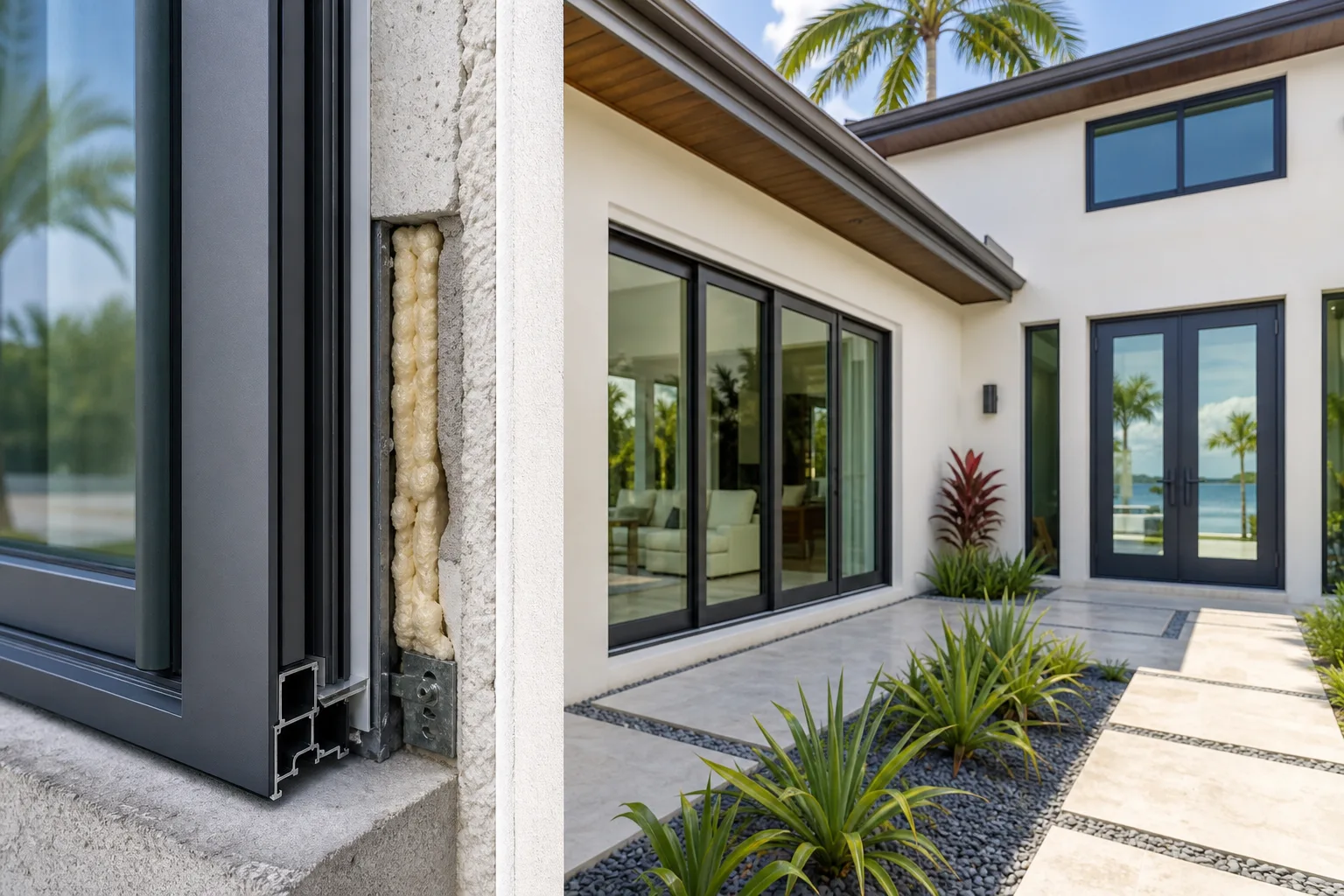
The solution is a thermally broken aluminum frame, which incorporates a low-conductivity barrier (usually a polyamide strip) between the interior and exterior aluminum sections. Thermally broken aluminum frames cost more but significantly reduce heat transfer and condensation risk. For any home where energy efficiency is a priority in Palm Beach Gardens, Plantation, or Weston, a thermally broken aluminum frame is worth the investment.
Vinyl Impact Window Frames
How Vinyl Has Evolved for Impact Ratings
Vinyl (PVC) impact window frames have become increasingly popular over the past decade, particularly for inland locations in Palm Beach County and Broward County. Modern vinyl compounds formulated specifically for impact windows are a significant improvement over the vinyl used in standard residential windows from the 1990s.
Key advantages of vinyl impact frames include:
No corrosion. Vinyl does not rust, oxidize, or react with salt air. For properties that are not right on the water, this means virtually zero maintenance related to frame corrosion - a genuine advantage over aluminum in neighborhoods like Coral Springs, Greenacres, or Coconut Creek.
Excellent thermal insulation. Vinyl is a poor conductor of heat, which means vinyl frames naturally minimize thermal bridging without needing a separate thermal break. This makes vinyl frames inherently more energy-efficient than standard (non-thermally-broken) aluminum, and the lower U-Factor can contribute to better overall impact window energy efficiency.
Lower price point. Vinyl frames typically cost less than comparable aluminum frames, making them attractive for homeowners on tighter budgets who need to protect larger numbers of windows.
Sound dampening. The mass and multi-chambered construction of vinyl frames provides some additional acoustic dampening compared to aluminum, which can matter for homes near I-95 in Boca Raton or near Fort Lauderdale-Hollywood International Airport. Our guide on impact window noise reduction explains the full picture.
Vinyl Impact Windows and Humidity: The Real Risks
Here is where many homeowners get surprised. Despite vinyl's corrosion resistance, it has its own vulnerabilities in South Florida's climate:
UV degradation. Standard PVC degrades under prolonged UV exposure, becoming brittle and chalky. Quality impact-rated vinyl frames use formulations with UV stabilizers and titanium dioxide to resist this, but not all manufacturers use the same quality of compounds. Ask specifically about the UV stabilizer content and whether the vinyl is virgin PVC (not regrind material).
Thermal expansion. Vinyl expands and contracts significantly with temperature changes - roughly three times more than aluminum. In South Florida's wide temperature swings, this can stress frame seals and joinery over time, particularly on large window openings. This is one reason why vinyl is generally not recommended for very large picture windows or for high-rise applications above the 5th floor where structural demands are higher.
Structural limitations. Vinyl has lower stiffness than aluminum, which limits how large a single frame can be while maintaining impact ratings. Most vinyl impact windows require steel or aluminum reinforcement inserts in the frame sections to achieve the structural performance needed for high wind zones. Without proper reinforcement, vinyl frames can flex excessively, compromising the integrity of the impact glazing system. This is especially relevant for retrofit vs full-frame installations.
Color limitations. Vinyl frames are typically limited to white, tan, and a small range of light colors. Dark-colored vinyl absorbs heat, causing even greater expansion and potential warping in South Florida's summer temperatures. If your HOA or historic district requires specific frame colors, vinyl may not meet those requirements. Our guide on HOA and condo impact window approval covers how frame color requirements can affect your options.
Where Vinyl Makes Sense in Palm Beach and Broward
Vinyl impact windows are a reasonable choice for:
- Inland locations, generally more than 3 miles from the coast, in cities like Wellington, Tamarac, Lauderhill, or Lake Worth
- Single-story homes with standard-sized window openings
- Budget-conscious projects where the corrosion resistance of vinyl outweighs its structural limitations
- Homeowners prioritizing energy efficiency on a moderate budget
Vinyl is generally a poor choice for direct oceanfront or Intracoastal properties, large openings, high-rise buildings, or applications requiring dark frame colors.
Fiberglass Impact Window Frames
The Premium Option for South Florida's Harshest Conditions
Fiberglass impact window frames represent the premium tier of the market, and in South Florida's demanding environment, they earn that premium in several meaningful ways. Manufacturers like Andersen (available through Window Guys of Florida) offer fiberglass composite frames specifically designed for high-performance applications.
Dimensional stability. Fiberglass has an extremely low coefficient of thermal expansion - similar to glass itself. This means fiberglass frames expand and contract at nearly the same rate as the glass they hold, which reduces stress on seals and maintains tighter tolerances over decades of South Florida temperature cycling. For homeowners concerned about impact window condensation and long-term seal integrity, fiberglass is the most stable choice.
Corrosion immunity. Like vinyl, fiberglass does not corrode, rust, or react with salt air. Unlike vinyl, fiberglass maintains its structural integrity at the temperatures and UV levels found in South Florida. For waterfront properties where salt spray and wind load codes are a daily concern, fiberglass combines the corrosion resistance of vinyl with structural performance approaching aluminum.
Superior thermal performance. Fiberglass is a poor heat conductor, providing excellent thermal insulation without any thermal bridging. Combined with high-performance impact glazing, fiberglass-framed windows routinely achieve the best U-Factor ratings available, directly benefiting your cooling costs and energy efficiency.
Paintability and color retention. High-quality fiberglass frames accept exterior paint and hold color well under UV exposure. This makes fiberglass a viable option for historic district design review requirements in places like West Palm Beach's El Cid neighborhood or historic districts in downtown Delray Beach.
Long-term durability. Properly maintained fiberglass frames have demonstrated service lives of 30-50 years in harsh coastal environments. When you consider impact window warranty red flags and total cost of ownership, fiberglass often justifies its higher upfront cost.
The Drawbacks of Fiberglass Frames
Cost. Fiberglass frames typically cost 20-40% more than comparable aluminum frames and significantly more than vinyl. For a whole-house replacement project in Parkland or Boca Raton, this price difference is substantial.
Limited product availability. Fewer manufacturers produce fiberglass impact frames compared to aluminum, and the range of sizes, styles, and Florida Product Approval listings is more limited. This can create challenges for projects requiring specific configurations or for properties subject to strict code requirements.
Weight. Fiberglass is heavier than aluminum, which can complicate installation for very large openings and may require additional structural considerations for matching impact windows to roof types and structural systems.
Side-by-Side Comparison for South Florida Conditions
Performance Summary by Key Factor
| Factor | Aluminum | Vinyl | Fiberglass |
|---|---|---|---|
| Salt Air Resistance | Moderate (finish-dependent) | Excellent | Excellent |
| UV Resistance | Excellent (with quality finish) | Good (UV-stabilized compounds required) | Excellent |
| Thermal Performance | Poor to Good (thermally broken) | Good | Excellent |
| Structural Strength | Excellent | Moderate | Very Good |
| Large Opening Suitability | Excellent | Limited | Good |
| Thermal Expansion | Low | High | Very Low |
| Maintenance Requirements | Low to Moderate (coastal) | Low | Very Low |
| Cost | Moderate | Lower | Higher |
| Product Availability | Excellent | Good | Limited |
| Color Options | Excellent | Limited | Good |
Recommendations by Location and Property Type
Direct oceanfront and Intracoastal properties (Juno Beach, Delray Beach oceanfront, Hillsboro Beach, Fort Lauderdale beach): High-quality anodized or KYNAR-coated aluminum with thermally broken frames, or fiberglass where budget allows. Vinyl is generally not recommended for primary structural frames in these environments.
Inland suburban neighborhoods (Boca Raton west, Coral Springs, Weston, Wellington, Boynton Beach inland): All three materials are viable. Vinyl offers good value. Aluminum provides the widest product selection. Fiberglass is the premium option for buyers focused on long-term performance.
High-rise condominiums (Pompano Beach, Hollywood, Deerfield Beach, West Palm Beach towers): Aluminum is the standard choice given structural demands. Review our guide on high-rise impact windows in Broward for additional considerations.
Historic districts and design-sensitive properties: Fiberglass or aluminum with custom color options. Check requirements with your local design review board and review our article on choosing impact windows for historic district approval.
Frame Material and Your Insurance Discount
Many homeowners do not realize that frame material selection can indirectly affect their insurance outcomes. Florida's windstorm insurance market primarily cares about the impact rating and installation quality of your windows, not the frame material per se. However, a corrosion-compromised or failed frame can become a claims issue.
If your aluminum frames corrode to the point where the window's structural integrity is questionable, an insurance adjuster may dispute a claim arguing the window was not properly maintained. Understanding why impact window insurance claims get denied often comes back to maintenance and material integrity issues that started at installation. For a full picture of potential savings, review our guide on impact window tax credits and insurance discounts for 2025.
The Importance of Professional Installation Regardless of Frame Material
The best aluminum, vinyl, or fiberglass frame in the world can fail prematurely if installation is done incorrectly. In South Florida, specific installation factors that directly affect frame longevity include:
- Proper flashing and weather barrier integration - Critical for preventing water intrusion behind the frame, particularly during the rainy season. Review our guide on impact window installation timing and rainy season risks.
- Correct fastener material - Stainless steel fasteners are required for coastal applications. Mixing metals destroys aluminum frames from the inside out.
- Proper shimming and alignment - Vinyl frames especially require careful shimming to avoid racking under thermal expansion.
- Sealant selection - Silicone sealants compatible with the frame material and rated for UV and salt-air exposure.
- Permit compliance - Every frame material option must be installed under a valid permit with proper inspections. Our article on impact window permits in Palm Beach and Broward covers what contractors sometimes skip.
Window Guys of Florida has been installing impact windows and impact doors throughout Palm Beach County and Broward County for over 25 years. We are authorized dealers for PGT, CGI, ES Windows, Andersen, and other leading brands, and our team understands exactly how each frame material performs in your specific neighborhood's microclimate - whether you are in Jupiter or Hollywood, Boca Raton or Tamarac.
Ready to Choose the Right Frame for Your Home?
Frame material selection should be based on your property's specific location, your budget, your aesthetic preferences, and your long-term goals. There is no single right answer for every home in South Florida, but there is a right answer for your home.
Contact Window Guys of Florida today for a free consultation. Our team will assess your specific conditions - coastal exposure, existing frame conditions, opening sizes, and local code requirements - and recommend the frame material and product that will perform best for your property over the long term. Learn more about us and why South Florida homeowners have trusted us for decades.
Frequently Asked Questions
FAQ Section
Q: Is aluminum or vinyl better for impact windows in South Florida?
For most South Florida properties, especially those within a few miles of the coast, high-quality aluminum with a proper anodized or KYNAR finish is the more reliable choice due to its structural strength and proven performance in hurricane conditions. Vinyl can be a good option for inland locations and budget-conscious projects, but its higher thermal expansion and structural limitations make it less suitable for large openings or direct coastal exposure. Contact our team to evaluate which material is best for your specific address.
Q: How do I know if my aluminum impact window frames are corroding?
Early signs include white or gray chalky deposits on the frame surface, pitting in the metal (visible as small craters or rough patches), reddish-brown staining around fasteners, and difficulty operating windows that previously opened smoothly. If you have coastal exposure and your frames are older than 10-15 years without a finish inspection, our article on coastal impact window maintenance from Jupiter to Hollywood explains what to look for and when to act.
Q: Do fiberglass impact window frames qualify for Florida Product Approval?
Yes, fiberglass frames from approved manufacturers can receive Florida Product Approval and meet local code requirements in Palm Beach County and Broward County, including HVHZ requirements in applicable zones. However, the range of approved sizes and configurations is more limited than for aluminum. Your installer should verify specific Florida Product Approval numbers for any fiberglass product before purchase. Review the HVHZ vs Non-HVHZ guide for Broward for additional context.
Q: Will vinyl impact window frames warp or degrade in South Florida heat?
Low-quality or improperly formulated vinyl can degrade under South Florida's UV intensity, and all vinyl expands significantly with heat. However, quality impact-rated vinyl frames use UV-stabilized virgin PVC compounds and incorporate reinforcement inserts that minimize warping. The key is choosing products from reputable manufacturers and ensuring they have adequate steel or aluminum reinforcement for the frame size. Avoid very large openings in vinyl frames, and be aware that dark colors are generally not available due to heat absorption issues.
Q: Does frame material affect my impact window warranty?
Yes, in several important ways. Most manufacturers' warranties specifically require maintenance of the frame finish, particularly for coastal aluminum frames. Failure to maintain the finish as specified - for example, not cleaning salt deposits or allowing corrosion to develop at fastener points - can void the warranty. Fiberglass and vinyl frames typically have fewer maintenance-related warranty conditions. Before you purchase, review our guide on impact window warranty red flags in Palm Beach and Broward to understand what to look for.
Q: Can I mix frame materials in one home, for example aluminum for some windows and vinyl for others?
Technically yes, but it is generally not advisable for several reasons. Different materials have different maintenance schedules and lifespans, which complicates long-term upkeep. Visual consistency can be affected since aluminum and vinyl frames have different profile widths and appearances. Additionally, for permit and inspection purposes, mixing product types can complicate Florida Product Approval documentation. If you have specific openings that drive the need for different materials, discuss this with your installer before committing to a project plan. Reach out to Window Guys of Florida for guidance on your specific situation.
Frequently Asked Questions
Is aluminum or vinyl better for impact windows in South Florida?
For most South Florida properties, especially those within a few miles of the coast, high-quality aluminum with a proper anodized or KYNAR finish is the more reliable choice due to its structural strength and proven performance in hurricane conditions. Vinyl can be a good option for inland locations and budget-conscious projects, but its higher thermal expansion and structural limitations make it less suitable for large openings or direct coastal exposure. Contact our team to evaluate which material is best for your specific address.
How do I know if my aluminum impact window frames are corroding?
Early signs include white or gray chalky deposits on the frame surface, pitting in the metal visible as small craters or rough patches, reddish-brown staining around fasteners, and difficulty operating windows that previously opened smoothly. If you have coastal exposure and your frames are older than 10-15 years without a finish inspection, our article on coastal impact window maintenance from Jupiter to Hollywood explains what to look for and when to act.
Do fiberglass impact window frames qualify for Florida Product Approval?
Yes, fiberglass frames from approved manufacturers can receive Florida Product Approval and meet local code requirements in Palm Beach County and Broward County, including HVHZ requirements in applicable zones. However, the range of approved sizes and configurations is more limited than for aluminum. Your installer should verify specific Florida Product Approval numbers for any fiberglass product before purchase. Review the HVHZ vs Non-HVHZ guide for Broward for additional context.
Will vinyl impact window frames warp or degrade in South Florida heat?
Low-quality or improperly formulated vinyl can degrade under South Florida's UV intensity, and all vinyl expands significantly with heat. However, quality impact-rated vinyl frames use UV-stabilized virgin PVC compounds and incorporate reinforcement inserts that minimize warping. The key is choosing products from reputable manufacturers and ensuring they have adequate steel or aluminum reinforcement for the frame size. Avoid very large openings in vinyl frames, and be aware that dark colors are generally not available due to heat absorption issues.
Does frame material affect my impact window warranty?
Yes, in several important ways. Most manufacturers' warranties specifically require maintenance of the frame finish, particularly for coastal aluminum frames. Failure to maintain the finish as specified - for example, not cleaning salt deposits or allowing corrosion to develop at fastener points - can void the warranty. Fiberglass and vinyl frames typically have fewer maintenance-related warranty conditions. Before you purchase, review our guide on impact window warranty red flags in Palm Beach and Broward to understand what to watch for.
Can I mix frame materials in one home, for example aluminum for some windows and vinyl for others?
Technically yes, but it is generally not advisable for several reasons. Different materials have different maintenance schedules and lifespans, which complicates long-term upkeep. Visual consistency can be affected since aluminum and vinyl frames have different profile widths and appearances. Additionally, for permit and inspection purposes, mixing product types can complicate Florida Product Approval documentation. If you have specific openings that drive the need for different materials, discuss this with your installer before committing to a project plan. Reach out to Window Guys of Florida for guidance on your specific situation.