Broward vs Palm Beach: Why inspection practices can feel different
If you are planning an impact window replacement in South Florida, you quickly learn that the product is only half the project. The other half is permitting and inspections, and that is where many homeowners notice a difference between Broward impact window inspection practices and Palm Beach County impact window inspection practices.
Both counties enforce the Florida Building Code (FBC) and local amendments. Both care about wind pressures, attachment schedules, and approved product documentation. But in day-to-day reality, the inspection process can feel different depending on:
- Whether your home is in a mapped wind-borne debris (WBD) region
n- How the permit set is assembled (NOA, FL approvals, engineering) - How inspectors prefer to see documentation on site
- How rough and final inspections are scheduled and recorded
This article breaks down what those differences typically mean for your project, with a homeowner-focused checklist you can use to reduce delays and re-inspections.
For background on how WBD zones affect product selection, start here: Palm Beach vs Broward WBD Zones: Impact Window Guide.
A quick refresher: What is a WBD inspection in South Florida?
A WBD inspection South Florida homeowners hear about is not always a separate inspection called “WBD.” More often, WBD requirements show up inside plan review and standard building inspections, because WBD affects whether your glazing and doors must be impact-rated (or protected by shutters).
What “WBD” changes for impact window compliance
In WBD areas, windows and doors typically must meet impact requirements (large-missile or small-missile depending on exposure and opening location), and the permit set must prove compliance with approved testing and product approvals.
If you want a deeper explanation of the testing behind impact products, see: Impact Windows vs Debris: Large-Missile Test Explained.
Useful data: Why counties stay strict
South Florida’s inspection culture is rooted in storm loss history. According to NOAA’s National Centers for Environmental Information, the U.S. has sustained hundreds of billion-dollar weather disasters since 1980, and Florida is routinely one of the most impacted states. Wind-driven rain and envelope failures also drive insurance losses and claims frequency.
For homeowners, the takeaway is simple: inspectors are trained to look for anything that could compromise the building envelope during high-wind events, especially attachment, waterproofing, and approved products.
Broward vs Palm Beach: What is actually different?
The Florida Building Code is the baseline in both counties, but the “feel” of the process can differ because of administrative routines, inspector preferences, and how each jurisdiction manages documentation.
1) How plan review and product approvals are scrutinized
In both counties, the permit set typically needs:
- Product approvals (Florida Product Approval or Miami-Dade NOA)
- Installation instructions
- Anchor schedules and fastener types
- Design pressure (DP) / structural pressures that match your openings
- Any engineering required for non-standard conditions
Where homeowners notice differences is how strictly the plan reviewer checks that every opening, configuration, and mullion condition is covered.
If you want to understand what your contractor should be submitting, read: Reading PBC & Broward Impact Window Permit Plans.
And if you keep hearing “DP rating,” this helps: DP Ratings Explained for Impact Windows in South FL.
2) Inspector expectations at rough or in-progress checks
Not every job has the same inspection sequence. Some jurisdictions and inspectors emphasize in-progress verification (especially for larger opening changes), while other jobs primarily hinge on the final.
Regardless of county, inspectors commonly focus on:
- Correct fasteners (type, length, embedment)
- Correct spacing and edge distances
- Proper buck condition (wood, concrete, CMU) and substrate integrity
- Sealant compatibility and continuity
- Egress and safety glazing locations
Many re-inspections happen due to avoidable installation errors. See: Common Impact Window Install Mistakes in South FL.
3) Documentation on site: the small difference that causes big delays
A common practical difference between permit inspection timeline Broward and permit inspection timeline Palm Beach experiences is how much inspectors expect to see physically on site at the time of inspection.
Best practice in either county is to have a simple “inspection packet” available that includes:
- The approved permit set or job summary
- Product approvals and installation instructions for each model installed
- Engineer letter (if applicable)
- Any revision approvals if substitutions occurred
If your home is in an HOA or condo, add the approved architectural form or board letter. These communities often add requirements beyond code. Two strong resources:
- Impact Windows for HOA and Condo Approvals in South FL
- HOA and Condo Board Approval for Impact Windows
4) How timelines behave in the real world
Homeowners often ask for a firm schedule, but inspection timelines depend on city workload, staffing, seasonality, and whether corrections are required.
Here is what most homeowners experience:
- Permit review can be faster when the submittal is complete and clearly matches the opening schedule.
- Installation duration is usually predictable (a few days for many single-family homes), but it can stretch if there are frame repairs, stucco work, or custom orders.
- Final inspection scheduling can vary by municipality, and re-inspections add time.
In other words, the best way to control the permit inspection timeline Broward or permit inspection timeline Palm Beach is not to “rush inspections.” It is to reduce corrections with correct plans, correct products, and clean workmanship.
For help selecting windows that match South Florida microclimates (and why coastal vs inland matters), see:
- Palm Beach vs Broward: Choosing Impact Windows
- Salt-Air Microclimates: Impact Windows PBC vs Broward
County-by-county realities homeowners should plan for
The most accurate statement is this: inspection practices vary not only by county, but by city and even by inspector.
Still, homeowners in specific areas often report common patterns.
Broward County: common inspection and documentation pain points
In many Broward cities (like Fort Lauderdale, Hollywood, Pembroke Pines, Miramar, Plantation, Coral Springs, and Weston), homeowners frequently run into:
- More detailed product approval cross-checking when multiple window types are mixed
- Strong emphasis on correct attachment for masonry vs wood framing conditions
- Strictness on jobsite documentation matching installed models (no “close enough” substitutions)
If your project includes large patio openings, sliders, or pocketing configurations, be extra cautious. Those openings can be heavily scrutinized due to size, water intrusion risk, and structural loads.
Helpful reading for patio openings:
Palm Beach County: common inspection and project planning issues
Across Palm Beach County cities (like West Palm Beach, Boca Raton, Delray Beach, Boynton Beach, Lake Worth Beach, Palm Beach Gardens, Jupiter, and Wellington), homeowners often encounter:
- More architectural review involvement in certain neighborhoods and historic districts
- Extra scrutiny when exterior appearance changes (frame color, grid pattern, sightlines)
- More coordination needed for HOA approvals in planned communities
If you own a historic or Mediterranean-style home, you may need windows that meet impact requirements without changing curb appeal. Start here:
What these differences mean for your project cost and schedule
Inspection practices affect your project in three main ways.
1) Product selection has to match both code and plan review habits
Most homeowners shop by brand and look, but the permit phase cares about documentation and pressures.
At Window Guys of Florida, we commonly install and permit impact products from trusted manufacturers like PGT, CGI, ES Windows, Andersen, and other top brands. The right choice depends on:
- Exposure category and WBD requirements
- Opening sizes and required DP
- Coastal corrosion risk
- Heat, glare, and glass options
For glass and comfort, see: Impact Window Glass Options for South Florida Heat.
For long-term hardware and frame durability near salt air, see:
2) Installation method choices can change inspection outcomes
Retrofit (insert) vs full-frame replacement is not only a design choice. It changes what inspectors may look for in terms of substrate, waterproofing continuity, and anchorage.
If you are weighing methods, read: Retrofit vs Full-Frame Impact Windows in PBC & Broward.
3) Delays often come from change orders and substitutions
A window model substitution that seems minor to a homeowner can create inspection risk if:
- The approval number changes
- The mullion condition changes
- The pressure rating changes
- The installation schedule changes (fasteners, buck requirements)
This is why having a contractor who pre-plans the permit package matters as much as the install crew.
Impact windows compliance Florida: what inspectors typically verify
When people search impact windows compliance Florida, they are usually trying to avoid a failed final inspection, or they want to make sure they are protected for storms and insurance.
Inspectors are generally verifying two things:
- The installed product matches the approved documentation.
- The installation matches the approved method and code intent.
Compliance hot spots that trigger re-inspections
- Incorrect anchor type or spacing
- Missed fasteners at corners or near mullions
- Substrate issues, rotted wood buck, cracked masonry, unsupported stucco returns
- Sealant gaps or incompatible sealant choices
- Egress or tempered glass errors (especially near doors, bathrooms, or low glazing)
If your project includes a Florida room or enclosed patio, pay special attention. These spaces often fail first because they have large openings, drainage challenges, and older framing.
Read: Impact Windows for Florida Rooms: What Fails First?.
Impact window final inspection checklist (homeowner-friendly)
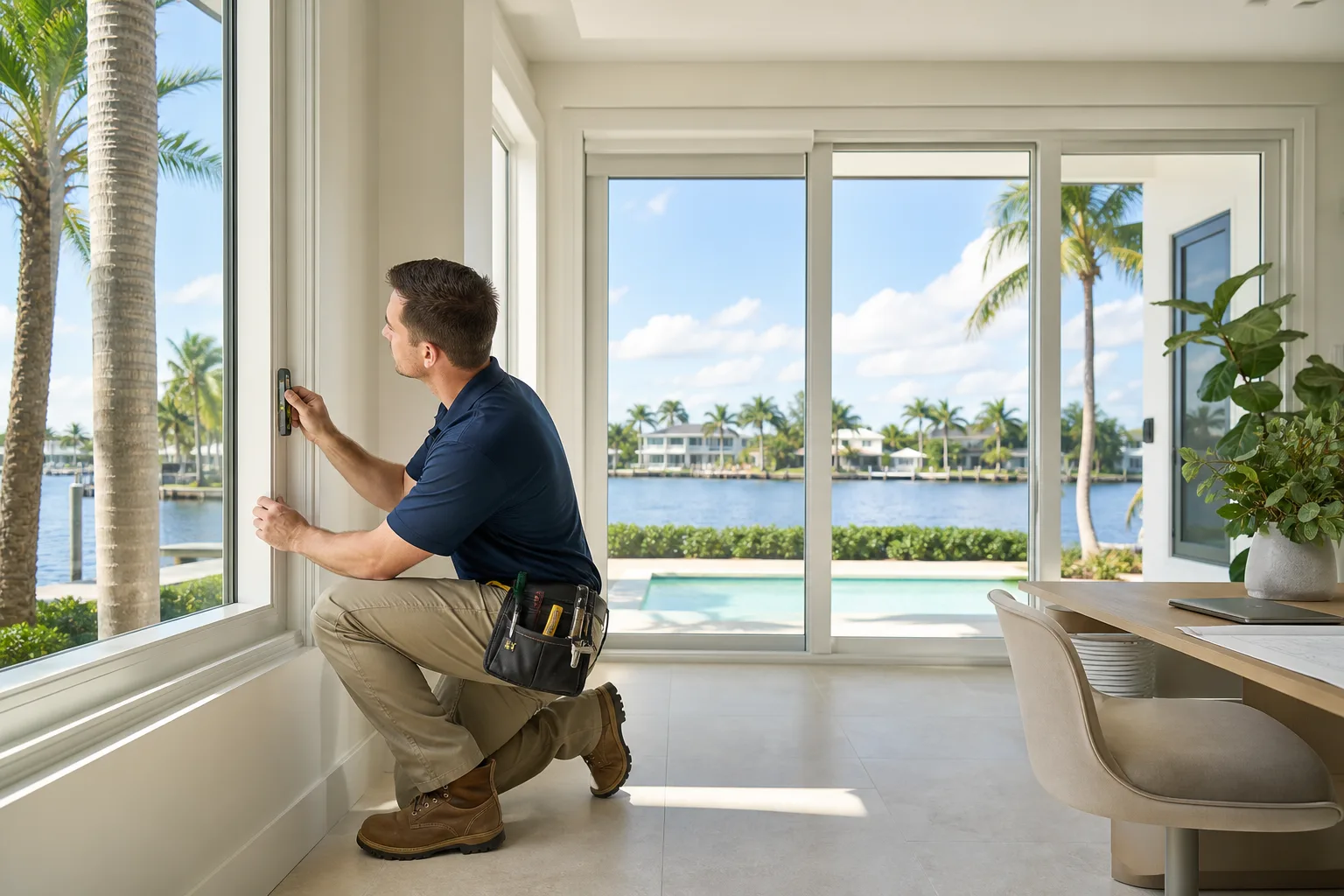
Use this impact window final inspection checklist the day before your inspection. It will not replace your contractor’s responsibilities, but it helps you spot common issues early.
Documentation checklist (have this on site)
- Approved permit card or permit summary
- Final approved plans (or the latest revision set)
- Product approvals (FL or NOA) for each installed window and door
- Installation instructions for each model series
- Engineer letters (if required)
- Any HOA approval letters if your community requires them
If you are unsure what should be in the permit set, review: Reading PBC & Broward Impact Window Permit Plans.
Visual and functional checklist
- Windows open, close, lock, and latch smoothly
- Sliding doors roll and lock correctly (no dragging)
- Weep paths are clear (do not caulk over drainage)
- Exterior sealant bead is continuous and clean
- No visible gaps at frame-to-wall transitions
- Screens (if included) fit and do not interfere with operation
Installation quality checklist (ask your contractor)
- Fastener type and spacing matches the approved schedule
- Proper embedment into concrete/CMU or studs
- Any buck repairs documented and completed correctly
- Proper shims and support at sill where required
- Correct mullion and reinforcement where specified
If you want to avoid the most common quality problems, read: Common Impact Window Install Mistakes in South FL.
How to reduce delays in permit inspection timelines in Broward and Palm Beach
Whether you are in Coral Springs or Jupiter, the best strategy is the same: design the project to be easy to approve and easy to inspect.
Choose a contractor who builds the permit set around your exact openings
A clean permit submittal ties together:
- Opening measurements
- Required DP
- WBD compliance
- Correct product approvals and options
This is especially important when mixing picture windows, casements, single-hungs, and doors.
Do not ignore second-story and upstairs openings
Some homeowners assume WBD only matters downstairs. But wind pressures often increase with height, and second-story product selection can be different.
Read: Do You Need Impact Windows Upstairs in South Florida?.
Plan for climate-specific details (heat, salt, wind-driven rain)
Inspection success is not only about anchors. In South Florida, long-term performance often depends on preventing leaks and corrosion.
Useful resources:
- Impact Windows for West-Facing Homes in South FL
- Salt-Air Microclimates: Impact Windows PBC vs Broward
- Stop Rain Bomb Leaks Around Impact Windows in FL
Keep expectations realistic about “quick fixes” and shortcuts
When timelines get tight, homeowners are tempted by shortcuts that can fail inspection or fail in storms.
Read: 7 South Florida Hurricane ‘Quick Fixes’ That Fail.
Special situations that can change inspection requirements
Condos, HOAs, and uniform elevations
Even if your permit is perfect, HOA rules can delay your project if the window style, frame color, or grid pattern does not match community standards.
Start here:
- HOA Approval for Impact Windows: PBC vs Broward
- HOA and Condo Approval Checklist for Impact Windows
- HOA and Condo Impact Window Specs Without Change Orders
Noise concerns near I-95, the Turnpike, PBI, and FLL
Some homeowners in Boca Raton, Deerfield Beach, Fort Lauderdale, and West Palm Beach want impact windows for noise control as much as hurricane protection. This can influence glass options and frame series, which should still match approvals.
Learn more:
- Airport Noise and Hurricane Impact Windows in FL
- Do Impact Windows Reduce Noise Near I-95 & Airports?
Insurance documentation and post-install proof
After final inspection, homeowners often want paperwork for insurance credits. It is easier when your permit file is complete and your products are clearly documented.
Read: Impact Windows for Insurance Discounts in South FL.
What working with Window Guys of Florida looks like
Window Guys of Florida is licensed and insured, with 25+ years of experience serving Palm Beach County and Broward County. We help homeowners in cities like Boca Raton, Delray Beach, Boynton Beach, West Palm Beach, Jupiter, Fort Lauderdale, Hollywood, Pembroke Pines, and Coral Springs choose compliant products and move smoothly through inspections.
If you are still deciding between windows and doors, explore our services:
Get a free consultation and permit-ready estimate
If you are comparing Broward impact window inspection requirements vs Palm Beach County impact window inspection expectations, we can review your address, exposure, opening sizes, and HOA constraints and recommend a permit-ready package.
Request a free consultation and quote here: Contact/Free Quote.
FAQ: Broward vs Palm Beach WBD inspections and impact windows
Do Broward and Palm Beach County use different building codes for impact windows?
They both enforce the Florida Building Code, plus local amendments and administrative procedures. The practical difference is usually documentation preferences, plan review habits, and how inspections are scheduled and recorded, not the core safety goal of impact windows compliance Florida.
What is the most common reason impact window finals fail inspection?
The most common issues are mismatches between what was permitted and what was installed, and attachment or fastener problems (type, spacing, embedment). Avoidable workmanship issues are also frequent. See Common Impact Window Install Mistakes in South FL.
How can I shorten the permit inspection timeline in Broward or Palm Beach?
The most reliable way is to submit a clean, complete permit set that includes correct product approvals, correct pressures, and a clear opening schedule, then install exactly what was approved. If substitutions are needed, process revisions before final inspection.
Is WBD compliance only for homes near the ocean?
No. WBD mapping can include inland areas depending on wind speed maps and local criteria. Your address determines what applies. Start with Palm Beach vs Broward WBD Zones: Impact Window Guide.
Do I need impact windows upstairs to pass inspection?
Not always, but second-story openings often face higher wind pressures and may have different product requirements depending on exposure and WBD rules. Read Do You Need Impact Windows Upstairs in South Florida?.
Can Window Guys of Florida help with permits and inspections?
Yes. We help homeowners in Palm Beach County and Broward County select approved products, assemble permit-ready documentation, and coordinate inspection milestones. Schedule a free consultation here: Contact/Free Quote.
Frequently Asked Questions
Do Broward and Palm Beach County use different building codes for impact windows?
Both counties enforce the Florida Building Code, plus local amendments and administrative procedures. The biggest differences homeowners notice are typically plan review and documentation preferences, and how inspections are scheduled and recorded, not the underlying safety requirements for impact-rated openings.
What is the most common reason an impact window project fails final inspection?
Most failures come from (1) a mismatch between the permitted product approvals and what was installed, or (2) anchorage issues like incorrect fastener type, spacing, or embedment. For examples that cause re-inspections, see Common Impact Window Install Mistakes in South FL.
How can I reduce permit and inspection delays in Broward or Palm Beach County?
Use a permit-ready submittal with the correct NOA/Florida approvals, pressures, and installation schedules, then avoid field substitutions. If changes are unavoidable, revise the permit before final inspection. If you want help coordinating the process, request a free consultation here: Contact/Free Quote.
Is WBD compliance only required for coastal homes?
No. WBD mapping can include inland areas depending on wind speed maps and local criteria. Your address determines what applies. A good starting point is Palm Beach vs Broward WBD Zones: Impact Window Guide.
Do I need impact windows upstairs to pass inspection?
Not always, but second-story openings can have higher wind pressures and may need different DP ratings or configurations based on exposure and WBD rules. See Do You Need Impact Windows Upstairs in South Florida?.
Can Window Guys of Florida handle permits, product approvals, and inspections?
Yes. We are licensed and insured with 25+ years of experience, and we help homeowners in Broward and Palm Beach County select compliant products and move smoothly through permitting and inspections. Get started here: Contact/Free Quote.